2018 Puesto n.º 2464 en BGG

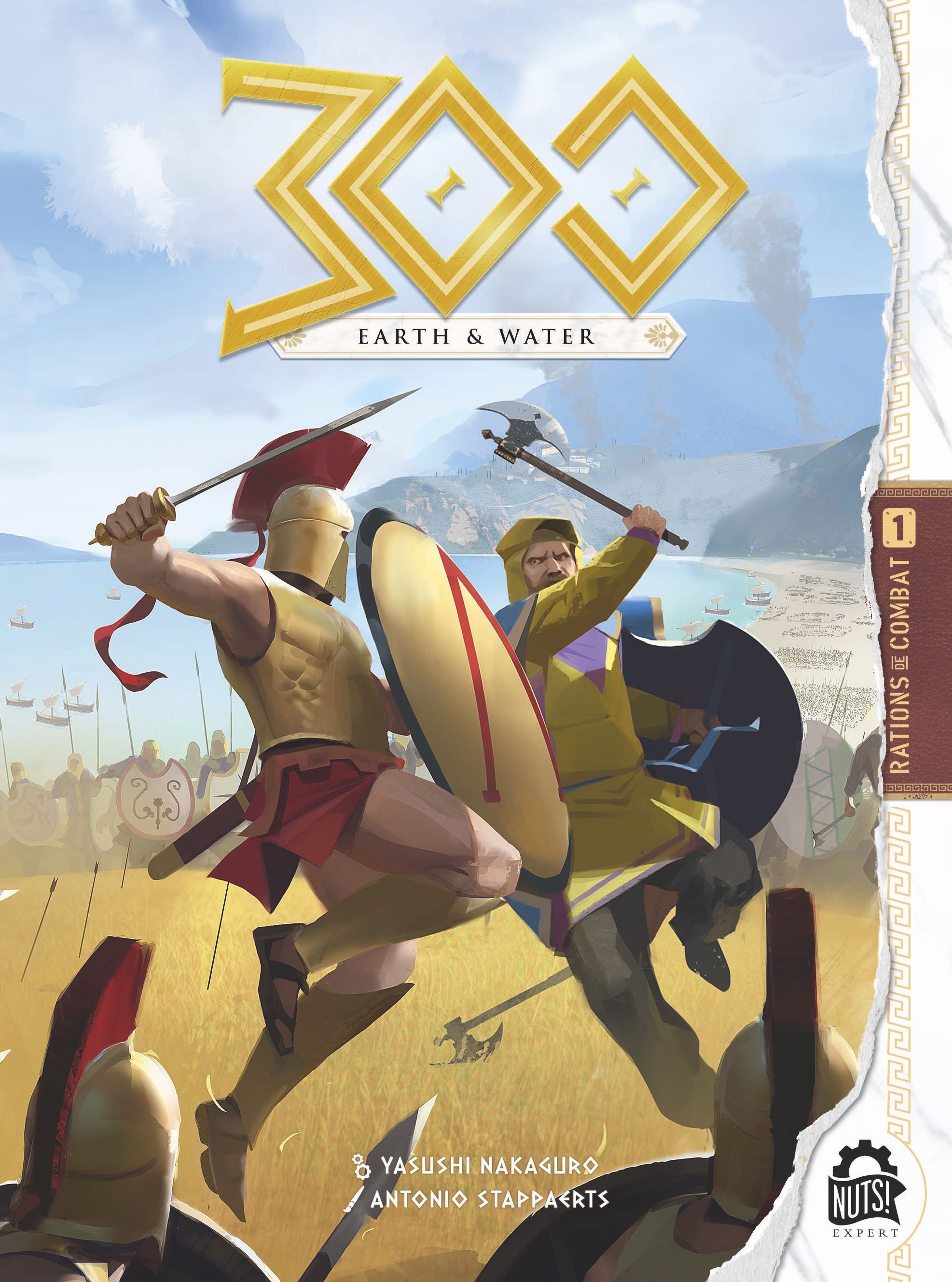
300: Earth & Water

2 jugadores 40 min A partir de 12 años 2.4/5 de complejidad 6.2/10 de valoración

Acerca de este juego

In 500 BC, Ionia rebelled against Persia's rule and Greece supported it. With this "foreign interference" as an excuse, the Persian empire decided to invade Greece. In 492 BC the Persian forces attacked Macedonia from land and sea. The Persians and the Greeks fought fiercely at Marathon, Thermopylae, and Salamis. Against the overwhelming forces of the Persian empire, the Greeks used superior tactics and "weapons" such as hoplites (heavy infantry) and triremes. The Greeks had also excellent leaders in times of crises and eventually prevailed over the Persians. 300: Earth & Water is a wargame for two players. One player controls the Greeks, gathered around the Athenians, and the other controls the Persians, fighting for the hegemony of the eastern Mediterranean. Through all five expeditions, each player aims to control more cities than their opponent. The game engine is a "card driven" system. Players raise armies and buy cards during production. Cards can be used to play an event or move an army or fleet. Events can provide advantages in battles or interfere with the enemy, but military action is paramount to win. Moreover, each game will change dramatically according the order the events occur. The rules are simple and the playing time is short, but both Greece and Persia have a wide range of strategies, so victory will challenge both players.

Qué sensaciones ofrece

Campaign / Battle Card Driven Simulation Point to Point Movement Tug of War Dice Rolling Wargame Ancient

Explora estas mecánicas en Cardboard

Crea un prototipo original con patrones de diseño reutilizables, no con el contenido de este juego.

Abrir el taller de mecánicas

Inteligencia del juego

Aprende el juego

100% de cobertura de conocimiento

Preparación

Setup follows the historical scenario configuration. Players choose or are assigned sides: Persian or Greek. Armies and fleets are placed in their starting positions on the map per the scenario rules. Each player receives their starting hand of Operations Cards (Event, Lightning, and Leader Cards). The map represents cities, ports, and roads across Greece and the surrounding region.

Flujo del turno

The game is structured around an Operations Phase in which players alternate turns. On each turn, a player must play one Operations Card (an Event, Lightning, or Leader Card) to conduct operations — marching armies or sailing fleets. Lightning Cards are intended to be played during the opponent's turn (as a reaction), not as a standard Operations Card; if one is played as an Operations Card it functions only as a sacrifice to allow movement. If a player does not play a card, that is a pass and no marching or sailing may occur. Two consecutive passes (one per player in a round) ends the Operations Phase. When a card is played, the player may choose to ignore the card's printed instructions and simply use it to enable movement.

Puntuación y victoria

The winner is determined by achieving the game's victory conditions, which are scenario-dependent — typically the Persian player wins by controlling sufficient Greek territory, while the Greek player wins by repelling the Persian invasion. Fuentes de puntuación: Control of key cities and territories on the map, Scenario-specific victory conditions

Fuente: Rulebook

Reglas que debes conocer

Las reglas más útiles para jugar bien la primera partida.

General

Event, Lightning, and Leader Cards are all classified as Operations Cards.

The 16 event cards — including Event Cards, Lightning Cards, and Leader Cards — are collectively called 'Operations Cards.' One of these cards must be played each turn in the Operations Phase in order for a player to carry out actions (marching or sailing). No player actions may occur in a turn without the playing of a card.

Card play

Lightning Cards are played during the opponent's turn; Event and Leader Cards are played at the start of your own turn.

Lightning Cards are intended to be played during the opponent's Operations Phase turn as a reactive play. Event Cards and Leader Cards are played at the beginning of a player's own Operations Phase turn. All three types together constitute Operations Cards.

Restriction

Do not play Lightning Cards as Operations Cards except as a sacrifice to allow movement.

Lightning Cards are designed to be played reactively during an opponent's turn. If a Lightning Card is played on your own turn as an Operations Card, it functions only as a sacrifice — enabling movement but not triggering its special effect. Players should avoid doing this unless no other option exists.

Turn structure

Not playing a card is a pass; a player who passes may not march or sail that turn.

If a player does not play an Operations Card on their turn, this constitutes a pass. A passing player may not conduct any operations — no marching or sailing is permitted. Two passes by both players in a single round of turns (i.e., both players pass consecutively) ends the Operations Phase immediately.

Turn structure

Two consecutive passes (one per player in a round) ends the Operations Phase.

The Operations Phase ends when both players pass in the same round of alternating turns. A 'round' means each player has had one turn. If Player A passes and then Player B also passes, the Operations Phase is over.

Card play

A player may ignore the printed instructions on any Operations Card they play.

When playing any Operations Card (Event, Lightning, or Leader), a player is permitted to ignore the card's printed instructions entirely. The card still counts as played for the purpose of enabling operations (marching or sailing) that turn, per the Operations Phase Procedure and Movement rules.

Movement

All armies moving in a single turn must move from the same city to another city.

Armies that move in one turn must all move from the same city to another city. You cannot move armies from multiple different cities in a single turn. This applies to land movement (marching).

Movement

All fleets moving in a single turn must move from the same port to another port.

Fleets that move in one turn must all move from the same port to another port. You cannot move fleets from multiple different ports in a single turn. This applies to naval movement (sailing).

Informe estratégico

Card Economy and the Pass Decision

Because two consecutive passes end the Operations Phase, a player with fewer cards or weaker cards may be incentivized to pass first and force the opponent to either act (potentially overextending) or also pass and end the phase. Managing when to pass is a key tempo decision.

Lightning Card Conservation

Lightning Cards lose their special reactive effect if played on your own turn (they only enable movement). Save them for the opponent's turn to maximize their disruptive potential. Only sacrifice a Lightning Card on your own turn if you have no other Operations Card and must move.

Ignoring Card Instructions for Flexibility

Since you can always ignore an Operations Card's printed instructions, every card in hand is at minimum a 'move enabler.' This means you should evaluate cards both for their special effect and as a fallback movement token, giving you full flexibility each turn.

Persian Supply Line Disruption (Greek Strategy)

Greek players can cut Persian supply by either (a) placing armies along the road network to interrupt land lines of communication to Major cities, or (b) positioning fleets in Major city ports to break sea supply. Doing both simultaneously forces Persian army removals via attrition.

Persian Fleet Positioning for Supply

As the Persian player, always ensure a fleet is stationed in the port of any occupied city deep in Greece, AND that at least one Major city port remains free of Greek fleets. Losing naval supremacy can cascade into army losses through supply failure.

Concentration of Force in Movement

Since all armies moving in a turn must depart from the same city (and all fleets from the same port), players should pre-position forces together before key operations rather than spreading them across multiple locations, to maximize the impact of a single turn's movement.

Preguntas frecuentes y casos límite

Can I play a Lightning Card on my own turn as my Operations Card?

Yes, but only as a sacrifice. The Lightning Card enables your movement for that turn, but its special printed effect does not trigger. Lightning Cards are designed to be played reactively during the opponent's turn; using one on your own turn wastes its special ability.

If I play an Event Card but want to ignore its instructions, can I still march?

Yes. A player may always ignore the printed instructions on any Operations Card they play. The card's play itself is what grants the ability to march or sail that turn — the instructions are optional.

What happens if both players pass on consecutive turns?

The Operations Phase ends immediately. Two passes by both players within a single round of turns (Player A passes, then Player B passes) terminates the phase. Neither player may conduct further operations that phase.

Can I move armies from two different cities in the same turn?

No. All armies moving in a single turn must move from the same city. You cannot split a turn's movement across armies in different cities. The same restriction applies to fleets — all moving fleets must depart from the same port.

Do Greek armies ever suffer attrition?

No. Attrition applies only to Persian armies located in Greece. Greek armies are never subject to attrition checks.

A Persian army has neither a road to a Major city nor a friendly fleet in its port — what happens?

The army is out of supply and is removed from the map. A Persian army in Greece must satisfy at least one of two supply conditions: (a) an uninterrupted land route to a Major city free of enemy armies, OR (b) a friendly fleet in its port plus a Major city port free of enemy fleets providing a sea line of communication.

A friendly fleet is in the Persian army's port, but all Major city ports are blocked by enemy fleets. Is the army in supply?

No. Both conditions must be met for sea supply: a friendly fleet in the occupied city's port AND a Major city port free of enemy fleets. If enemy fleets block all Major city ports, the sea supply line is broken. The army must then rely on land supply or be removed.

When a Leader Card causes the loss of an army or fleet, where is it removed from?

The card itself specifies whether the removal comes from the player's reserve or from the map. Players must follow the card's stated instructions regarding the location of removal.

Pregunta Sobre Este Juego

Juegos similares