1963 Puesto n.º 367 en BGG

Acquire

2–6 jugadores 90 min A partir de 12 años 2.5/5 de complejidad 7.1/10 de valoración

Acerca de este juego

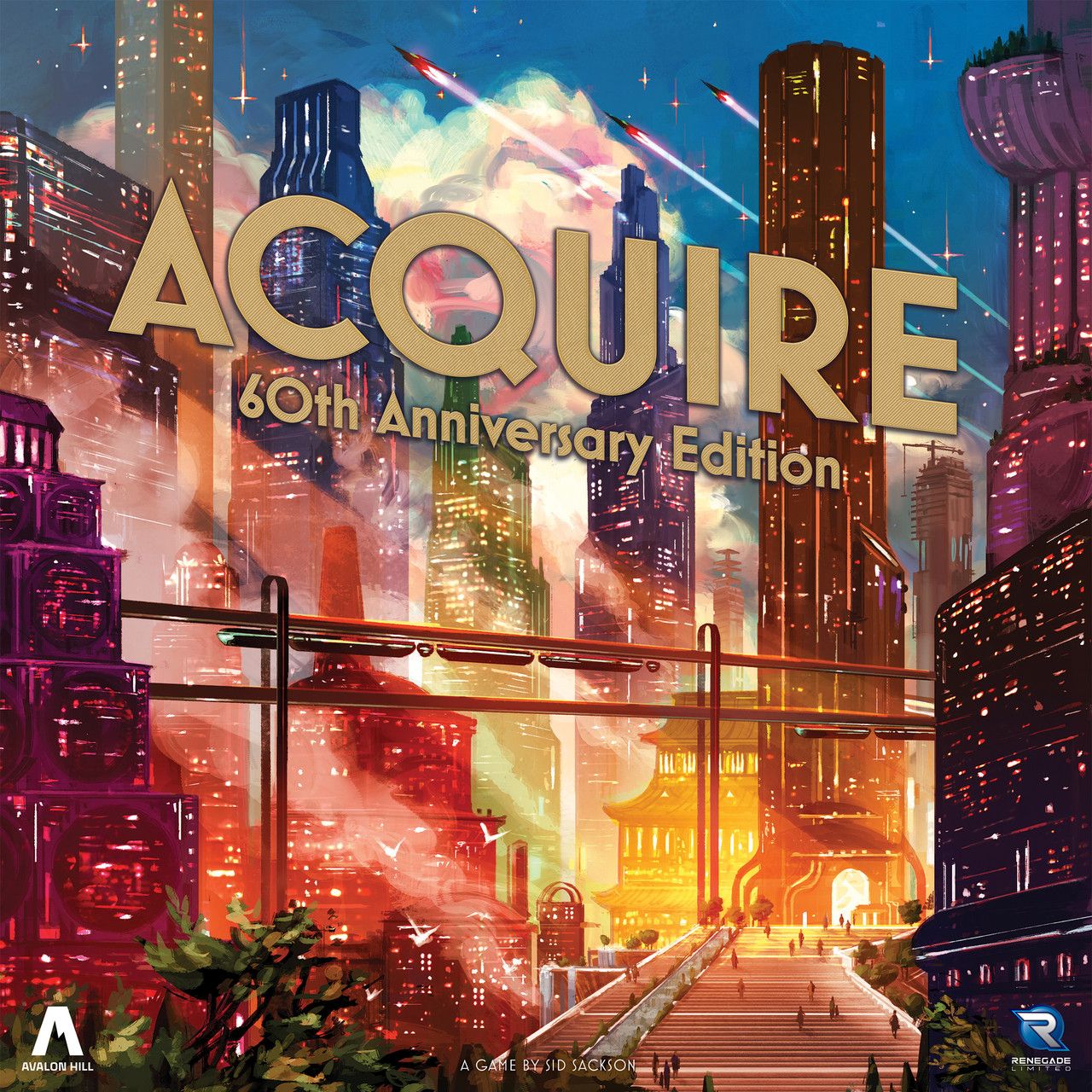
In Acquire, each player strategically invests in businesses, trying to retain a majority of stock. As the businesses grow with tile placements, they also start merging, giving the majority stockholders of the acquired business sizable bonuses, which can then be used to reinvest into other chains. All of the investors in the acquired company can then cash in their stocks for current value or trade them 2-for-1 for shares of the newer, larger business. The game is a race to acquire the greatest wealth. History of Acquire: This Sid Sackson classic has taken many different forms over the years depending on the publisher, yet the rules and game play have stayed the same. The 1966 version of the 3M bookshelf edition included rules for a 2-player variant. The original version is part of the 3M Bookshelf Series. Many books and websites incorrectly list this as a 1962 publication as the 3M Company used previously copyrighted artwork when they released the game in 1964. 3M actually received the idea for the game of "Vacations" from Sid Sackson in May of 1963 and decided to take his idea and put it into artwork they had developed the year before for a game called "ACQUIRE." 3M's original game idea for a game called ACQUIRE must not have been very good so they decided to take Sid's idea of Vacations and put it into their concept of ACQUIRE. They released some limited test market games in 8 Midwestern U.S. cities in December of 1963 with a box that had a 1963 copyright. These games had Sid's original rules. When 3M released the mass market games in 1964, they had developed some of Sid's original ideas and changed some rules and game play to match their production desires. They released them with outer boxes that were copyrighted 1962 and inner boxes with rules that were dated 1963. December 1963 - Test Market World Map Wood Tile Edition 1964 - Dated 1962/63 wood tiles, chipboard with plastic overlay & stocks with printed backs 1965 - Dated 1962/63 plastic tiles, chipboard with plastic overlay & stocks with printed backs (last edition made with printed backs until 1999) 1966 - Dated 1962/66 plastic tiles, chipboard with plastic overlay & non-wax coated stocks (Only edition with these stocks) 1968 - Dated 1968/66 plastic tiles, clear plastic board with paper underlay (Both 1966 inner box games have a lot of mixed parts) 1971 - Dated 1968/71 plastic tiles, yellow hard plastic board 1975 - 3M sells rights for game of ACQUIRE to the Avalon Hill Company 1976 - Dated 1976 plastic tiles, yellow hard plastic board, redesigned money, no inner box (This edition was also produced in 1977, 79, 81, 82, & 86) 1989 - Dated 1976 Gray box edition with new box artwork same contents as regular 1976 editions (This edition was also produced in 1992) 1995 - Dated 1995 Large box cardboard edition with chipboard board and tiles, Special Powers Variant Tiles inspired by German editions 1997 - Avalon Hill sells the rights to the game of ACQUIRE to Hasbro 1999 - Dated 1999 Large box with large plastic board and tiles, 3D company buildings, redesigned stocks & money, large info cards 2006 - Hasbro assigns rights for the game of ACQUIRE to their subsidiary, Wizards of the Coast 2006 - Lloyd's (private) Rules of ACQUIRE are made public, two major rule changes that help to bring the balance of the game of ACQUIRE back to the intentions of Sid Sackson's original ideas. Lloyd Solon's Rules help players to correct poor strategy during the beginning of the game that can been seen with new and unexperienced players (running out of money soon is the main mistake that must be omitted!). 2008 - Dated 2008 cardboard edition with chipboard board & tiles, redesigned stocks & money 2016 - Dated 2016 The current affordable mass-market edition. It looks at first sight to be similar to previous modern editions, but has been criticised for the use of inferior design choices such as hard-to-read grey-on-grey embossed slots and the unusual tile fonts. It contains modified rules and a slightly smaller playing grid. Although these changes have been criticised for not ultimately improving upon Sackson's original design, they are generally regarded as not being too damaging to it. 2023 - Renegade Game Studio partners with Hasbro, and releases their new version, with Classic Mode or Tycoon Mode — play with or without tertiary stockholder merger bonus. 2024 - The Renegade 60th Anniversary edition includes a set of plastic weighted poker chips, and Special Powers Variant cards.

Qué sensaciones ofrece

End Game Bonuses Stock Holding Tile Placement Square Grid Hidden Victory Points Pattern Building Victory Points as a Resource Connections Hand Management Income Market Investment Territory Building Economic

Explora estas mecánicas en Cardboard

Crea un prototipo original con patrones de diseño reutilizables, no con el contenido de este juego.

Abrir el taller de mecánicas

Inteligencia del juego

Aprende el juego

100% de cobertura de conocimiento

Preparación

1. Place the game board on the playing surface. 2. Cluster all gray tiles face-down beside the game board. 3. Choose one player to be the banker. Give the banker: all stock cards, all building markers, and all money. 4. Give each player: one information card, and $6,000 in cash (4×$1,000, 3×$500, 5×$100). 5. Each player draws one gray tile and places it face-up on its matching space on the board. The player whose tile is closest to space 1A goes first (9A is considered closer than 1B). 6. All starting tiles remain on the board. No corporations are formed even if any tiles are orthogonally adjacent at this point. 7. Each player draws six tiles, stands them up, and hides their values from other players. 8. Players decide whether money and stocks will be openly displayed (open play is recommended for new players).

Flujo del turno

Each player's turn consists of four sequential steps: 1. PLACE TILE: The player places one tile from their hand onto its matching space on the board, then resolves the consequences according to the Tile Placement Rules (founding a corporation, growing an existing corporation, or triggering a merger). 2. BUY STOCKS: The player may buy up to 3 stocks total in any combination of currently active corporations. The cost per share is determined by the number of tiles in that corporation, as shown on the information card. 3. DISCARD UNPLAYABLE TILES: The player discards any tiles in their hand that are permanently unplayable (e.g., a tile that would merge two or more 'safe' corporations of 11+ tiles). Discarded tiles are replaced later in the turn. 4. DRAW TILES: The player draws tiles from the face-down supply to bring their hand back up to 6 tiles.

Puntuación y victoria

The player with the most money at the end of the game wins. Money is accumulated through shareholder bonuses received during mergers and at game end, plus proceeds from selling stocks back to the bank at game end. Fuentes de puntuación: Majority shareholder bonus paid during each merger, Minority shareholder bonus paid during each merger, Majority shareholder bonus paid for all active corporations at game end, Minority shareholder bonus paid for all active corporations at game end, Selling defunct corporation stocks during mergers, Selling all remaining stocks back to the bank at game end

Fuente: Rulebook

Reglas que debes conocer

Las reglas más útiles para jugar bien la primera partida.

Turn structure

On their turn, a player must place exactly one tile onto its matching board space.

Each turn, a player must place exactly one tile from their hand onto its corresponding space on the game board. The tile's position relative to other tiles on the board determines the outcome: it may be an isolated tile (no immediate effect), extend an existing corporation, found a new corporation, or trigger a merger. The placement step is mandatory and occurs before buying stocks.

Building

Placing a tile orthogonally adjacent to a lone tile (not part of a corporation) founds a new corporation, if any corporation markers are available.

If a player places a tile that is orthogonally adjacent (up, down, left, or right — not diagonal) to one or more tiles that are not currently part of any corporation, and at least one corporation building marker is available in the tray, a new corporation is founded. The player takes one available building marker and places it on one of the tiles of the new corporation to designate it. As the founder, the player earns one bonus stock certificate in that corporation from the bank, if any shares remain available.

Building

Placing a tile orthogonally adjacent to an existing corporation adds that tile to the corporation, growing it by one tile.

If a player places a tile orthogonally adjacent to tiles that are already part of a single corporation (and the placement does not connect two or more separate corporations), the placed tile is simply added to that corporation, increasing its size by one tile. No special action is required. The corporation's stock price may change based on its new tile count, as reflected on the information card.

Special

Placing a tile that connects two or more corporations triggers a merger; the largest corporation absorbs the smaller one(s).

If a player places a tile that is orthogonally adjacent to tiles belonging to two or more different corporations, those corporations merge. The corporation with the most tiles is the surviving (acquiring) corporation and absorbs all smaller (defunct) corporations. If two or more corporations are tied for the largest size, the player who placed the merging tile chooses which corporation survives. The building marker(s) of all defunct corporations are returned to the tray. The merger is fully resolved — including shareholder bonuses and stockholder decisions — before the active player proceeds to buy stocks.

Scoring

During a merger, the player with the most shares in the defunct corporation earns the majority shareholder bonus.

When a corporation is made defunct by a merger, the player holding the greatest number of shares in that defunct corporation earns the majority shareholder bonus. The bonus amount is determined by the number of tiles in the defunct corporation just before the merger, as shown on the information card. If only one player holds shares, that player earns both the majority and minority shareholder bonuses.

Scoring

During a merger, the player with the second-most shares in the defunct corporation earns the minority shareholder bonus.

When a corporation is made defunct by a merger, the player holding the second-greatest number of shares in that defunct corporation earns the minority shareholder bonus. The bonus amount is determined by the number of tiles in the defunct corporation just before the merger, as shown on the information card. All other shareholders (those who are neither majority nor minority) receive nothing from the merger bonuses.

Special

If two or more players tie for the most shares in a defunct corporation, the majority and minority bonuses are combined and split equally among the tied players.

If two or more players are tied for the highest share count in a defunct corporation, the majority shareholder bonus and the minority shareholder bonus are added together, and the total is divided equally among all tied players (rounding in favor of whoever the game convention dictates, typically rounded to the nearest payable denomination). No minority bonus is separately awarded in this case — it is already included in the split. If players tie for second place (minority), those tied players split only the minority bonus equally between them.

Special

After a merger, each player holding shares in the defunct corporation must choose to hold, sell, or trade each share (options can be combined).

After shareholder bonuses are paid, each player holding shares in the defunct corporation decides what to do with those shares. Players may use any combination of the three options for their shares: • HOLD: Keep the stock certificates. They retain no current value but can be held in anticipation that the corporation is re-founded later in the game. • SELL: Sell any number of shares back to the bank at the price shown on the information card for the defunct corporation's tile count at the time of the merger. • TRADE: Exchange defunct corporation stock for surviving corporation stock at a rate of 2 defunct shares for 1 surviving corporation share, subject to availability of surviving corporation stock.

Informe estratégico

Prioritize merger bonuses over stock price appreciation

The game explicitly notes that the key to winning is engineering mergers and collecting bonuses — not inflating stock prices. Since stocks can only be sold during mergers or at game end, the main path to cash is being a majority or minority shareholder when a merger occurs. Focus on acquiring dominant share positions in corporations likely to be absorbed.

Found corporations to get a free share

Founding a new corporation grants a free bonus stock certificate at no cost. This makes founding corporations an efficient way to gain a head-start on share ownership. Being the first shareholder is especially powerful if you expect that corporation to grow and eventually be merged into a larger one.

Race to make corporations safe to protect your investment

A corporation with 11+ tiles becomes 'safe' and cannot be absorbed. If you hold a large stake in a corporation, growing it to 11 tiles protects your investment permanently. Conversely, you can try to merge a rival's corporation before it reaches safety.

Use the 2-for-1 trade to consolidate share dominance

When a merger occurs, you can trade 2 defunct shares for 1 surviving corporation share. This is a powerful way to build majority positions in the surviving corporation without spending cash — especially if you already have shares in the surviving corporation and want to extend your lead.

Control the timing of the game end

A player is never forced to announce the end-game condition. If you are trailing in cash, you may choose not to announce even when conditions are met, continuing to play until your position improves. Conversely, if you are leading, announcing end-game triggers immediate final bonuses and stock sales in your favor.

Discard unplayable tiles early and strategically

Tiles that would merge two safe corporations are permanently unplayable and must be discarded. Holding onto them costs you hand flexibility. Discard them promptly in the discard step to draw fresh, potentially useful tiles.

Preguntas frecuentes y casos límite

A player draws a tile that would connect two safe corporations (both with 11+ tiles). Can they play it?

No. A tile that would merge two or more safe corporations is permanently unplayable. The player must discard it during the 'Discard Unplayable Tiles' step and draw a replacement tile. They cannot choose to play it.

Can a safe corporation (11+ tiles) absorb a smaller corporation in a merger?

Yes. The 'safe' restriction only protects a corporation from being absorbed — it does not prevent a safe corporation from being the surviving corporation in a merger. A safe corporation can still absorb a smaller, non-safe corporation.

Only one player holds shares in a defunct corporation. What bonuses do they receive?

The sole shareholder receives both the majority and minority shareholder bonuses, for a combined total payout.

A placed tile connects two corporations of equal size. What happens?

The player who placed the merging tile chooses which of the tied corporations survives. The chosen corporation remains active; the other(s) are dissolved as defunct corporations and their building markers are returned to the tray.

A player wants to trade defunct corporation shares for surviving corporation shares 2-for-1, but the surviving corporation has limited remaining shares. What happens?

Trades are subject to the availability of surviving corporation shares. A player can only trade as many 2-for-1 pairs as there are surviving corporation shares available. Any shares that cannot be traded due to insufficient supply must be handled via the hold or sell options instead.

A player founds a new corporation, but all shares in that corporation are already held by players. Do they still get a founder bonus?

No. The founder bonus stock is only awarded 'if available.' If no shares remain in the bank for that corporation, the founding player receives no bonus stock.

Can a player sell stocks they own during the stock-buying phase of their turn?

No. Stocks can only be sold back to the bank when a corporation is dissolved in a merger, or at the end of the game. There is no mechanism to voluntarily sell stocks during the normal buy phase of a turn.

The conditions for ending the game have been met (e.g., one corporation has 41+ tiles), but the current player has not yet announced it. Must they end the game?

No. A player is not required to announce the end-game condition if it is to their advantage for the game to continue. The announcement — and thus the end of the game — is entirely optional and at the discretion of the player whose turn it is.

During setup, two starting tiles end up orthogonally adjacent on the board. Is a corporation immediately founded?

No. The rulebook explicitly states that no corporations are formed during setup, even if starting tiles are orthogonally adjacent. Corporation founding only happens as a result of tile placements during normal gameplay turns.

Pregunta Sobre Este Juego

Juegos similares