2025 Puesto n.º 404 en BGG

Arydia: The Paths We Dare Tread

1–4 jugadores 60–240 min A partir de 14 años 3.3/5 de complejidad 7.1/10 de valoración

Acerca de este juego

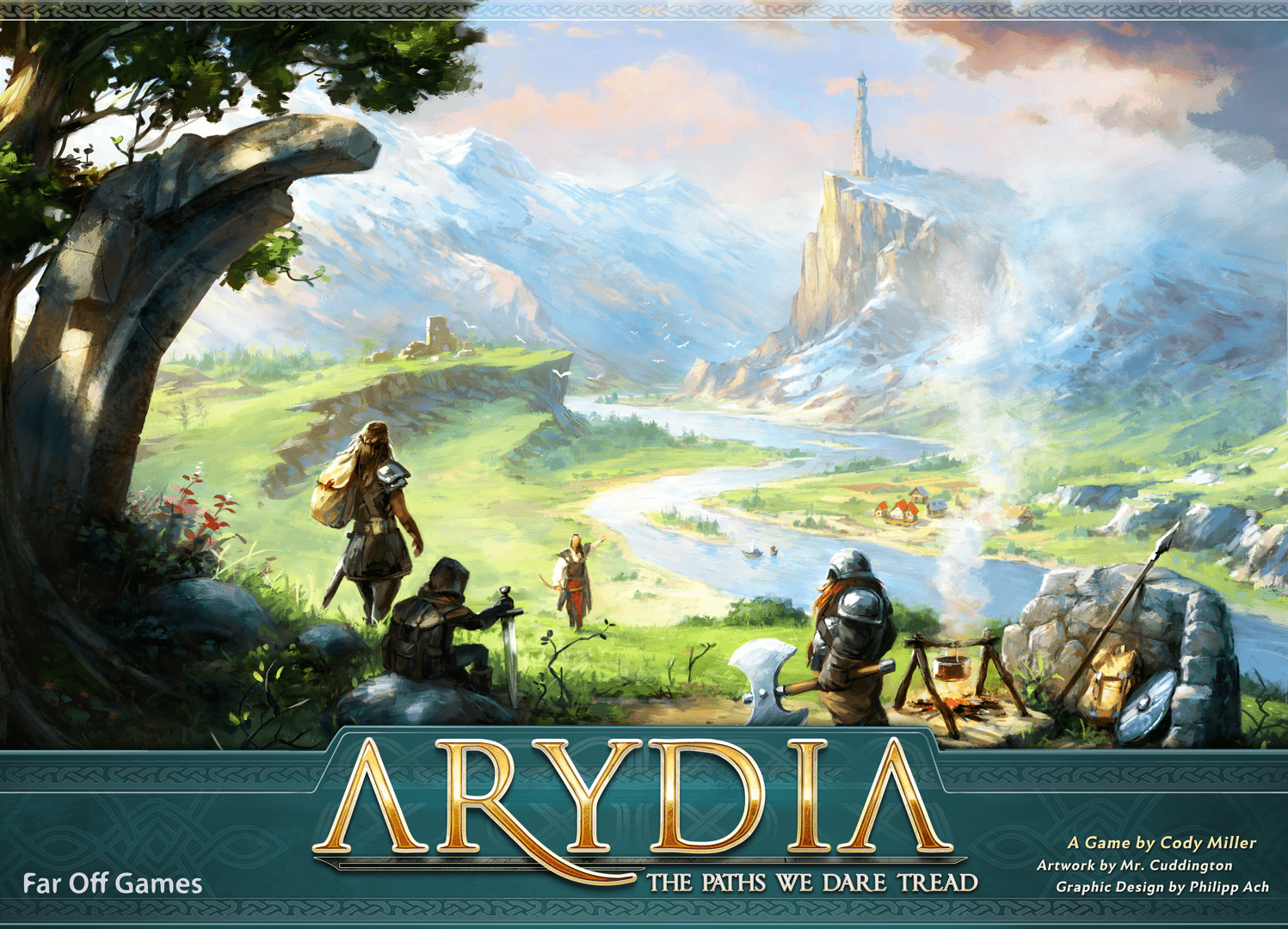
Arydia: The Paths We Dare Tread is an open world, campaign-based, co-operative, fantasy-based, "green legacy" role-playing board game. The game of Arydia is built on four design pillars: Exploration, Progression, Combat, and Role-playing. Exploration — Make your way across the world map, discovering new locations, interacting with memorable characters, fighting vicious monsters, and scavenging long-lost treasures. The world pulls you in through detailed descriptions and artwork for each place you visit. Every location is unique, not randomized, and is built piece by piece as you explore. Progression — Arydia is played as a campaign over the course of a number of game sessions; you start each session right where you left off! As you play, the game keeps track of your actions and decisions. Your characters will grow in power, collecting new items, weapons, and skills. NPCs and locations will change, depending on how you interact with them. All of this progression is done using a simple, but powerful, index system, which allows for quick and easy set-up and tear down. Combat — Arydia features a tactical, co-operative combat system. Enemies are controlled by game cards and dice, while you and your companions work together to defeat them. Role-playing — Take on the roles of a wide cast of characters as you encounter them throughout your journeys. The incentive-based role-play system encourages you to engage in dramatic storytelling, without being intrusive. As a "green legacy" game, Arydia features all the hallmarks of a legacy game — packages to open, hidden information, progression, discovery, exploration — but allows you to reset the game when you have completed it so that you can start again or pass it on to someone else.

Qué sensaciones ofrece

Cooperative Game Tech Trees / Tech Tracks Grid Movement Line of Sight Role Playing Modular Board Solo / Solitaire Game Dice Rolling Narrative Choice / Paragraph Critical Hits and Failures Storytelling Scenario / Mission / Campaign Game Exploration Fantasy Adventure Fighting

Explora estas mecánicas en Cardboard

Crea un prototipo original con patrones de diseño reutilizables, no con el contenido de este juego.

Abrir el taller de mecánicas

Inteligencia del juego

Aprende el juego

80% de cobertura de conocimiento

Preparación

1. Each player selects a Race (Human, Elf, Halfling, Dwarf, Lunari, Orc, Felish, Slynn, or Fae) and a Path (Cleric, Rogue, Warrior, Bard, Mage, or Ranger). 2. Take the corresponding Character skill card, Rules card, Character token, and matching portrait for your chosen race. 3. Set your character's starting stats (Level 0) according to your race card: HP, MP, SP, STR, DEX, INT, WIS, CHA, and END. 4. Take the starting Path skill cards corresponding to your chosen Path. 5. Place character tokens on the board as directed by the scenario setup. 6. Proceed with any additional scenario-specific setup instructions.

Flujo del turno

On each character's turn, they may use their available SP (Speed Points) to move and take actions. Players manage their HP (Hit Points), MP (Mana Points), and SP (Speed Points) as core resources during play. Characters may use Path skills and abilities gained through leveling. At certain level milestones (marked as EVT on the character card), Event checks occur. Each level-up allows the player to check (increase) 1 Stat and 1 Attribute according to their race's progression table.

Puntuación y victoria

Scenario-dependent; the game uses a cooperative structure where players win or lose together based on scenario objectives rather than individual point totals. Fuentes de puntuación: XP-based character progression, Scenario objective completion

Fuente: Rulebook

Reglas que debes conocer

Las reglas más útiles para jugar bien la primera partida.

Setup

Choose a race and take corresponding components.

Each player selects one of nine available races: Human, Elf, Halfling, Dwarf, Lunari, Orc, Felish, Slynn, or Fae. Upon choosing a race, the player takes: (1) the Character skill card for that race (e.g., SKL-HU for Human), (2) the Rules card for that race, (3) the Character token for that race (e.g., PC-HU for Human), and (4) the matching portrait card.

Setup

Choose a path (class) that defines combat abilities and skills.

Each player selects one of six available Paths: Cleric, Rogue, Warrior, Bard, Mage, or Ranger. The Path determines the character's combat style, available skills, and thematic abilities. Each Path has its own set of skill cards identified by path codes (e.g., CLR for Cleric, ROG for Rogue, WAR for Warrior, BRD for Bard, MAG for Mage, RNG for Ranger).

General

Characters level up by spending XP according to the progression table.

Characters progress from Level 0 to Level 10. The XP cost to reach each level is as follows: Level 1 = 3 XP, Level 2 = 5 XP, Level 3 = 7 XP, Level 4 = 10 XP, Level 5 = 15 XP, Level 6 = 20 XP, Level 7 = 25 XP, Level 8 = 36 XP, Level 9 = 45 XP, Level 10 = 50 XP. These XP costs are cumulative thresholds, not per-level costs.

General

On each level-up, check (increase) 1 Stat and 1 Attribute.

Each time a character gains a level, the player checks (increases) exactly 1 Stat (HP, MP, or SP) and exactly 1 Attribute (STR, DEX, INT, WIS, CHA, or END). The new value for the chosen stat or attribute is determined by the character's race card progression table for that level.

Special

EVT markers on the level track indicate that an Event occurs at those levels.

On each race's character card, certain levels are marked with 'EVT' (Event). These are levels 3, 5, 8, and 10 for all races (as indicated on the card layout). When a character reaches an EVT-marked level, an Event check or special event is triggered in addition to the normal level-up procedure.

General

HP (Hit Points) represents a character's life total; reaching 0 HP has severe consequences.

HP (Hit Points) is the primary survival stat. Each race starts with a different HP at Level 0 and increases it at different rates. At Level 0 starting HP by race: Human 4, Elf 2, Halfling 3, Dwarf 4, Lunari 3, Orc 3, Felish 2, Slynn 5, Fae 1. At max level (10), HP values are: Human 18, Elf 16, Halfling 17, Dwarf 19, Lunari 18, Orc 18, Felish 16, Slynn 20, Fae 15.

General

MP (Mana Points) is the resource used to fuel magical abilities and skills.

MP (Mana Points) fuels magic and special abilities. Starting MP at Level 0 by race: Human 2, Elf 3, Halfling 2, Dwarf 1, Lunari 3, Orc 1, Felish 2, Slynn 1, Fae 4. At max level (10), MP values are: Human 8, Elf 10, Halfling 9, Dwarf 8, Lunari 9, Orc 8, Felish 9, Slynn 8, Fae 10.

General

SP (Speed Points) governs how far a character can move and how many actions they can take per turn.

SP (Speed Points) represents movement and action economy. Starting SP at Level 0 by race: Human 1, Elf 2, Halfling 2, Dwarf 2, Lunari 1, Orc 3, Felish 3, Slynn 1, Fae 2. At max level (10), SP values are: Human 8, Elf 7, Halfling 8, Dwarf 7, Lunari 7, Orc 8, Felish 8, Slynn 7, Fae 8.

Preguntas frecuentes y casos límite

Does my race choice affect how effective my chosen Path is?

Yes. While all races share the same Attribute progression, their HP, MP, and SP differ significantly. High-MP races (Elf, Fae, Lunari) synergize well with MP-intensive paths like Mage or Cleric. High-SP races (Orc, Felish) synergize with action-heavy paths like Rogue or Ranger. High-HP races (Slynn, Dwarf) synergize well with frontline paths like Warrior.

Can I increase both HP and STR when I level up?

Yes, you may increase one Stat (HP, MP, or SP) AND one Attribute (STR, DEX, INT, WIS, CHA, or END) each level-up. These are separate choices — one from each category.

What happens when I reach an EVT-marked level?

When your character reaches a level marked 'EVT' on your race card (levels 3, 5, 8, and 10), an Event is triggered in addition to the normal level-up procedure (checking 1 Stat and 1 Attribute). Consult the relevant Event rules for what occurs.

The Fae starts with only 1 HP — is that correct?

Yes. The Fae race starts at Level 0 with only 1 HP, making them extremely fragile at the start of the game. This is offset by their highest starting MP (4) and moderate SP (2). Players choosing Fae should plan around protecting this character early, especially before leveling up increases their HP.

Orcs and Felish both start with 3 SP — does this give them more actions per turn?

Yes. Since SP (Speed Points) governs movement and actions per turn, Orcs and Felish starting with 3 SP at Level 0 — the highest of any race — have more turn economy from the very start. This makes them especially effective with action-heavy paths like Rogue or Ranger.

Which races are best suited for frontline combat paths like Warrior?

Slynn (HP 5–20) and Dwarf (HP 4–19) are the two highest-HP races and are best suited for the Warrior path, which excels at absorbing and dealing damage in melee. Their high HP pools compensate for the Warriors' tendency to take hits in combat.

Pregunta Sobre Este Juego

Juegos similares