1992 Puesto n.º 10608 en BGG

Atlanteon

2 jugadores 30 min A partir de 12 años 2.0/5 de complejidad 5.6/10 de valoración

Acerca de este juego

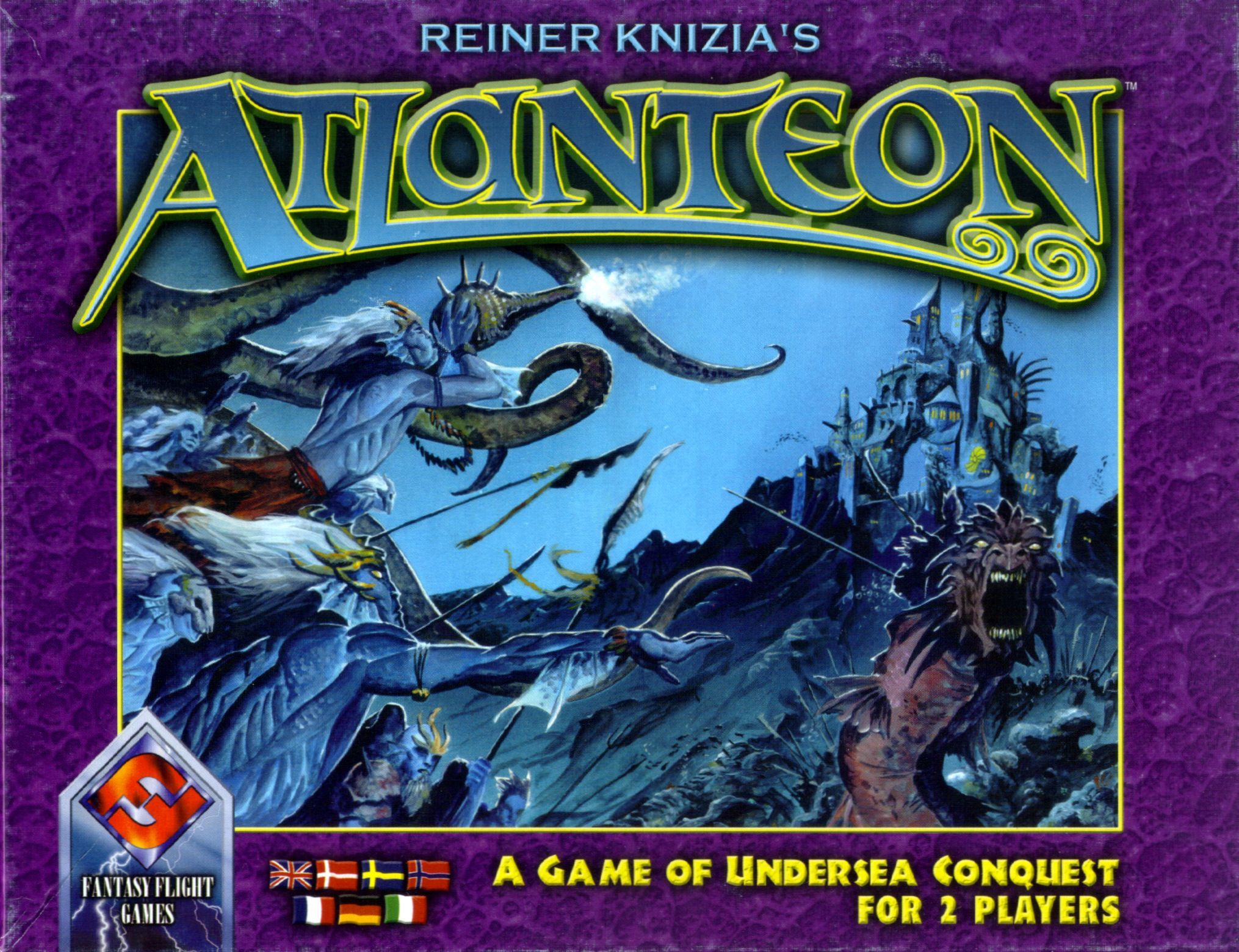
The original edition, titled Revolution, is set in French Revolution-era Paris. Royalists and Jacobins fight for superiority in the 25 city districts, which are represented by the game board. The two players alternately place one of their counters in order to control that space. When a player puts one of his number counters on the board, he projects influence onto the neighboring spaces in that row and column, and onto the space the counter itself is on. The amount of the influence corresponds to the number on the counter. Whoever controls all three of the buildings or controls eleven city districts has won the game. The game was later reprinted as Atlanteon, in which mighty undersea warriors fight to control the capital of the Sunken Kingdoms. One player controls the vicious Marauders, who are trying to capture the city, while the other player controls the heroic Guardians, who are trying to defend their home.

Qué sensaciones ofrece

Tile Placement Variable Player Powers Area Majority / Influence Napoleonic Abstract Strategy

Explora estas mecánicas en Cardboard

Crea un prototipo original con patrones de diseño reutilizables, no con el contenido de este juego.

Abrir el taller de mecánicas

Inteligencia del juego

Aprende el juego

100% de cobertura de conocimiento

Preparación

1. Randomly choose one player to be the Marauders (white) and the other to be the Guardians (blue). 2. Each player takes their 11 tiles (numbered 0–9 plus one King tile) and 11 control markers of their color and places them visibly in front of themselves. 3. Place the board between the two players. 4. The Guardian (blue) player selects one of the three towers and places it on top of its corresponding tower tile on any square of the board. 5. The Marauder (white) player selects one of the two remaining towers and places it (with its tower tile) on any empty square, but NOT orthogonally adjacent to the first tower. It may be placed diagonally adjacent. 6. The Guardian (blue) player places the last tower (with its tower tile) on any empty square, but NOT orthogonally adjacent to either tower already on the board. It may be placed diagonally adjacent to one or both.

Flujo del turno

The Marauder (white) player always takes the first turn. Players then alternate turns. On your turn you must: 1. Place one of your tiles on any empty square on the board. 2. After placing your tile, check whether any tiles or towers are now surrounded (all orthogonally adjacent squares occupied by tiles, board edges, or towers). - Any surrounded tiles are immediately scored: the player whose tiles exert the most total orthogonal influence (including the tile itself) gains a control marker on that tile. Ties go to the tile's owner. - Any surrounded towers are immediately captured according to tower-type rules. 3. After all surrounded tiles and towers are resolved, your turn ends.

Puntuación y victoria

The first player to fulfill any one of three win conditions at the end of their turn wins the game. For a two-game match, the winner of each game earns points equal to the number of the opponent's control markers not yet placed on the board; the player with more total points after two games wins the match. Puntuación objetivo: 11 control markers + your King tile in play, OR all 3 towers captured, OR opponent's King tile controlled Fuentes de puntuación: Control markers placed on scored tiles (tiles 0–9 and King), Control marker placed on the black tower tile upon capture, Capturing white towers (no control marker, but counts toward the 3-tower win), Capturing the black tower (control marker + tower toward 3-tower win)

Fuente: Rulebook

Reglas que debes conocer

Las reglas más útiles para jugar bien la primera partida.

General

A tile's number indicates how much influence it exerts over each orthogonally adjacent tile.

The number printed on each tile is its influence value. A tile exerts that amount of influence over each tile orthogonally (up, down, left, right) adjacent to it. Influence is NOT exerted diagonally. The '0' tile and the King tile exert zero influence. Tiles with a control marker on them still exert their influence normally for their original owner — e.g., a blue tile with value 4 that has a white control marker on it still exerts 4 influence for the blue player.

General

A tile or tower is surrounded when all orthogonally adjacent squares are occupied by tiles, board edges, or towers.

A tile or tower is surrounded when every orthogonally adjacent square (up, down, left, right) is occupied by another tile OR is a board edge OR is another tower. Because board edges and towers reduce the number of tiles needed, a tile near the edge or a tower may be surrounded by fewer than four tiles. Diagonal adjacency does not count toward surrounding.

Turn structure

On your turn, you must place exactly one of your tiles on any empty square of the board.

Each turn, you must place exactly one tile from your remaining unplayed tiles onto any empty square on the board. You cannot skip placing a tile. Towers and tower tiles already occupy squares; you cannot place a tile on an occupied square. After placing, you immediately check for surrounded tiles and towers.

Scoring

When a tile is surrounded, sum the influence of all orthogonally adjacent tiles plus the tile itself; the player with the most total influence places a control marker on it.

When a tile becomes surrounded, it is immediately scored. To score it: count the influence exerted by all tiles orthogonally adjacent to that tile, plus the influence value of the tile itself. The player whose tiles contribute the most total influence wins control and places one of their control markers on the tile. If both players are tied for influence, the player who OWNS the tile (i.e., the tile is their color) wins the tie and places their control marker. Control markers do not change a tile's influence: a tile still counts its influence for its original owner regardless of which control marker is on it.

General

A control marker of your color on a tile shows you control it, whether it is your tile or your opponent's.

When you control a tile (by winning the influence count when it is scored), you place one of your colored control markers on that tile. You may control your own tiles or your opponent's tiles. The color of the control marker reflects current control, not tile ownership. Control markers do not affect the tile's influence, which always belongs to the original tile owner.

Special

When a white tower is surrounded, the player with the MOST adjacent influence captures it; ties go to the player who did NOT place the last surrounding tile.

When a white tower is surrounded, count the influence exerted by all tiles orthogonally adjacent to that tower (the tower itself has no influence). The player whose tiles exert the most total influence captures the white tower. If there is a tie, the player who did NOT place the tile that completed the surrounding wins. To capture: remove the white tower from the board and place it in front of you. Leave the white tower tile on its square. Do NOT place a control marker on the white tower tile. For the rest of the game, neither player may place a control marker on that square. Capturing a single white tower provides no immediate benefit beyond progress toward the three-tower win condition.

Special

When the black tower is surrounded, the player with the LEAST adjacent influence captures it; ties go to the player who did NOT place the last surrounding tile.

When the black tower is surrounded, count the influence exerted by all tiles orthogonally adjacent to that tower. The player whose tiles exert the LEAST total influence captures the black tower (opposite of white towers). If there is a tie, the player who did NOT place the tile that completed the surrounding wins. To capture: remove the black tower from the board and place it in front of you. Leave the black tower tile on its square. Then place one of your control markers on the black tower tile. This means capturing the black tower immediately grants a control marker (unlike white towers).

Special

If you control your opponent's King tile when it is scored, you win the game immediately at the end of your turn.

The King tile is a special tile each player has. It exerts zero influence. If your opponent's King tile becomes surrounded and you win the influence contest over it (gaining a control marker on it), you win the game at the end of your turn. This is one of three win conditions.

Informe estratégico

Black Tower Priority

Capturing the black tower is doubly valuable: it advances you toward the 3-tower win condition AND immediately grants a control marker toward the 11-marker win condition. Prioritize surrounding the black tower with low-influence tiles to win it, while keeping high-influence tiles away from it.

Low-Influence Tiles Near the Black Tower

The black tower is won by the player with the LEAST influence. Place your 0 tile or King tile adjacent to it to minimize your influence contribution, making it easier to have less total influence than your opponent while still surrounding the tower.

Board Edge and Tower Adjacency for Easier Surrounding

Tiles placed near board edges or towers are surrounded faster because edges and towers count as blocking squares. Placing tiles in corners or next to towers can create scoring opportunities with fewer tile placements.

King Tile Defense

Your King tile exerts zero influence and is worth nothing offensively, but your opponent controlling it ends the game. Keep the King tile away from positions where it could easily be surrounded, or surround it yourself with high-influence tiles to ensure you win the tie-break (owner wins ties).

Influence Persistence After Control Loss

Even if your opponent gains a control marker on your tile, that tile still exerts influence for YOU. This means your tiles never truly 'turn against you' — losing control of a tile only costs you its scoring contribution, not its influence on neighbors.

White Tower Tie-Break Exploitation

When contesting a white tower, the tie-break favors the player who did NOT place the last surrounding tile. If you can engineer a tie situation, let your opponent place the final tile to lose the tie-break and hand you the tower.

Dual Win Condition Pressure

Pursuing two win conditions simultaneously forces your opponent to defend on two fronts. For example, building toward 11 control markers while also threatening a tower capture can divide your opponent's attention and make it impossible to block both.

Preguntas frecuentes y casos límite

There's a tie in influence when a white tower is surrounded — who wins?

For white towers, a tie is broken in favor of the player who did NOT place the last tile that completed the surrounding (opposite to the tile tie-break rule). For tiles, a tie goes to the player who OWNS the tile (its color).

There's a tie in influence when the black tower is surrounded — who wins?

For the black tower, a tie is broken in favor of the player who did NOT place the last tile adjacent to it that completed the surrounding.

A blue tile with value 4 has a white control marker on it. Whose influence does it count toward?

It still counts as 4 influence for the blue (Guardian) player. Control markers change who 'controls' a tile for win condition purposes but do not transfer the tile's influence to the controlling player.

A white tower has been captured. Can either player place a control marker on the white tower tile square?

No. Once a white tower is captured, neither player may ever place a control marker on that square. The white tower tile stays there as a permanent blocker for surrounding purposes only.

Capturing the black tower gives a control marker. Does this control marker count toward the 11-marker win condition?

Yes. The control marker placed on the black tower tile counts as one of the 11 control markers needed to win, in addition to the tower counting toward the 3-tower win condition.

When a King tile is surrounded, how is control determined given it exerts no influence?

Control is determined solely by the influence of tiles orthogonally adjacent to the King tile (the King tile itself contributes 0). If tied, the owner of the King tile wins the tie — so a King tile surrounded only by equally matched opponents defaults to its owner retaining control.

My tile placement surrounds two tiles simultaneously. The first gives me my 11th control marker, and the second gives my opponent control of my King tile. When is the win check done?

All surroundings triggered by a single tile placement are resolved before the win check. Win conditions are checked at the END of the turn after all resolutions. If both players simultaneously fulfill win conditions, clarify based on turn order — but the rules specify the active player checks their win at the end of their turn.

Can a tower count as one of the surrounding pieces needed to surround a tile?

Yes. A tile adjacent to a tower has that direction considered blocked. A tile next to a tower (or board edge) requires fewer additional tiles to become surrounded.

Can both players each capture towers, or can one player capture all three?

Yes, one player can capture all three towers, which is itself a win condition. Each tower is independently captured when surrounded, so it is possible for one player to capture all three (winning immediately) or for towers to be split between players.

Pregunta Sobre Este Juego

Juegos similares