1999 Puesto n.º 9869 en BGG

Cape Horn

3–5 jugadores 45–60 min A partir de 12 años 2.0/5 de complejidad 5.6/10 de valoración

Acerca de este juego

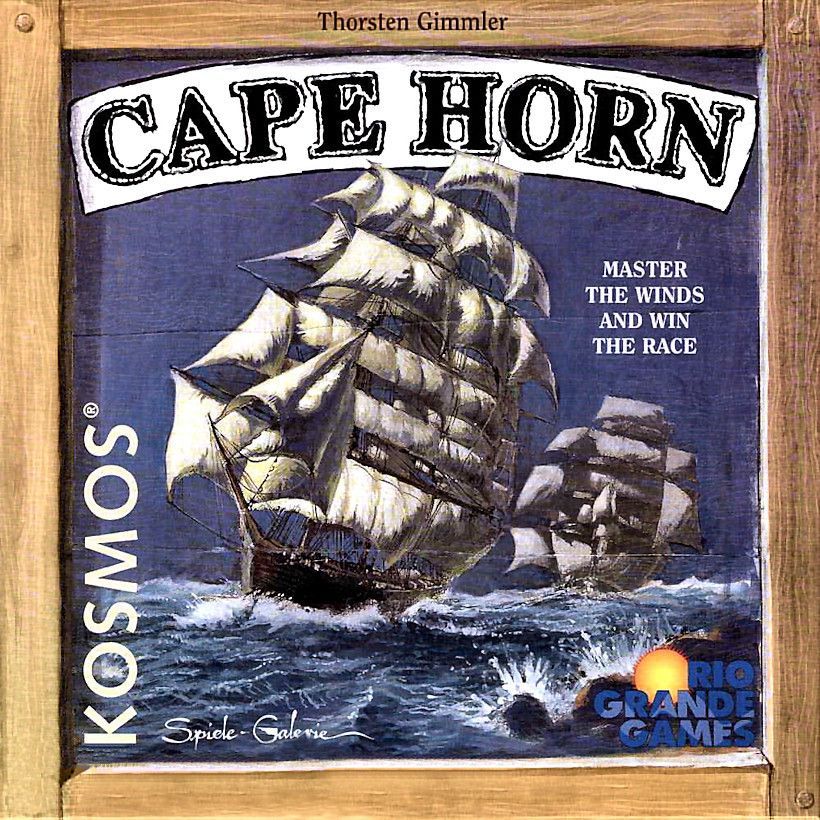
This is a sailing game where players are racing around Cape Horn. Each turn a player may move their boat by using the wind markers that are placed out on the board. The trick is other players can impede your progress by playing their wind markers to slow you down. First person to hit 3 way-points wins. You can also win by hitting 2 way-points and then crossing the finish line.

Qué sensaciones ofrece

Tile Placement Racing Nautical

Explora estas mecánicas en Cardboard

Crea un prototipo original con patrones de diseño reutilizables, no con el contenido de este juego.

Abrir el taller de mecánicas

Inteligencia del juego

Aprende el juego

100% de cobertura de conocimiento

Preparación

1. Place a starting tile on the board to establish the initial board position.\n2. Each player places their ship on a valid starting tile.\n3. Set the Sail Point marker for each player to zero.\n4. Deal each player an initial hand of tiles according to the game's starting rules.\n5. Identify and mark the 3 placement zones on the board, as tile orientation depends on which zone a tile is placed in.

Flujo del turno

Each player's turn proceeds in four mandatory phases in order:\n\n1. SAIL POINT GAIN – Declare "I am gaining one Sail Point" and advance your Sail Point marker by 1.\n2. TILE PLACEMENT – Optionally place any number of tiles from your hand onto the board, following adjacency and orientation rules. Special overplacement rules apply when placing a tile on top of an existing tile.\n3. SHIP MOVEMENT – Optionally move your ship according to the movement directions shown on the tile your ship starts on. Special movement options can be purchased with Sail Points. Choosing NOT to move earns 1 additional Sail Point.\n4. TILE DRAW – Draw 1 tile, then optionally purchase additional tiles for 1 Sail Point each.

Puntuación y victoria

The specific victory condition is not fully detailed in the provided rulebook excerpt; it is determined by game objectives typical of the Cape Horn design. Fuentes de puntuación: Sail Points (used as a resource/currency rather than a direct victory point in the described rules), Tile placement and navigation objectives (implied by the nautical theme and zone-based board)

Fuente: Rulebook

Reglas que debes conocer

Las reglas más útiles para jugar bien la primera partida.

Turn structure

At the start of every turn, the active player gains exactly 1 Sail Point.

The first action of every turn is mandatory: the active player must declare 'I am gaining one Sail Point' and immediately advance their personal Sail Point marker by 1. This happens before any tiles are placed or ships are moved.

Turn structure

Tile placement is optional; a player may place as many tiles as they wish from their hand, or none at all.

During the second phase of a turn, the active player may place any number of tiles from their hand onto the board, or may choose to place none. There is no cost to place tiles in this phase beyond the standard placement rules.

Tile placement

Tiles must be placed adjacent (orthogonally or diagonally) to an existing tile on the board.

Every tile placed on the board must be adjacent to at least one tile already on the board. Adjacency includes all 8 surrounding spaces: the 4 orthogonal (up, down, left, right) and the 4 diagonal directions. A tile cannot be placed in an isolated position with no neighboring tiles.

Tile placement

Tiles must be oriented based on which of the 3 board zones they are placed in.

The board is divided into 3 distinct zones. When placing a tile, the player must orient it correctly according to the zone in which it is being placed. The specific orientation rules are determined by the zone designation. Placing a tile in the wrong orientation for a zone is not permitted.

Tile placement

A tile may be placed on top of an existing tile only under strict conditions.

Placing a new tile on top of an already-placed tile on the board is only permitted if ALL three of the following conditions are met simultaneously: (1) It is the only tile the active player places during this turn — no other tiles may be placed in the same turn. (2) The active player's ship cannot reach that tile during this turn according to normal movement rules. (3) There is no ship of any player currently occupying that tile.

Movement

Moving your ship is optional; you may choose not to move.

During the third phase of a turn, the active player may choose not to move their ship at all. This is a valid choice even if valid moves exist. Choosing not to move grants the player 1 additional Sail Point (see sail_point_no_move_bonus).

Movement

A ship must move in the direction and number of spaces shown on the tile where it begins its movement.

When a ship moves, the direction and number of spaces it travels are dictated by the tile the ship is currently standing on at the start of the movement phase. The ship follows those movement instructions exactly for its standard move.

Movement

A ship may pass over empty (tile-less) spaces but must end its movement on a tile.

During movement, a ship is allowed to travel through empty board spaces that contain no tile. However, the ship's movement must conclude on a space that contains a tile. A ship cannot end its turn on an empty space.

Informe estratégico

Sail Point Economy

Sail Points are both income and currency. You gain 1 automatically each turn (sail_point_gain_mandatory) and a bonus 1 for skipping movement (sail_point_no_move_bonus). Skipping movement frequently accelerates your Sail Point pool, enabling powerful special actions like the double-move (5 SP) or free-direction move (3 SP) in later turns.

Tile Placement Denial

Because ships cannot end movement on occupied tiles (ship_movement_no_end_on_occupied), strategically placing your ship on a key tile can block opponents from landing there. Combine with tile placement (tile_placement_adjacency) to shape routes that only benefit your ship's starting position.

Overplacement Timing

Overplacement (tile_placement_on_tile) is a powerful but heavily restricted tool — it requires no other tiles be placed that turn, the tile must be unreachable by your ship, and no ship can be on it. Plan overplacement turns carefully: save it for tiles deep in the board that your ship cannot reach yet.

Zone Orientation Planning

Since tile orientation is forced by the zone a tile is placed in (tile_placement_orientation), scout which tiles in your hand are useful in each zone before placing. A tile that creates a perfect route in one zone may be wasted or harmful if forced into an incompatible orientation in another zone.

Buying Extra Tiles vs. Saving Sail Points

Each extra tile drawn at turn-end costs 1 Sail Point (tile_draw_end_of_turn). Weigh this against saving Sail Points for special movement. If you are near 5 or 8 SP, consider not buying extra tiles so you can unlock the double-move or both special actions on your next turn.

Navigation Station Control

Navigation Stations (ship_movement_no_end_on_occupied) are the only tiles where multiple ships can coexist. Controlling the area around Navigation Stations with tile placement can create safe harbors or contested chokepoints depending on your position.

Preguntas frecuentes y casos límite

A player wants to place a tile on top of an existing tile. Can they also move their ship to that tile in the same turn?

No. One of the three conditions required for overplacement is that the active player's ship cannot reach that tile during the same turn. If the player's ship could reach the tile via movement, overplacement on that tile is not allowed. Both conditions (unreachability and single-tile placement and no ship present) must all be met.

Can a player place multiple tiles and also place one of them on top of an existing tile?

No. Overplacement (placing a tile on top of an existing tile) is only permitted if it is the ONLY tile placed during that turn. If any other tile is also placed, overplacement is forbidden.

A player places several tiles but chooses not to move their ship. Do they still earn the no-move Sail Point bonus?

Yes. The 1 additional Sail Point for choosing not to move is awarded regardless of whether tiles were placed earlier in the turn. Tile placement does not affect the no-move bonus.

If a player spends Sail Points for a special move (double move or free direction), do they still earn the no-move Sail Point bonus?

No. The no-move bonus is only granted if the player chooses not to move at all. Using any movement action, including special Sail Point-powered moves, means the player does move and therefore does not receive the bonus.

Can two ships occupy the same tile at the end of their movement?

Only if the tile has a Navigation Station marker. Normally, a ship cannot end its movement on a tile already occupied by another ship. The Navigation Station marker is the sole exception that allows multiple ships to share a tile.

Can a player place a tile on top of a tile that currently has a ship on it?

No. One of the three mandatory conditions for overplacement is that no ship of any player is currently on the target tile. The presence of any ship, including the active player's own ship, prevents overplacement.

A player has exactly 8 Sail Points. Can they use both the double-move and free-direction special actions?

Yes. With exactly 8 Sail Points, a player can spend 5 for a double move and 3 for free directional movement, using both special actions in the same turn for a total cost of 8 Sail Points.

When using the 3 Sail Point free-direction move, can the ship move to any empty space or only to spaces with tiles?

Only to spaces that contain a tile. The free-direction move (3 Sail Points) allows the ship to move to any of the 8 adjacent spaces, but only those that contain a tile. Empty adjacent spaces are not valid destinations.

Pregunta Sobre Este Juego

Juegos similares