1999 Puesto n.º 9122 en BGG

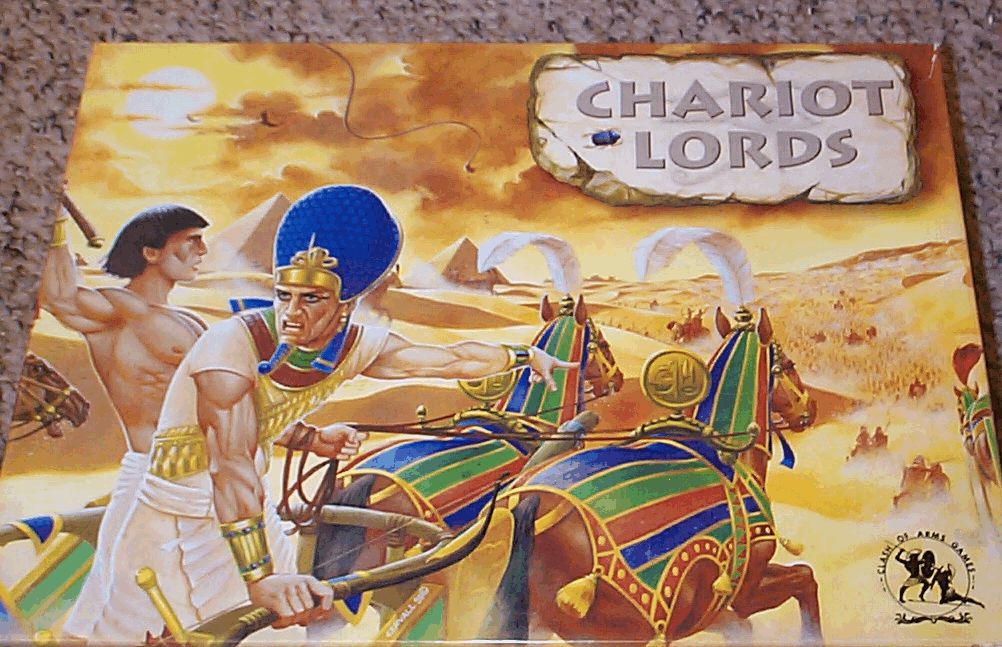
Chariot Lords

3–4 jugadores 360 min A partir de 12 años 2.8/5 de complejidad 5.6/10 de valoración

Acerca de este juego

Between 1500 and 600 BC, Asia Minor and the Mediterranean witnessed the rise and fall of several mighty empires. Often the birth of one empire precipitated the death of another. How could a small people like the Judeans establish an empire when located between such giants as Egypt and Assyria? Why did some Empires endure for centuries while others lasted only a few generations? Chariot Lords shows you the how and why. Each Lord controls between 5 and 6 nations, some strong, others weak, each with varying goals and objectives - indeed some of these countries may not even exist at the same time. Players compete against one another to achieve the victory criteria for their empires. Nations quickly become rivals, involving them in death struggles over expansion. Each turn (90 years) will see new countries come to the fore, while established empires struggle to levy reinforcements and arrange alliances. A fine line must be walked between conserving one's forces and expanding one's empire. Too much expansion will see your resources spread thin and possibly swept away by a new emerging empire, but not enough aggression will see your empire fail to garner sufficient victory points to win. Armies are of a mix of foot and mounted units, along with the occasional leader of note. It is not enough to conquer -- you must be able to keep what you have taken. The winner will be the one who has the most victory points after all the armies have had their moment on the stage. It is up to you to determine whether your empire will be relegated to the dustbin of history, or whether others will hail you as...The Chariot Lord. Contents: 8 pages of Rules, 4 of notes and commentary 1 hard-backed map 140 3/4 inch square counters/markers 170 5/8 inch square counters 4 victory point charts with combat charts on reverse 4 nation force arrival charts 1 master nation force arrival chart

Qué sensaciones ofrece

Simulation Area Movement Variable Player Powers Dice Rolling Wargame Territory Building Ancient

Explora estas mecánicas en Cardboard

Crea un prototipo original con patrones de diseño reutilizables, no con el contenido de este juego.

Abrir el taller de mecánicas

Inteligencia del juego

Aprende el juego

80% de cobertura de conocimiento

Preparación

Players are divided into four color groups — Blue, Red, White, and Yellow — each controlling a set of assigned nations. Each nation has unique special rules covering movement, stacking, replacement, and special abilities. Major Empires (Egypt, Assyria, Hatti, Chaldea) have designated gods and capital cities. Consult each nation's special rules section and the game board to place starting units in their respective starting areas before beginning Turn 1.

Flujo del turno

Each turn, players activate their nations to move units across the map, engage in combat with enemy units in contested areas, replace lost units, and score victory points. Nations with special terrain access (Arabian Desert, Libyan Desert, Nubia) may use those off-map or restricted zones for movement, stacking, and replacement. At the end of each turn, players tally Generic Victory Points for controlled areas and units slain, and check whether any Mighty Warriors bonus objectives have been achieved.

Puntuación y victoria

Player with the most Victory Points at game end wins. VPs are accumulated each turn from Generic Victory Points (area control and units slain) and from Mighty Warriors bonus objectives. Cimmeria uses a modified area scoring system and may only claim area VPs once per game. Fuentes de puntuación: 0 VPs per desert area controlled, 1 VP per mountain area controlled (standard nations), 2 VPs per non-desert, non-mountain area controlled, 1 VP per enemy unit slain (attacking or defending), Cimmeria: 3 VPs per Hill area (once per game per area), Cimmeria: 1 VP per Fertile/Marsh/Mountain area (once per game per area), Mighty Warriors bonus objectives (10–40 VPs, nation-specific, triggered by area control conditions)

Fuente: Rulebook

Reglas que debes conocer

Las reglas más útiles para jugar bien la primera partida.

Movement

Standard sea movement allows a nation to move units up to 3 areas by sea.

By default, nations that have sea movement capability may move units up to 3 areas via sea routes in a single turn. Some nations have enhanced or restricted sea movement as noted in their special rules.

Movement

Achaea, Egypt, and Assyria have extended sea movement of 6 areas instead of 3.

Achaea (Blue), Egypt (Blue), and Assyria (Red) may move units up to 6 areas by sea in a single turn, rather than the standard 3 areas. This is noted under rule 5.6.1.1.

Restriction

Arameans, Libya, Cimmeria, and Chaldea have no sea movement.

The following nations may NOT move units by sea at all: Arameans (Blue), Libya (Red), Cimmeria (White), and Chaldea (Yellow). This is noted under rule 5.6.1.3 for each respective nation.

Movement

Standard movement cost to enter a mountain area is 2.

By default, moving a unit into a mountain area costs 2 movement points. Cimmeria is an exception to this rule.

Movement

Cimmeria moves through mountain areas at a cost of 1 instead of 2.

Cimmerian units treat mountain areas as costing only 1 movement point to enter, rather than the standard cost of 2. This is noted under rule 5.5.

Movement

Arameans may enter the Arabian Desert at a movement cost of 2.

Aramean units may move into the Arabian Desert, treating it as a movement cost of 2. This is a special privilege — most nations cannot enter the Arabian Desert. This is noted under rule 5.7.

Movement

Chaldea may enter the Arabian Desert at a movement cost of 2.

Chaldean units may move into the Arabian Desert at a movement cost of 2. This is a special privilege — most nations cannot enter the Arabian Desert. This is noted under rule 5.7.

Movement

Libya may enter the Libyan Desert at a movement cost of 1.

Libyan units may move into the Libyan Desert at a movement cost of only 1. This is a special privilege. This is noted under rule 5.7.

Pregunta Sobre Este Juego

Juegos similares