1984 Puesto n.º 13189 en BGG

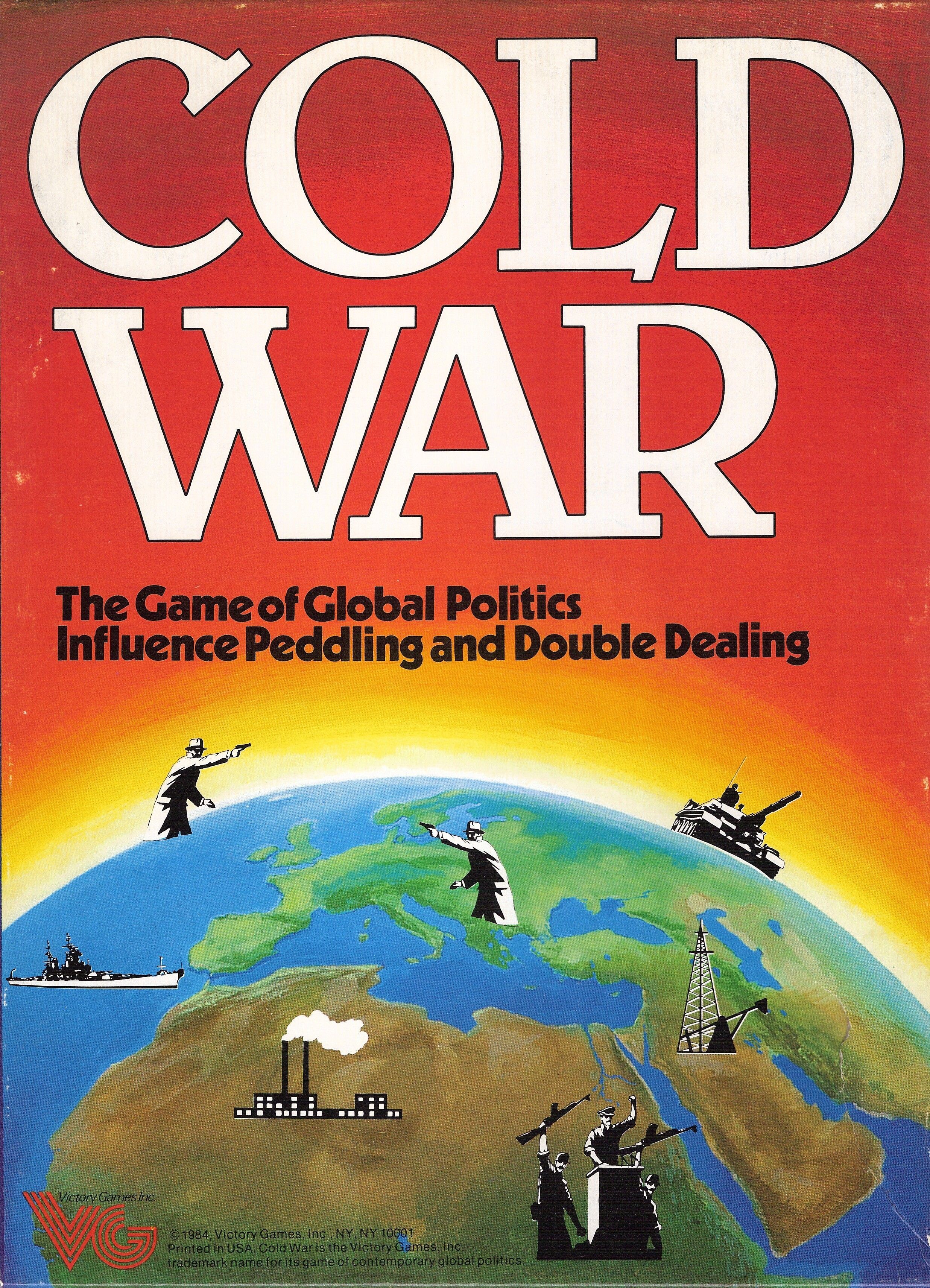
Cold War

4 jugadores 180 min A partir de 12 años 2.8/5 de complejidad 5.5/10 de valoración

Acerca de este juego

A game for four players, Cold War gives you command of the economic, military, and intelligence forces of one of the contemporary world's major powers, and dares you to seize political, military, and economic control of as much of the world as possible. The only obstacles in your way are your three opponents, each of whom has a bag of dirty tricks to play and an equal stake in the world regions you claim for your own. Cold War is designed to be easy to learn, fun to play, and hard to win.

Qué sensaciones ofrece

Area Movement Area Majority / Influence Wargame Political Economic Modern Warfare Negotiation

Explora estas mecánicas en Cardboard

Crea un prototipo original con patrones de diseño reutilizables, no con el contenido de este juego.

Abrir el taller de mecánicas

Inteligencia del juego

Aprende el juego

100% de cobertura de conocimiento

Preparación

1. Each player selects a faction color (Red, Yellow, Green, or Blue) and takes the corresponding Establish card printed on their color's card stock.\n2. Shuffle and distribute Action cards as directed by the scenario rules.\n3. Each player places their starting units (Diplomats, Agents, Military Presence) in their Deploy Box.\n4. Set up the world map with regions as indicated by the scenario.\n5. Each player begins with their starting SP allocation as defined by the scenario.\n6. Determine first player and begin play.

Flujo del turno

Each player's turn consists of three sequential phases:\n\n1. PURCHASE PHASE – Players spend 5 SP each to purchase new Diplomats, Agents, or Military Presence units and place them in their Deploy Box. A Diplomat already in the Deploy Box costs 0 SP. A Diplomat or Military Presence already on the map costs 5 SP if unsupported by a Faction, Alliance, Political Control, or Military Control.\n\n2. MOVE PHASE – Diplomats and Agents move at 0 SP cost; they may never move to their own home country. Military Presence costs 5 SP to move and may only move to a sea zone or a region containing a friendly Faction, Alliance, Political Control, or Military Control. Diplomats and Military Presence movement may be restricted by opposing Military or Political Control. Players may also voluntarily degrade their own markers during the Move Phase.\n\n3. ACTION PHASE – Players perform actions: Establish Factions, Alliances, and Factories; Establish Economic, Military, and Political Control; and play Action cards. A maximum of one Column A action and one Column B action may be taken per region per turn. Where a player holds Military or Political Control, they may expel Diplomats, degrade opposing markers, and expropriate opposing Factories and Economic Control.

Puntuación y victoria

Player with the most total SP at game end wins. Fuentes de puntuación: Region SP value collected via Factory each turn, Double region SP value collected via Economic Control each turn, 8 SP end-game bonus per region with Economic Control, 10 SP end-game bonus per region with Military Control, 12 SP end-game bonus per region with Political Control

Fuente: Rulebook

Reglas que debes conocer

Las reglas más útiles para jugar bien la primera partida.

Turn structure

During the Purchase Phase, players spend 5 SP to buy each new Diplomat, Agent, or Military Presence unit and place it in their Deploy Box.

During the Purchase Phase, a player may spend 5 SP per unit to purchase any number of Diplomats, Agents, or Military Presence counters. All newly purchased units are placed in the player's Deploy Box and are available for movement in the Move Phase of the same turn.

Turn structure

A Diplomat already in the Deploy Box costs 0 SP to retain/place.

If a Diplomat is already sitting in a player's Deploy Box at the start of the Purchase Phase, it costs 0 SP (i.e., no additional purchase cost is needed to keep it available for deployment).

Turn structure

Military Presence on the map without supporting control costs 5 SP during the Purchase Phase.

If a player's Military Presence counter is on the map but is not supported by a friendly Faction, Alliance, Political Control, or Military Control in that region, it costs 5 SP during the Purchase Phase to maintain. If supported by any of those markers, the maintenance cost does not apply.

Movement

Diplomats and Agents move for free (0 SP) but may never move to their own home country.

During the Move Phase, Diplomats and Agents may move to any eligible region at no SP cost (0 SP). However, neither Diplomats nor Agents may ever enter their controlling player's own home country region.

Movement

Military Presence costs 5 SP to move and may only enter sea zones or regions with a friendly Faction, Alliance, Political Control, or Military Control.

During the Move Phase, moving a Military Presence counter costs 5 SP. Military Presence may only move to (a) a sea zone, or (b) a region in which the player already has a Faction, Alliance, Political Control, or Military Control marker. Military Presence cannot move to a region where the player has no such supporting presence.

Movement

Opposing Military or Political Control can restrict the movement of Diplomats and Military Presence into a region.

If an opposing player holds Military Control or Political Control in a region, they may deny entry to a moving player's Diplomat or Military Presence. This restriction is evaluated at the time of movement during the Move Phase.

Movement

Players may voluntarily degrade their own markers during the Move Phase.

During the Move Phase (not the Action Phase), a player may choose to voluntarily degrade (reduce in tier) any of their own markers on the map. This can be used strategically to reposition influence.

Turn structure

During the Action Phase, players establish control markers, play Action cards, and exercise control-based privileges, with a maximum of one Column A and one Column B action per region.

During the Action Phase, a player may: establish Factions, Alliances, and Factories; establish Economic, Military, and Political Control; and play Action cards. The key restriction is that a player may take a maximum of one Column A action and one Column B action per region per turn. Additionally, where a player holds Military or Political Control, they may expel Diplomats, degrade opposing markers, and expropriate opposing Factories and Economic Control.

Informe estratégico

Escalate Influence Efficiently Using the Column A/B Limit

Since only one Column A and one Column B action may be taken per region per turn, plan your escalation path across multiple turns. Prioritize establishing a Faction (Column A) one turn and a Factory (Column A) another turn, since both are Column A and cannot be combined in one turn in the same region.

Prioritize Political Control for Maximum End-Game Value

Political Control yields the highest end-game bonus (12 SP per region) and grants the same combat-like privileges as Military Control (degrade, expropriate, expel). Focus on regions where you can build the Faction → Alliance → Political Control chain uncontested.

Use Military Control to Block Opponents

Military Control blocks opponents from establishing Alliances, Political Control, and Economic Control in that region, and can deny movement of their Diplomats and Military Presence. Seizing Military Control in a contested region effectively freezes out rivals.

Secure Factories Early for SP Income

Factories generate SP income every turn. Pairing a Factory with Economic Control doubles that income and adds an 8 SP end-game bonus. Securing high-SP-value regions with Factories early creates a compounding advantage.

Manage Military Presence Maintenance Costs

Unsupported Military Presence (without a Faction, Alliance, or Control marker in the region) costs 5 SP per unit during the Purchase Phase. Keep Military Presence backed by influence markers to avoid draining your SP on maintenance.

Use Move Phase Degrading to Reposition Strategically

You may voluntarily degrade your own markers during the Move Phase. This can be used to drop from a costly high-tier marker to a lower tier in a region you no longer wish to defend, freeing SP resources for higher-priority regions.

Deny Diplomat Access to Lock Down Regions

Political and Military Control holders can expel Diplomats and deny their entry. Since Diplomats are required to establish Factions (the first step of the influence chain), denying Diplomats locks opponents out of establishing any presence in your controlled regions.

Preguntas frecuentes y casos límite

Can I establish a Faction in a region where I already have Military Control?

No. The Establish Faction rule explicitly states a Faction cannot be established in a region where the player already has Military Control. Military Control supersedes the need for a Faction.

Can I establish an Alliance or Political Control in a region where an opponent has Military Control?

No. Both Establish Alliance and Establish Political Control are blocked if an opposing player holds Military Control in that region. You must first neutralize the opposing Military Control.

Can I establish Economic Control in a region where an opponent has Military Control?

No. Establishing Economic Control requires the absence of opposing Military Control, even if the player has an Alliance and a Factory present.

If I have both a Factory and Economic Control, do I collect the SP value once or twice?

Twice — Economic Control allows you to collect double the region's SP value. The Factory's single-collection benefit is superseded by Economic Control's double-collection benefit. You do not stack both on top of each other.

Can I move Military Presence into a region controlled by an opponent's Military or Political Control?

No. Opposing Military or Political Control can deny entry to a moving Military Presence. Movement of Military Presence into such a region is blocked unless the opposing control is removed first.

Can I move a Diplomat into a region where an opponent has Military or Political Control?

No. Opposing Military or Political Control can deny entry to a Diplomat. The controlling player may block the Diplomat from entering that region.

What is the difference between expropriation and degrading?

Degrading reduces an opposing marker by one tier (e.g., Alliance → Faction, Economic Control → Factory). Expropriation completely removes opposing Factory or Economic Control markers from the board. Only Military Control and Political Control holders can perform either action, and expropriation is limited to Factories and Economic Control.

Can I establish both a Faction and a Factory in the same region on the same turn?

Only if they fall into different columns (one Column A, one Column B). Establish Faction and Establish Factory are both Column A actions. Therefore, you cannot perform both in the same region on the same turn. You may only take one Column A and one Column B action per region per turn.

I have Military Presence on the map but no Faction, Alliance, or Control marker in that region. Do I pay SP during the Purchase Phase?

Yes. Military Presence on the map without supporting Faction, Alliance, Political Control, or Military Control costs 5 SP during the Purchase Phase to maintain.

Can I degrade my own markers during the Action Phase to re-establish them at a lower tier?

No. Voluntary degradation of your own markers is only permitted during the Move Phase, not the Action Phase. Degrading opposing markers is an Action Phase privilege granted by Military or Political Control.

Which is worth more at game end: Political Control or Military Control?

Political Control is worth more: 12 SP per region vs. 10 SP per region for Military Control. Both also grant the same in-game privileges (degrade, expropriate, expel), but Political Control yields a 20% higher end-game bonus.

Pregunta Sobre Este Juego

Juegos similares