1993 Puesto n.º 3747 en BGG

En Garde

2 jugadores 20–30 min A partir de 8 años 1.4/5 de complejidad 5.9/10 de valoración

Acerca de este juego

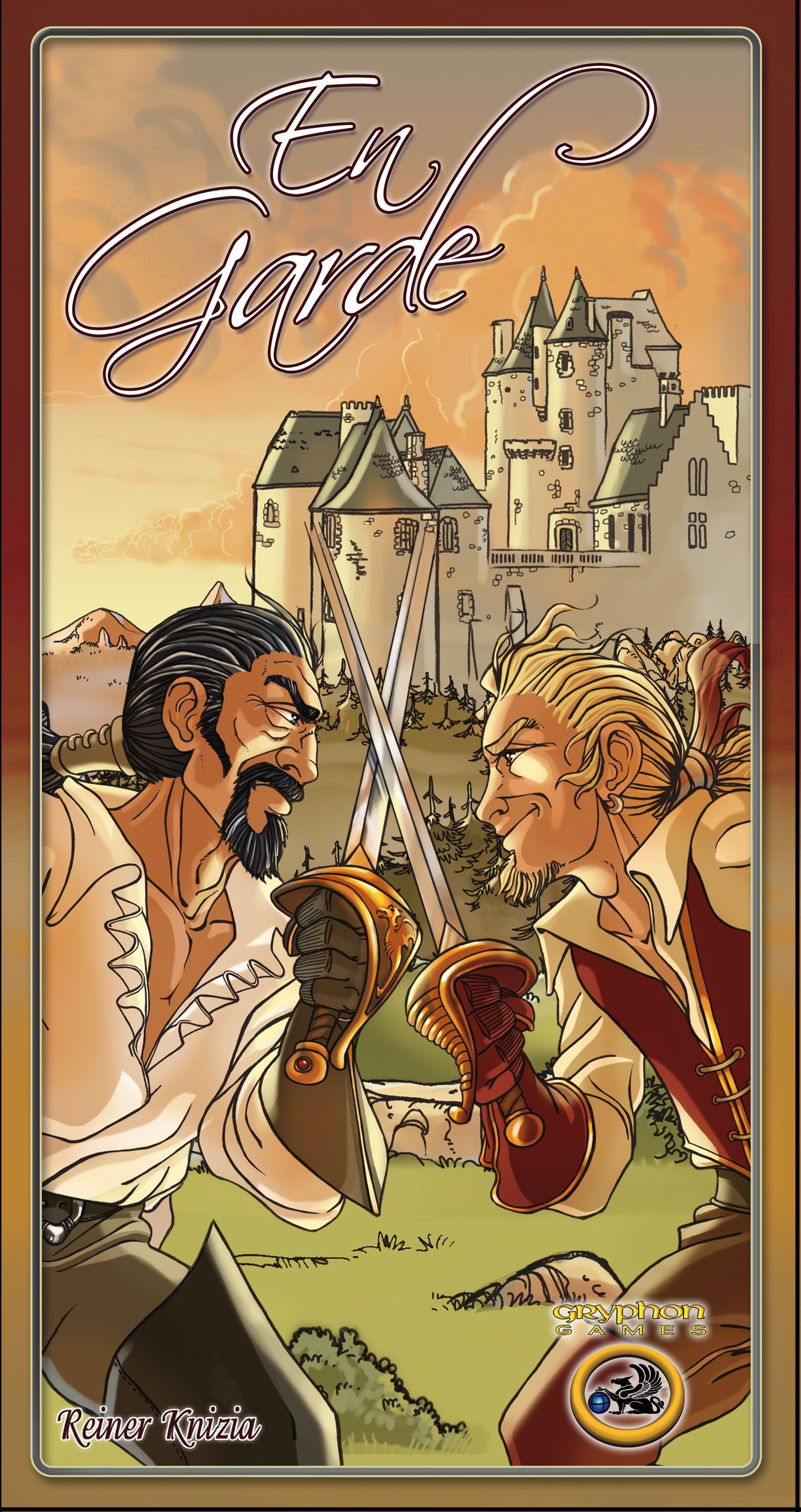
Experience the thrill of fencing— board game style! In this two-player game, tactics, skill, and a little bit of luck will determine the best fencer. Teach yourselves the concepts with the basic game, test yourselves with the standard game, and challenge yourselves with the advanced game. Cards fly back and forth as the fencers attack, and parry-riposte. Who will be bold enough to attack first? Is it possible to win with that initial attack or has your opponent beguiled you into an attack while waiting to mount a parry-riposte? En Garde is a very dynamic game— strategically rich yet easy to learn and play. Three levels of rules are included in the game. En Garde is played with 25 cards (5 each of 1-5). Each turn you play one or more cards to advance or retreat your fencer, or perform a direct or indirect attack. Following an attack, the opponent may have a chance to parry the attack or retreat. In each round the winner is the player who successfully lands an attack (or who has the upper hand in a round that uses up all the cards without a successful attack) and the first to five points wins the game. Re-Imagined as: Flash Duel Re-implemented as: Duell

Qué sensaciones ofrece

Tug of War Hand Management Card Game Sports

Explora estas mecánicas en Cardboard

Crea un prototipo original con patrones de diseño reutilizables, no con el contenido de este juego.

Abrir el taller de mecánicas

Inteligencia del juego

Aprende el juego

100% de cobertura de conocimiento

Preparación

1. Place the board between both players. Place the White fencer figure on space 1 and the Black fencer figure on space 23.\n2. Shuffle all 25 fencing cards (five each of values 1, 2, 3, 4, and 5).\n3. Deal 5 cards to each player; players keep their hand secret from their opponent.\n4. Place the remaining 15 cards face-down next to the board as the draw pile.\n5. White is the starting player in the first round. The starting player alternates each subsequent round.

Flujo del turno

Players alternate turns. On your turn, you play 1 or more cards to perform exactly one of three actions: (1) Move your fencer forward or backward the exact number of spaces on a single played card; (2) Make a direct attack by playing a card whose value equals the exact distance to your opponent, optionally playing additional cards of the same value to strengthen the attack; (3) Make an indirect (advance and attack) by first playing one card to advance forward, then one or more cards of the same value to attack. After completing your action, you draw replacement cards from the face-down pile until you have 5 cards again. If you were forced to parry on your opponent's turn, you take your turn with a depleted hand and only replenish at the end of your turn.

Puntuación y victoria

First player to win 5 rounds wins the game. Each round won scores 1 point. A drawn round scores 0 points for either player. Puntuación objetivo: 5 Fuentes de puntuación: Winning a round by landing an undefendable attack, Winning a round because the opponent has no legal move, Winning a round tiebreaker by having the most directly-attackable cards when the draw pile is exhausted, Winning a round tiebreaker by having the fencer that advanced furthest when the draw pile is exhausted

Fuente: Rulebook

Reglas que debes conocer

Las reglas más útiles para jugar bien la primera partida.

Setup

Fencers start at opposite ends of the 23-space board.

At the start of each round, the White fencer is placed on space 1 and the Black fencer is placed on space 23. All 25 cards are reshuffled and each player is dealt 5 cards, kept secret from the opponent. The remaining cards form a face-down draw pile beside the board.

Setup

White goes first in round 1; starting player alternates each round.

White is the starting player in the first round. In every subsequent round, the starting player alternates between White and Black.

General

The deck contains 25 fencing cards: five copies each of values 1 through 5.

There are exactly 25 fencing cards in the deck, comprising five cards of each value: 1, 2, 3, 4, and 5. No other card values exist. This limits the maximum number of identical cards a player could play in one attack to two (since there are only five of each value and each player has at most 5 cards, but three-card attacks are explicitly impossible to parry because only five of each value exist and two are already played by the attacker).

General

Players always maintain a hand of 5 cards; cards are replenished after each turn.

Each player's hand size is 5 cards. After completing any action on your turn (move, direct attack, or advance and attack), you draw replacement cards at random from the face-down draw pile until your hand is back to 5 cards. If you used multiple cards on your turn, you draw multiple replacement cards. Cards played are discarded and cannot be reused.

General

Played cards are discarded and cannot be used again.

Once a card has been played for any purpose (movement, attack, or parry), it is discarded and removed from play for the rest of the round. Cards are not recycled.

Movement

A player may play one card to move their fencer the exact number of spaces shown, forward or backward.

On your turn, you may play exactly one card to move your fencer. You must move the exact number of spaces shown on the card — no more, no less. You choose whether to advance (move toward your opponent) or retreat (move away from your opponent). Restrictions: the fencer may not move off the board (past space 1 or space 23), and the fencer may not move onto or over the space occupied by the opposing fencer. After moving, draw a replacement card to return to 5 cards.

Restriction

A fencer cannot move off the board.

A fencer may never be moved to a space beyond the ends of the board (spaces 1–23). If a card's movement value would take the fencer past the board's edge, that card cannot be used for movement in that direction.

Restriction

A fencer cannot move onto or over the space occupied by the opposing fencer.

During a movement action, a fencer may not land on the same space as the opposing fencer, nor may the fencer's path pass through that space. Movement is strictly a repositioning action; landing on the opponent's space constitutes an attack, not a move.

Informe estratégico

Hand Management for Attacks

Because you must play a card whose value matches the exact distance to your opponent for a direct attack, positioning your fencer at distances that match the values in your hand is critical. Prioritize moves that place you at a distance you can attack from with multiple cards — a two-card attack is harder to parry than a single-card attack, and a three-card attack is unparriable.

Forcing Unparriable Attacks

The most decisive winning strategy is to engineer a three-card attack by accumulating three cards of the same value and positioning at the matching distance. Since a three-card attack cannot be parried (only 5 cards of each value exist), it guarantees a round win. Monitor discards to estimate whether the defender could still hold matching cards.

Depleting the Defender's Hand via Parries

Forcing your opponent to parry — especially multi-card attacks — depletes their hand before their turn. Since they cannot replenish until after they've played cards on their turn, a successfully parried two-card attack leaves them with only 3 cards to act with. This weakens their attack options on their next turn.

Using Indirect Attacks to Bypass Defense

An indirect attack creates a dilemma for the opponent: they must either parry (spending cards) or retreat (spending a card and ceding ground). Retreating may push the defender toward the board edge, eventually leaving them with no retreat option, which can make a future indirect attack undefendable.

Draw Pile Tiebreaker Awareness

When the draw pile is running low, the tiebreaker favors the player with more cards that can be used for a direct attack on the current position. Keep track of the distance to your opponent and try to hold cards of that value. Advancing also helps the positional tiebreaker (furthest advanced wins).

Retreating to Avoid Indirect Attacks

Retreating in response to an indirect attack preserves your hand (only one card spent vs. multiple for a parry) but surrenders board position. Be careful not to retreat so far that you are pushed off the board, as that would end the round in your opponent's favor.

Preguntas frecuentes y casos límite

A player parries an attack. When do they draw replacement cards — immediately after parrying, or later?

The parrying player does NOT draw cards immediately after parrying. They must first take their own turn and play 1 or more cards. Only after completing their turn do they draw replacement cards back up to 5. This means they face their turn with a hand reduced by the number of cards used in the parry.

A player faces an indirect attack and wants to retreat, but retreating would move them off the board. What happens?

If the player cannot parry the indirect attack AND cannot retreat (because any retreat card would take them off the board), they cannot defend and immediately lose the round.

Can a player ever play three cards of the same value as an attack, and can it be parried?

Theoretically a player could hold three cards of the same value and use them as a three-card attack. However, this attack cannot be parried — the rulebook explicitly states this is impossible because only five of each card value exist (three are used in the attack, so the defender cannot obtain three matching cards). A three-card attack therefore always wins the round.

Can a player retreat to avoid a direct attack?

No. Retreating as a defense is only available against an indirect attack. Against a direct attack, the only defense is to parry. If the player cannot parry a direct attack, they are immediately hit and lose the round.

The draw pile runs out and neither player has won through an attack. How is the round winner decided?

After the last card is drawn and all final attack/defense actions are resolved, if there is still no winner: (1) The player who holds the most cards in hand that could currently be used for a direct attack wins. (2) If tied, the player whose fencer moved furthest from their starting position wins. (3) If still tied, the round is a draw — neither player scores.

In an indirect attack, does the fencer's advance count toward the attack distance, or is the attack distance measured after the advance?

Yes — the fencer physically advances first (moves forward the number of spaces on the first card), and then the attack card value must equal the exact distance between the advanced fencer and the opponent. The fencer does not move again on the attack card(s).

Can a player parry a two-card attack (e.g., two 4s) by playing two cards of a different value?

No. To parry, the defender must play the exact same number of cards as the attacker AND those cards must be the same value as the attacker's cards. Playing two 3s cannot parry two 4s.

Pregunta Sobre Este Juego

Juegos similares