2018 Puesto n.º 2825 en BGG

First Contact

2–7 jugadores 15–40 min A partir de 12 años 2.0/5 de complejidad 6.1/10 de valoración

Acerca de este juego

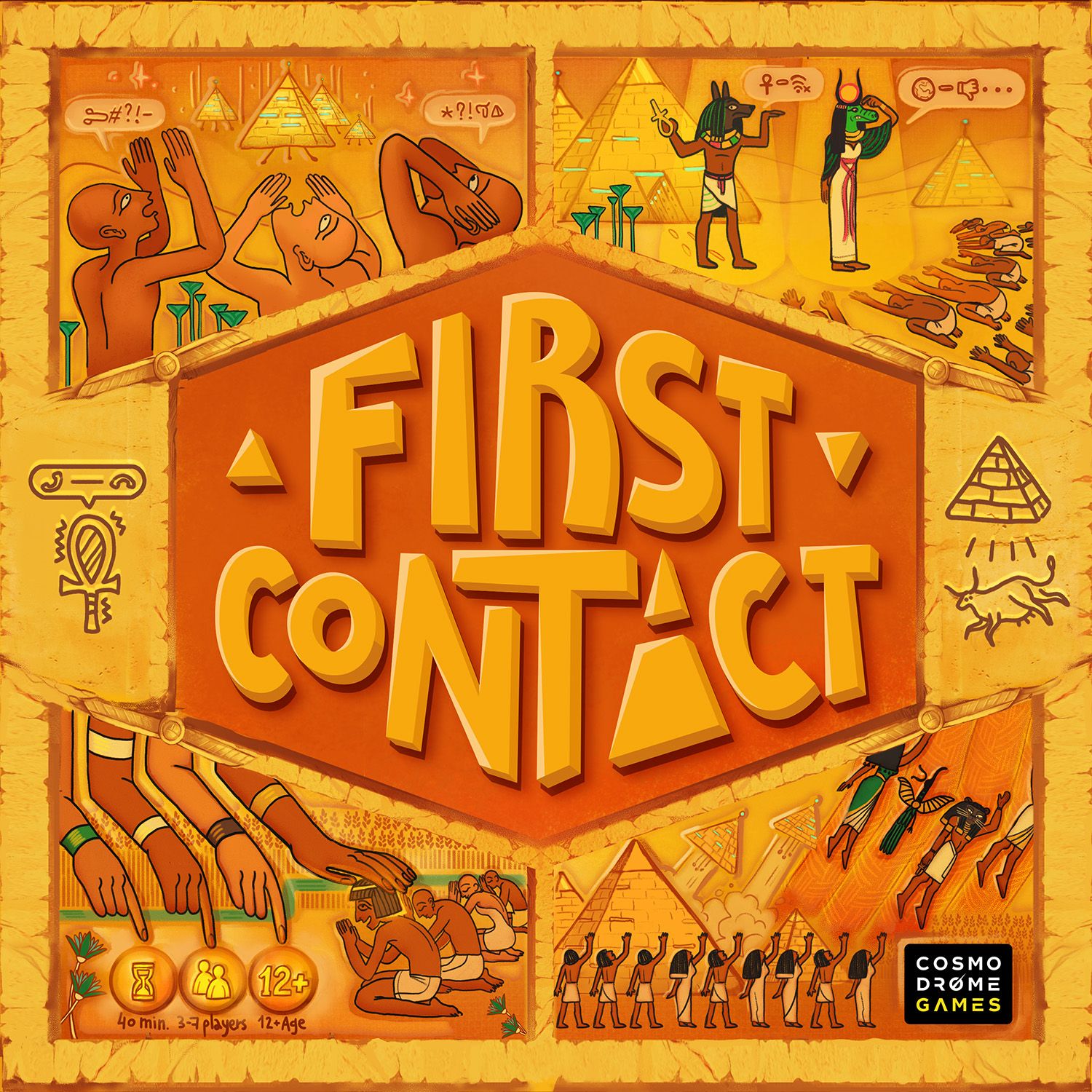
An exceptional party game where imaginary ancient Egyptians are trying to overcome the language barrier with… Aliens. In each turn Aliens would draw weird symbols, trying to explain which earthly items they’d like to collect. Puzzled Egyptians are to figure out what this could mean. On top of that, Aliens compete for being the first to grab the souvenirs and fly back home, while each human wants to be the best at learning the Alien language! «First Contact» is perfect for associative-deductive games lovers. The unique theme adds even more fun to the game process, and every setup gives players new puzzles to solve. Incredibly good time guaranteed!

Qué sensaciones ofrece

Deduction Communication Limits Humor Science Fiction Card Game Deduction Word Game Party Game Fictional Languages

Inteligencia del juego

Aprende el juego

100% de cobertura de conocimiento

Preparación

1. Divide all players into 2 teams: aliens and earthlings. Maximum 3 aliens and maximum 4 earthlings. 2. The two teams sit opposite each other at the table. 3. Shuffle the deck of item cards and place 25 cards face-up in the centre of the table in a 5×5 square grid. This is 'the field'. 4. The alien team receives: 1 random alien language pad, 1 random assignment card, 1 drawing pad, 1 alien screen, and 1 marker. Arrange these as shown in the rulebook illustration. Note: all alien components have blue backs. 5. Each alien chooses a colour and takes benevolence tokens of that colour. The player who chose red tokens goes first in the alien phase (this does not change for the entire game); the player who chose green tokens goes last in the alien phase for the entire game. 6. Each earthling receives: 1 note pad, 1 voting pad, 1 human screen, and 1 marker. Note: all earthling components have yellow backs. 7. The earthling who knows the most languages takes the first turn in the earthling phase. 8. Players take the Zero Turn before the game begins: each earthling requests the alien team to draw the symbol for one characteristic of their choice. Aliens draw these symbols in turn, giving all players a starting vocabulary.

Flujo del turno

The game proceeds in a series of rounds. Each round consists of two phases: the Earthling Phase and the Alien Phase, which alternate until the game ends. EARTHLING PHASE: Earthlings take turns clockwise, starting with the first earthling. On their turn, an earthling rotates 1 to 5 item cards on the field that they believe share a common characteristic (as listed on their note pad). The aliens observe this, then draw a symbol on their drawing pad representing the characteristic they think the earthling intended. All players, including other earthlings, can see the symbol drawn. Earthlings may record new symbols into their personal note pads. The alien team may also record symbols already shown to earthlings in their own pads. An earthling's note pad must always be kept hidden from other earthlings behind their screen. ALIEN PHASE: Aliens take turns clockwise, starting with the red-token player. On their turn, an alien draws one or more symbols on the drawing pad representing characteristics of the item they need. The symbols describe the item the alien wants earthlings to bring them. All earthlings then secretly mark on their voting pad (behind their screen) which item on the field they think the alien needs. When all earthlings are ready, they simultaneously reveal their voting pads. Any earthling who correctly identified the needed item receives a benevolence token from that alien; the alien then covers the collected item on the field with a second token to mark it as obtained. If multiple earthlings guessed correctly, each receives a token. If earthlings accidentally offer an item wanted by a different alien, nothing happens — items must be offered during the correct alien's turn. After all aliens complete their alien phase turns, the earthling phase begins again.

Puntuación y victoria

Two separate winners are declared at game end — one per team. The alien who first collects three needed items wins the alien team. The earthling with the most benevolence tokens wins the earthling team. Ties among earthlings result in shared victory. Puntuación objetivo: Aliens: collect 3 assigned items. Earthlings: most benevolence tokens at game end. Fuentes de puntuación: Benevolence tokens awarded by aliens to earthlings who correctly identify the needed item during the alien phase, Multiple earthlings can each earn a token in the same alien turn if they all guessed correctly

Fuente: Rulebook

Reglas que debes conocer

Las reglas más útiles para jugar bien la primera partida.

Setup

Players are split into two teams: aliens (max 3) and earthlings (max 4).

All players are divided into exactly two teams before the game begins: aliens and earthlings. The alien team may have a maximum of 3 players. The earthling team may have a maximum of 4 players. Teams sit on opposite sides of the table.

Setup

25 item cards are arranged in a 5×5 grid in the centre of the table to form the field.

Shuffle the full deck of item cards and place 25 of them face-up in the centre of the table, arranged in a 5×5 square grid. This grid is called 'the field' and is the central board for the game.

Setup

The alien assignment card is a map of the field; the bottom row of the card corresponds to the row closest to the aliens.

The alien assignment card shows which items each alien needs to collect, indicated by colour. The card mirrors the layout of the 5×5 field: the bottom row of squares on the assignment card corresponds to the row of item cards closest to the alien team's side of the table.

Setup

The red-token alien always goes first and the green-token alien always goes last in the alien phase.

At setup, each alien chooses a colour and takes benevolence tokens of that colour. The player who chose red tokens is always the first to take their turn in the alien phase for the entire game. The player who chose green tokens is always the last to take their turn in the alien phase for the entire game. This order does not change.

Setup

The earthling who knows the most languages goes first in the earthling phase.

The earthling player who knows the most languages in real life is designated as the first player for the earthling phase and takes their turn first, with play continuing clockwise.

Setup

Before the game, each earthling asks the aliens to draw the symbol for one characteristic, establishing a starting vocabulary.

Before the first round begins, a zero turn is taken. Each earthling chooses one characteristic and asks the alien team to draw its symbol. The aliens draw the symbol for each requested characteristic in turn. This gives all players a shared starting vocabulary of alien symbols and prevents the game from stalling at the beginning due to a complete lack of shared language.

Turn structure

On their turn in the earthling phase, an earthling rotates 1 to 5 item cards that share a common characteristic.

During the earthling phase, each earthling takes a turn in clockwise order. On their turn, the earthling rotates between 1 and 5 item cards on the field by 90 degrees. The cards they choose to rotate should share a common characteristic as listed on the earthling's personal note pad. The intention is to communicate a characteristic to the aliens so the aliens can respond with its symbol.

Turn structure

After an earthling rotates cards, the aliens draw a symbol on their pad representing the characteristic they think was intended.

After an earthling rotates cards on the field, the alien team discusses and then draws a symbol on their alien drawing pad representing the characteristic they believe the earthling was trying to communicate. This symbol is visible to all players. Earthlings may record this new symbol in the empty cells of their personal note pads for future reference. The alien team may also record previously shown symbols on their own pad.

Informe estratégico

Earthling Note Pad Secrecy

Because earthling note pads must always be hidden from other earthlings (rule: note_pad_hidden), each earthling independently develops their own alien vocabulary. This creates meaningful divergence — two earthlings may interpret the same alien symbol differently, so aliens benefit from drawing multiple symbols to narrow down the item and reduce ambiguous guesses.

Zero Turn Vocabulary Selection

The zero turn lets each earthling choose which characteristic symbol to request from the aliens. Earthlings should coordinate to request different, high-value characteristics (e.g., size, material, function) to maximize the starting vocabulary, since aliens must collect items with diverse characteristics.

Earthling Phase Card Rotation Strategy

An earthling can rotate 1 to 5 cards per turn. Rotating more cards establishes a clearer pattern for the aliens to identify the characteristic (more data points), but also risks revealing your vocabulary mappings to other earthlings who might use that information. Since note pads are hidden, each earthling's interpretation remains private.

Alien Token Coverage as Information

When an alien collects an item, they cover it with a token on the field. Earthlings can use the positions of covered cards alongside the assignment card layout (rule: assignment_card_layout) to infer which items remain, helping narrow down future guesses.

Alien Turn Order and Race Dynamics

Since the first alien to collect 3 items wins the alien team (rule: win_condition_alien), and turn order is fixed (red always first), the red-token alien has a structural advantage: they always draw symbols and receive guesses before other aliens. Later aliens should use the earthling phase between turns to build better shared vocabulary, compensating for their positional disadvantage.

2–3 Player Alien Pacing

In the 2–3 player variant, the alien loses a red token every round and an extra one whenever earthlings offer a black-listed item. The alien should prioritize communicating clearly for the coloured (red/green/blue) items and avoid ambiguous symbol usage that might inadvertently lead earthlings toward black-marked items.

Preguntas frecuentes y casos límite

Two or more earthlings all correctly guess the same alien's needed item on the same turn — how many tokens are awarded?

Each earthling who correctly guessed the needed item receives one benevolence token from the alien. All correct guessers are rewarded individually; there is no limit to the number of tokens awarded in a single alien turn.

An earthling marks an item on their voting pad that is actually needed by a different alien, not the one currently taking their turn. Does anything happen?

Nothing happens. The item must be offered during the turn of the specific alien who needs it. Other aliens are not interested in it. No tokens are awarded and the item is not collected.

Can earthlings see the symbols the aliens draw during both phases?

Yes. When aliens respond to an earthling rotating cards (earthling phase) by drawing a symbol, it is visible to all players including all earthlings. When an alien draws symbols during the alien phase to request an item, those symbols are also visible to all earthlings. However, each earthling's note pad (where they record symbols) must be kept hidden behind their screen from other earthlings.

Can the alien turn order change during the game?

No. The alien turn order is fixed for the entire game. The player with red tokens always goes first in the alien phase; the player with green tokens always goes last. This is established at setup and does not change.

In a 2–3 player game, when exactly does the alien place a red token, and what triggers the extra token?

The alien places one red token in front of their screen at the end of each round. They place one additional red token if any earthling(s) offered them an item marked in black on the assignment card during that round. The game ends immediately when the alien places their last red token, and the alien loses.

What happens to an item card on the field once an alien collects it?

When an alien collects an item, they place a benevolence token on top of that item card on the field. This token acts as a marker indicating the item has already been received. The item is no longer available to be offered.

Pregunta Sobre Este Juego

Juegos similares