2020 Puesto n.º 4076 en BGG

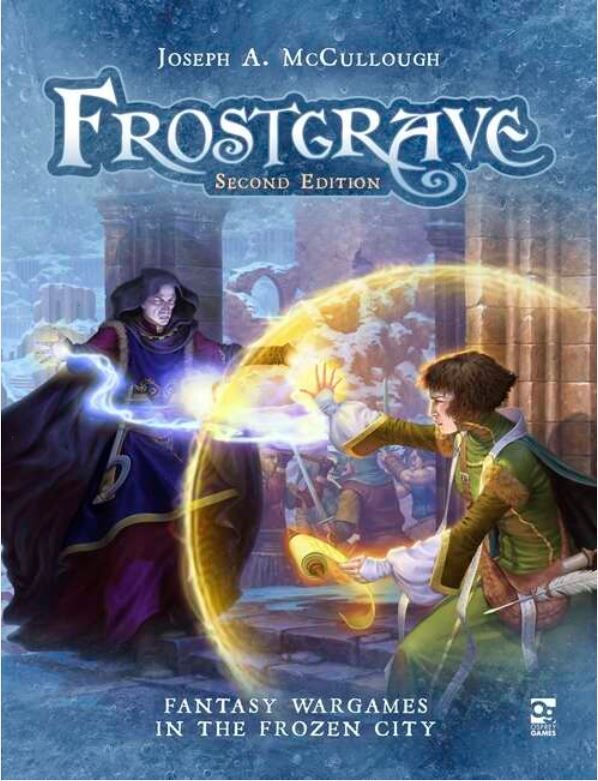
Frostgrave: Second Edition

2–8 jugadores 60–120 min A partir de 12 años 2.6/5 de complejidad 5.9/10 de valoración

Acerca de este juego

A revised and expanded edition of the multi-award-winning fantasy wargame, featuring updated rules, new spells and scenarios to challenge adventurers in the Frozen City. This new edition of the multi-award-winning fantasy skirmish wargame offers improved rules based on years of player feedback, a revised spell list, and a host of brand-new scenarios. It remains fully compatible with all previously published Frostgrave supplements, allowing players to revisit past adventures as well as face new challenges. Choose a wizard from one of ten schools of magic, and select from a list of eighty spells. Hire a warband filled with soldiers, from lowly thugs and thieves to mighty knights and barbarians, then lead your men into the frozen ruins of the magic city of Frostgrave on the hunt for ancient treasures and the secrets of lost magic. Be warned – it is a deadly place, filled with rival wizards, wandering monsters, animated constructs, and demonic entities. Do you dare enter the Frozen City one more time? —description from the publisher

Qué sensaciones ofrece

Variable Player Powers Line of Sight Role Playing Zone of Control Dice Rolling Action Points Measurement Movement Wargame Fantasy Miniatures Book

Explora estas mecánicas en Cardboard

Crea un prototipo original con patrones de diseño reutilizables, no con el contenido de este juego.

Abrir el taller de mecánicas

Inteligencia del juego

Aprende el juego

100% de cobertura de conocimiento

Preparación

1. Build or select a scenario board using modular terrain representing the frozen ruins of Felstad. 2. Each player assembles their warband: one Wizard (of a chosen school of magic), one optional Apprentice, one optional Captain, and up to 8 soldiers/hired figures for a typical warband size. 3. Record each figure's stats on the warband roster sheet: Move, Fight, Shoot, Armour, Will, and Health. 4. Record the Wizard's school, level, XP, spells (with Casting Numbers), items, injuries, vault contents, treasury, grimoires, scrolls, and potions. 5. Record the Apprentice's stats, items, and injuries. 6. Record the Captain's level, XP, stats, items, Tricks of the Trade, and injuries. 7. Record all soldiers/warband members with their stats and equipment. 8. Place treasure tokens and any scenario-specific markers on the board according to the scenario rules. 9. Determine deployment zones and player turn order as per the scenario. 10. Players deploy their warbands in their respective deployment zones.

Flujo del turno

The game is played in a series of rounds. Each round, players alternate activating their figures one at a time, starting with the player who wins initiative. Each figure can Move and perform one Action (such as attacking, casting a spell, picking up treasure, etc.), or perform two half-actions. Wizards and Apprentices may attempt to cast spells as their action. After all figures have been activated, any wandering monster or scenario effects are resolved. The game ends when a scenario end condition is met (typically when all treasure has been claimed or one warband is eliminated).

Puntuación y victoria

In a campaign context, the overall 'winner' is the warband that accumulates the most power, wealth, and spell knowledge over the course of the campaign. In individual scenarios, victory is typically determined by achieving the scenario's objective (most treasure carried off, last warband standing, etc.). Fuentes de puntuación: Carrying treasure tokens off the board, Killing enemy figures (Wizard, soldiers), Completing scenario objectives, Experience points (XP) leading to Wizard/Captain levelling, Gold coins accumulated in the Treasury

Fuente: Rulebook

Reglas que debes conocer

Las reglas más útiles para jugar bien la primera partida.

Setup

A warband consists of a Wizard, an optional Apprentice, an optional Captain, and up to 8 soldiers.

Each player controls a warband centred on their Wizard. The warband may include: one Wizard (required), one Apprentice (optional, always same school as Wizard), one Captain (optional, a powerful non-magical leader), and up to 8 additional soldiers or hired figures. The total warband size including the Wizard is typically capped per scenario or campaign rules.

General

The Wizard has six core stats: Move, Fight, Shoot, Armour, Will, and Health.

Every figure in Frostgrave, including the Wizard, is defined by six statistics: Move (how far in inches the figure can move per activation), Fight (melee combat roll modifier), Shoot (ranged combat roll modifier), Armour (target number opponent must beat to deal damage), Will (resistance to spells and magical effects), and Health (number of wounds before being taken out of action). Wizards also have a Level and XP (experience points) that increase over a campaign.

General

Each Wizard belongs to one of ten schools of magic, which determines their spell list and casting number modifiers.

A Wizard chooses one school of magic at warband creation from: Chronomancer, Elementalist, Enchanter, Illusionist, Necromancer, Sigilist, Soothsayer, Summoner, Thaumaturge, or Witch. The school determines which spells are 'in-school' (lower casting numbers), which are 'aligned' (slightly higher), and which are 'neutral' (highest casting numbers). Each school has 8 signature spells.

Card play

Each spell has a Casting Number that the Wizard must meet or beat on a d20 + Will to successfully cast it.

To cast a spell, the Wizard (or Apprentice) rolls a d20 and adds their Will stat. If the result equals or exceeds the spell's Casting Number, the spell is successfully cast. In-school spells for the Wizard's school have the lowest base Casting Numbers. Aligned school spells have Casting Numbers increased by 2. Out-of-school (neutral) spells have Casting Numbers increased by 4. Casting Numbers can be reduced through experience upgrades, grimoires, and scrolls.

General

The Apprentice is a lesser spellcaster who knows the same spells as the Wizard but casts them at a higher difficulty.

The Apprentice shares the same school and spell list as the Wizard. However, the Apprentice's Casting Numbers for all spells are increased by 2 compared to the Wizard's current Casting Numbers. The Apprentice has its own stats (Move, Fight, Shoot, Armour, Will, Health), items, and injury records on the roster.

General

The Captain is an experienced non-magical fighter who gains XP and Levels, and can learn Tricks of the Trade.

The Captain functions as a powerful combat-focused leader for the warband. The Captain has their own Level, XP, stats (Move, Fight, Shoot, Armour, Will, Health), items, and injury records. As the Captain gains levels, they can learn special abilities called 'Tricks of the Trade' that enhance their combat effectiveness. The Captain cannot cast spells.

General

Soldiers and other warband members each have stats (Move, Fight, Shoot, Armour, Will, Health) and equipment recorded on the roster.

Each non-Wizard, non-Apprentice, non-Captain member of the warband is a soldier or hired figure. They are defined by the same six stats as other figures. Their name, stat line, equipment, and carried items are recorded on the warband roster sheet. Soldiers do not gain XP or levels in the base game.

Special

Chronomancer school spells: Crumble, Fast Act, Petrify, Time Store, Decay, Fleet Feet, Slow, Time Walk.

The Chronomancer school focuses on manipulation of time and entropy. Their 8 school spells are: Crumble, Fast Act, Petrify, Time Store, Decay, Fleet Feet, Slow, and Time Walk. Each has its own Casting Number recorded on the warband sheet.

Informe estratégico

School Selection

Choose your school based on your preferred playstyle. Schools like Elementalist and Necromancer excel at aggressive combat-heavy play, while Sigilist and Soothsayer offer strong utility and board control. Because in-school spells have the lowest Casting Numbers, leaning into your school's strengths is more efficient than spreading across schools.

Apprentice Spell Selection

Because the Apprentice always casts at Casting Number +2 compared to the Wizard, prioritise improving the Wizard's Casting Numbers first. The Apprentice benefits automatically as those numbers drop, making grimoire acquisition and level-up investments in key spells doubly efficient.

Treasure Priority

Treasure tokens are the primary source of gold and magic items. Prioritising treasure collection over combat allows your warband to grow faster. Since figures must carry treasure off your board edge to claim it, positioning your warband between the treasure and your edge from the start is more efficient than fighting for it in the centre.

Captain Development

The Captain is your most reliable combat figure and gains Tricks of the Trade independently of the Wizard. Deploying the Captain aggressively to kill enemy soldiers and complete objectives maximises their XP gain, accelerating their levelling and making your warband significantly more durable in later campaign games.

Protecting Your Wizard

Wizards can suffer lasting injuries when taken out of action. Since injuries can reduce stats or cause missed games — directly hampering your ability to cast spells and gain XP — keeping your Wizard away from direct combat and using soldiers and the Captain as a screen is a critical long-term strategy.

Vault and Treasury Management

Items in the Vault are only useful when equipped. Prioritise assigning found items (grimoires, potions, scrolls) to your Wizard and Apprentice promptly, as unequipped items generate no benefit. Simultaneously, maintain enough gold in the Treasury to replace lost soldiers after costly games.

Preguntas frecuentes y casos límite

Does the Apprentice use the same Casting Numbers as the Wizard for spells?

No. The Apprentice always casts spells at a Casting Number 2 higher than the Wizard's current Casting Number for each spell. If the Wizard has reduced a spell's Casting Number through levelling or grimoires, the Apprentice still adds 2 on top of that reduced number.

What happens when a Wizard tries to cast a spell from a school that is not their own?

Aligned school spells have their Casting Number increased by 2; neutral (out-of-school) spells have their Casting Number increased by 4 for the Wizard. The Apprentice then adds a further +2 on top of those already-increased numbers.

If a Wizard studies a grimoire for a spell, does the Apprentice also benefit from the reduced Casting Number?

Yes, indirectly. The Apprentice always casts at the Wizard's current Casting Number +2. If the Wizard's Casting Number for a spell is reduced (e.g. via a grimoire or levelling), the Apprentice's effective Casting Number for that spell is also reduced by the same amount, since it is always calculated as Wizard's CN + 2.

Do Wizards and Captains progress the same way?

No. Wizards gain XP and Levels that can be used to reduce Casting Numbers or improve stats, and they focus on magical development. Captains also gain XP and Levels but improve through 'Tricks of the Trade' — combat-focused special abilities. Neither can benefit from the other's progression type.

If a Wizard or Captain suffers an injury, can they still play in the next game?

It depends on the injury rolled. Some injuries are minor stat penalties and allow the figure to play normally. Others may cause the figure to miss the next game entirely. The specific injury result from the post-game injury table determines this. Injuries are recorded on the roster and persist until healed or removed.

Can the Apprentice use a scroll to cast a spell that the Wizard's school doesn't know?

Scrolls allow any eligible figure to cast the contained spell once, typically without needing to roll or at a fixed difficulty, regardless of school. The standard school Casting Number penalties do not apply to scrolls in the same way as normal spell casting. Check the specific scenario or campaign rules for any restrictions.

Pregunta Sobre Este Juego

Juegos similares