2023 Puesto n.º 9075 en BGG

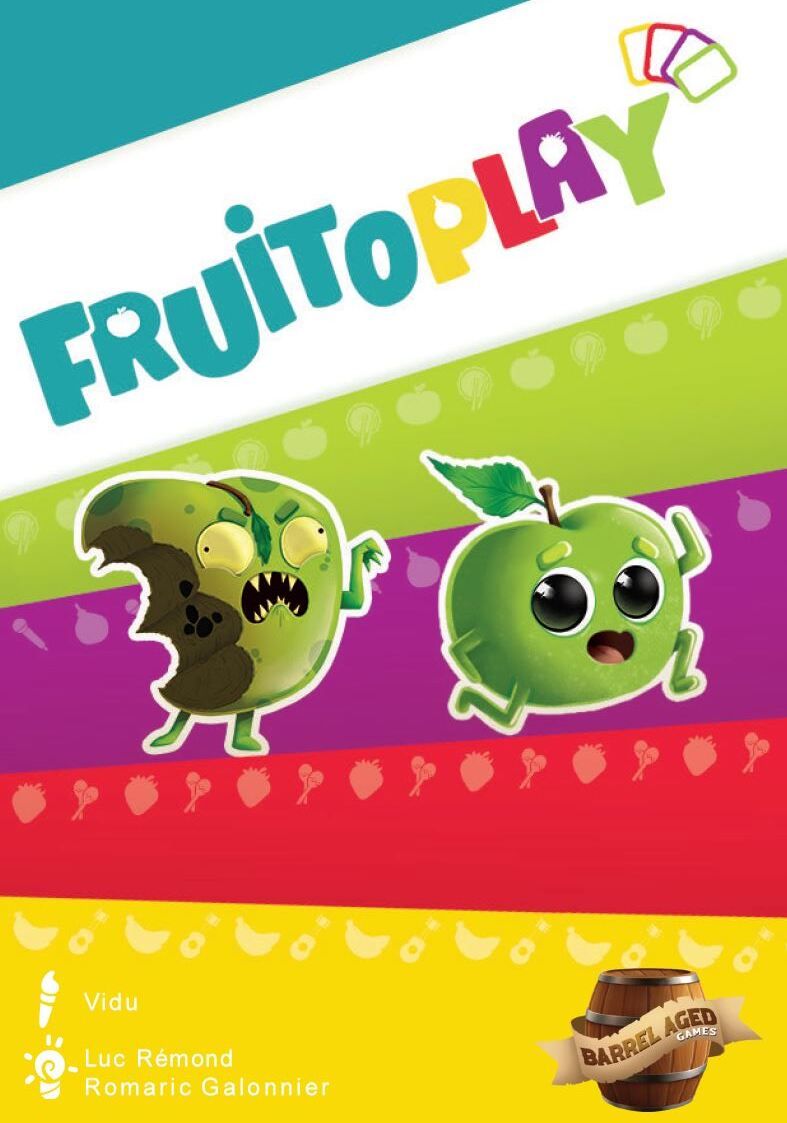
Fruitoplay

2–6 jugadores 20 min A partir de 8 años 1.2/5 de complejidad 5.6/10 de valoración

Acerca de este juego

Fruitoplay is a set collection game with simultaneous card selection that's played over three rounds, with each round lasting seven turns. At the start of the round, create a river of seven "target fruit" cards that correspond to the seven turns. On a turn, each player considers the current target fruit card, then chooses and plays a fruit card at the same time. Whoever plays a card of the same color with the smallest difference from the target fruit wins the target. (If no played cards are of the same color as the target card, the card closest in value to the target card wins it. If cards are tied for closest, ignore them.) After seven turns, you add your remaining cards in hand to your collection, separating the types of fruit, then you score points by multiplying the value of the column with the most fruit by the value of the column with the fewest fruit. If you have only one column, then you multiply that value by itself...so you don't necessarily want to win cards! After three rounds, the player with the highest score wins.

Qué sensaciones ofrece

Set Collection Simultaneous Action Selection Hand Management Card Game

Explora estas mecánicas en Cardboard

Crea un prototipo original con patrones de diseño reutilizables, no con el contenido de este juego.

Abrir el taller de mecánicas

Inteligencia del juego

Aprende el juego

100% de cobertura de conocimiento

Preparación

1. Shuffle all 80 Fruit cards. Deal 7 cards to each player for 2–3 players, or 6 cards each for 4–6 players. 2. Form a River of 7 cards face down in a stack in the center of the table (slightly offset so each card is partially visible). These are the Target cards; the fully visible card at the end of the river is played first. 3. Place all remaining Fruit cards face down to form a draw deck. 4. Set aside the 4 Collective Fruit cards — they are not used until Rounds 2 and 3. At the start of Round 2, the player with the fewest points chooses 1 Collective Fruit card of Single Fruit value and places it beside the river (valid for all players). At the start of Round 3, repeat this with a Collective Fruit card of Double Fruit value.

Flujo del turno

Each turn: (1) The Target card at the visible end of the river is placed face-up in the center of the table. (2) All players simultaneously choose 1 Fruit card from their hand and place it face-down in front of them. (3) All players reveal their chosen cards at the same time. (4) The trick winner is determined (see trick-winning rules). (5) The winner collects all played cards plus the Target card, organizing them into columns by fruit type. (6) Every player who did NOT win the trick draws 1 card from the deck (mandatory, except in the final turn of each round where drawing is optional). This repeats for all 7 turns. After all 7 turns, the round ends and scoring occurs.

Puntuación y victoria

Each round, multiply the total value of a player's largest fruit column by the total value of their smallest non-zero fruit column. Sum all 3 round scores. Highest total wins. Tiebreaker: highest Round 3 score; then shared victory. Fuentes de puntuación: Winning tricks (collecting Target cards and played Fruit cards), Hand cards remaining at round end (added to columns), Collective Fruit card bonus (applies to all players each round from Round 2), Double Fruit cards (worth 2 per card in column totals)

Fuente: Rulebook

Reglas que debes conocer

Las reglas más útiles para jugar bien la primera partida.

General

There are four fruit types; cards are either Single Fruit (value 1) or Double Fruit (value 2) for scoring purposes.

The game uses four fruit types: Banana, Strawberry, Apple, and Fig. Every numbered Fruit card (1–20) belongs to one fruit type. Single Fruit cards contribute a value of 1 to their fruit column during scoring. Double Fruit cards contribute a value of 2 to their fruit column during scoring. There are also special Rotten Fruit cards (one per type) and Collective Fruit cards (one per type, double-sided).

Turn structure

The game is played over exactly 3 rounds, each composed of 7 turns (tricks).

Fruitoplay consists of exactly 3 rounds. Each round contains exactly 7 turns, and each turn corresponds to 1 trick driven by 1 Target card from the river. After all 7 tricks in a round are resolved, players score and then all cards are reshuffled for the next round.

Setup

Deal 7 cards per player for 2–3 players, or 6 cards per player for 4–6 players.

At the start of every round, shuffle all 80 Fruit cards together. Deal 7 cards to each player if there are 2 or 3 players, or 6 cards to each player if there are 4, 5, or 6 players. The remaining cards form a face-down draw deck.

Setup

Create a River of 7 Target cards in the center; the fully visible card at the end is played first.

After dealing, place 7 cards in a staggered column called the River. Each card is partially overlapping the next so that card numbers are visible as markers. The card at the end of the river (fully visible, position 1 in the sequence) is the first Target card to be played. The river is depleted one card per turn over the 7 turns of the round.

Setup

At the start of Round 2, the player with fewest points picks a Single Collective Fruit card; at Round 3, a Double Collective Fruit card.

The 4 Collective Fruit cards are set aside during Round 1. At the start of Round 2, after dealing and forming the river, the player with the fewest cumulative points chooses 1 Collective Fruit card and places it Single Fruit side up beside the river — this card's fruit value applies to ALL players for scoring that round. At the start of Round 3, the same player (fewest points) chooses 1 Collective Fruit card and places it Double Fruit side up. If two or more players are tied for fewest points when the Collective Fruit card is to be chosen, it is drawn randomly instead.

Turn structure

Each turn, all players simultaneously choose and reveal 1 Fruit card from their hand.

At the start of each turn, the Target card at the end of the river is placed face-up in the center. Then ALL players simultaneously choose exactly 1 Fruit card from their hand and place it face-down in front of them. Players are NOT required to play a card matching the Target card's fruit type. Once all players have placed a card, all cards are flipped face-up at the same time.

Special

If at least one played card matches the Target card's fruit type, the matching card with the smallest numeric difference to the Target wins the trick.

If one or more players played a card of the SAME fruit type as the Target card, only those matching-type cards are eligible to win. Among those eligible cards, the one whose numeric value has the smallest absolute difference from the Target card's value wins the trick. That player collects all cards played this turn (all fruit cards from all players) plus the Target card.

Special

If no played card matches the Target card's fruit type, the card with the smallest numeric difference to the Target wins.

If no player played a card matching the fruit type of the Target card, then ALL played cards are eligible. The card with the smallest absolute numeric difference from the Target card's value wins the trick. That player collects all played cards plus the Target card.

Informe estratégico

Balancing your fruit columns

Your score is Max × Min, not a sum. A huge column means little if your minimum column is 0 or 1. Actively pursue at least two fruit types to raise your minimum, since columns of 0 are ignored and a minimum of 1 caps your score severely.

Using the Rotten Fruit card strategically

The Rotten Fruit card cancels two cards (itself + one other) in its fruit type. Use it to eliminate a card from a column you want to shrink, but beware: if it's your only card in that column it only cancels itself — a wasted penalty. Ideally hold it against the Collective Fruit card of the matching type to deny yourself the bonus only when the bonus would hurt your scoring balance.

Exploiting the Collective Fruit card

From Round 2 onward, the Collective Fruit card gives every player free fruit in one type. Target that same fruit type aggressively so your column grows large enough to be your maximum, and let the collective bonus amplify it. Alternatively, if the collective type would be your minimum, focus on growing other columns to match it.

Managing simultaneous card selection

Because all players reveal simultaneously, there is no perfect information about what others will play. Prioritize playing same-type cards as the Target when you want to win that trick — a same-type card beats any off-type card regardless of numeric closeness, as long as it is the closest same-type card.

Drawing cards as a losing benefit

Players who lose tricks draw cards, expanding their hand. Deliberately losing low-value tricks (turns 1–6) is a viable strategy to accumulate specific fruit cards that complete your target columns, since all hand cards are added to your columns at round end.

Choosing the Collective Fruit card (fewest points player)

The player with the fewest points chooses the Collective Fruit card — a significant catch-up mechanism. Choose the fruit type that best covers a weakness (e.g., a type no one has many cards of, creating a free column for everyone, or one you're already building for maximum synergy).

Tie-breaking awareness

Deliberately playing a card of identical distance to another player's likely play can invalidate both cards, preventing a strong opponent from winning a crucial trick. However, this risks discarding all cards if all cards tie, giving no one the trick.

Preguntas frecuentes y casos límite

Two players both play a Banana card, and both are equidistant from the Banana Target card. Does the same-fruit-type priority still apply?

No. Tied cards become invalid regardless of type. Both Banana cards are removed from consideration, and the trick is re-evaluated among remaining cards. If no other cards were played, no one wins the trick and all cards are discarded.

A player has a Rotten Strawberry card and the Collective Fruit card is +2 Strawberries. Can the Rotten card cancel the Collective card?

Yes. The player may use their Rotten Strawberry card to cancel the Collective +2 Strawberries card, negating the collective bonus for that player only. Both the Rotten card and the Collective card's effect are cancelled for that player. The Collective card still applies normally to all other players.

A player's only Apple card is the Rotten Apple card. What happens during scoring?

The Rotten Fruit card cancels itself. Since there is no other card in the column to cancel, it simply removes itself. The Apple column has a value of 0 and is ignored for the max/min multiplication.

A player has cards of only one fruit type after cancellations. How do they score?

If a player has only one non-zero fruit column (it is simultaneously the largest and smallest), they multiply that column's value by itself. E.g., 9 strawberries → 9 × 9 = 81 points.

A player has no Fig cards at all, but the Collective Fruit card is +1 Fig. Do they score a Fig column?

Yes. The Collective Fruit card applies to ALL players. Even a player with no Fig cards gains a Fig column worth 1 for scoring purposes, which will factor into their max/min calculation.

A player never won a trick but drew cards all round. What happens to their hand at round end?

All cards remaining in a player's hand at round end — including any drawn cards — are added to that player's fruit columns (creating new columns if needed). These count fully during scoring. A player who won no tricks can still score from their hand cards.

Every card played is tied (same difference to Target). What happens to the Target card and played cards?

If all cards are tied and no valid cards remain after removing ties, no one wins the trick. All played Fruit cards are discarded from the round. The trick (and its Target card) is lost — no player collects anything.

A player has fruit in two columns but one column is zeroed out by a Rotten Fruit card. Which is the minimum?

Columns with a total value of 0 are ignored entirely and do not count as the minimum. Only non-zero columns are considered. If only one non-zero column remains, the player multiplies it by itself.

In the final (7th) turn of a round, is drawing mandatory for players who didn't win?

No. In the last turn of each round only, players who did not win the trick may choose whether or not to draw a card. Drawing is optional in the final turn only; it is mandatory in turns 1–6.

At the start of Round 2, two players are tied for fewest points. Who chooses the Collective Fruit card?

If there is a tie for fewest points when the Collective Fruit card is to be chosen, the card is drawn randomly rather than chosen by a player.

Pregunta Sobre Este Juego

Juegos similares