2012 Puesto n.º 19244 en BGG

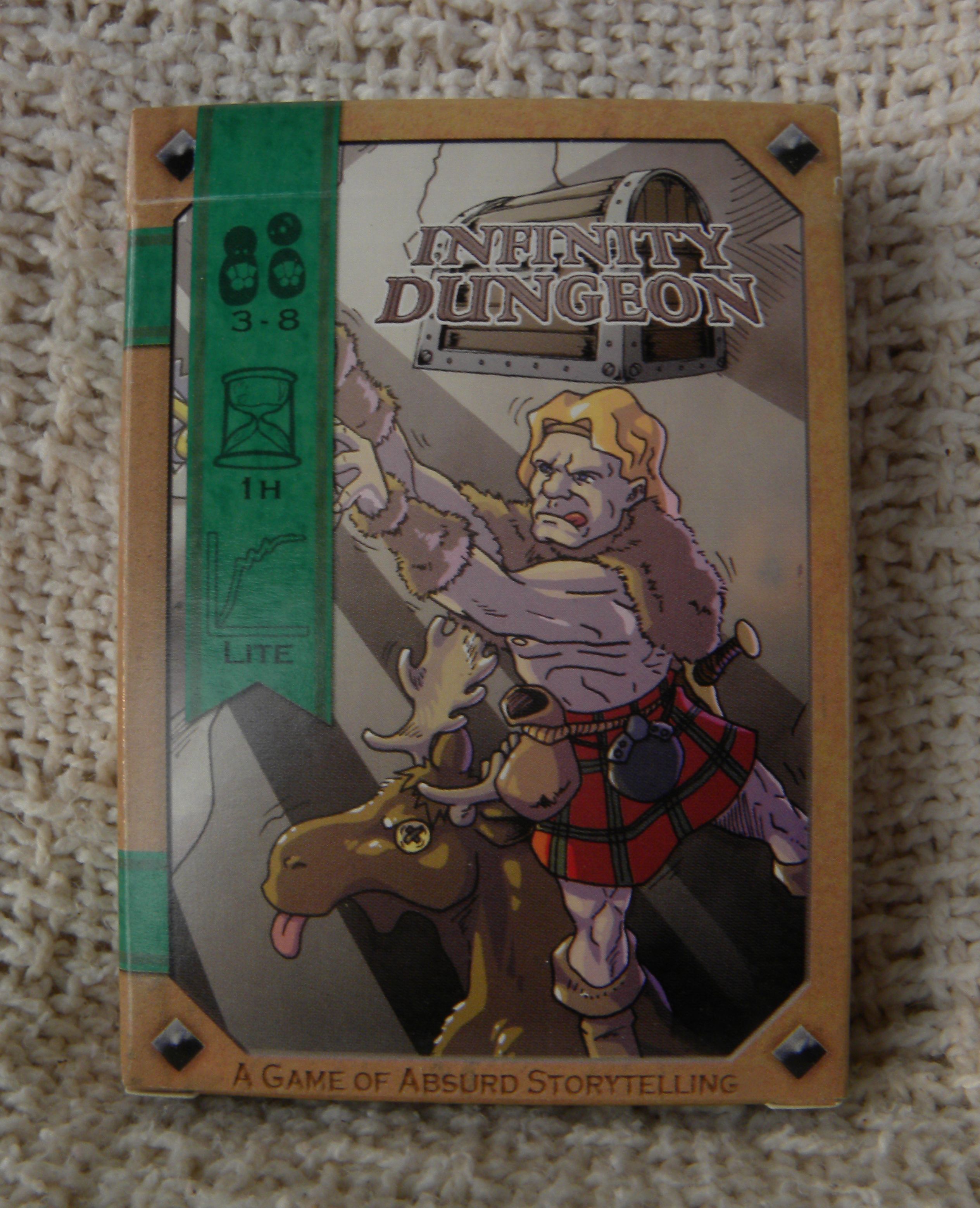
Infinity Dungeon: Peril Without End

3–8 jugadores 60 min A partir de 10 años 1.1/5 de complejidad 5.5/10 de valoración

Acerca de este juego

Infinity Dungeon is a storytelling party game for four or more players. Players take on the roles of outlandish characters like the Postman, Rock Star, Evil Overlord, and Archaeologist and must attempt to escape from Infinity Dungeon. Each turn of play, a room will be revealed from the room deck and read aloud. Each room contains a puzzle, trap, or monster to overcome. At this point, the party leader must describe how he will utilize his own character's powers, plus the powers of his willing allies, in order to get his team safely from this room and into the next. Each player votes on whether they believe the plan is likely to succeed. After this point, a card is drawn and a random number printed on it is compared to the number of confidence votes the player received. If he meets this number or exceeds it, the GM must narrate how his plan succeeds. If he does not, the GM must narrate how the plan fails and results in his grisly death. Players who die receive a new character class and get immediately back into the action. When the team completes a pre-determined number of rooms, they win!

Qué sensaciones ofrece

Voting Cooperative Game Storytelling Card Game Party Game

Inteligencia del juego

Aprende el juego

100% de cobertura de conocimiento

Preparación

1. Shuffle the character cards to form a character deck. Deal each player 2 character cards. Each player chooses one card to keep as their character, places it face-up in front of them, and returns the other card to the bottom of the character deck. 2. Randomly determine which player will be the first Active GM. Give the Active Player card to the player on the Active GM's right. Give 1 voting card to each remaining player. 3. Decide how many rooms the dungeon will consist of — typically 1 room per player (or 2 per player for groups of 5 or fewer). 4. Shuffle the room cards to form the Dungeon Deck. Deal 5 cards from the top of the deck and arrange them so that items on the bottoms of the cards are visible and the top card is fully visible. This forms the first room. 5. Proceed to character introductions: starting with any player and moving left, each player introduces their character (either by reading the card text or improvising).

Flujo del turno

Each round of play centers on one dungeon room. The Active GM reads aloud the current room card and all visible item cards beneath it, then answers any questions players have about observable phenomena in the room. The Active Player devises a plan to get themselves and all allies (including the Active GM) out of the room and into the next. After a brief discussion, the Active Player makes a final proposal. Starting to the Active Player's left and moving left, each other player (including the Active GM, but not the Active Player) either votes Agree or issues a Challenge. The Active Player has ~30 seconds to accept or decline each challenge; accepted challenges must be integrated into the plan. After all votes are cast, the plan's strength is calculated using the Active GM Card chart (base number + agreement values + accepted challenge values). A card is drawn from the Dungeon Deck and its treasure-box number is compared to the plan's strength. If the number is ≤ the plan's strength, the plan succeeds; if higher, it fails. On success, both the Active GM and Active Player roles pass (GM passes right, Active Player passes left, skipping the new GM if necessary) and a new room is revealed. On failure, only the Active Player role passes left; the Active GM stays. The failed player discards their character, draws 2 new character cards, picks one, and rejoins as a new persona.

Puntuación y victoria

Cooperative — the entire party wins together when all planned rooms are cleared. There is no formal point scoring. The 'winner' is subjectively the player who had the most fun. Puntuación objetivo: Clear all planned rooms to escape Infinity Dungeon Fuentes de puntuación: Clearing the agreed-upon number of dungeon rooms as a group

Fuente: Rulebook

Reglas que debes conocer

Las reglas más útiles para jugar bien la primera partida.

Setup

Deal 2 character cards to each player; each player keeps one and returns the other to the bottom of the deck.

At the start of the game, shuffle the character cards and deal 2 to each player. Each player selects one of these cards to be their character, places it face-up in front of them, and returns the unchosen card to the bottom of the character deck.

Setup

Randomly determine the first Active GM; give the Active Player card to the player on the GM's right.

Randomly determine which player will be the first Active GM and give them the Active GM card. Give the Active Player card to the player immediately to the Active GM's right. All remaining players each receive 1 voting card.

Setup

Decide the number of rooms before play begins — usually 1 per player (or 2 per player for groups of 5 or fewer).

Before starting, the group decides how many rooms the dungeon will consist of. The recommended amounts are: 2 rooms per player for groups of 3–5, and 1 room per player for groups of 6–8. The total number of rooms determines when the game ends.

Setup

Deal 5 room cards to form the first room display; the top card is fully visible and items on the bottoms of the other cards are visible.

Shuffle the room cards to form the Dungeon Deck. Deal 5 cards from the top and arrange them so that items printed on the bottoms of cards are visible, and the topmost card is fully visible. The Active GM reads aloud the top room card and all visible item text below it.

Turn structure

Before entering the dungeon, each player introduces their character, starting with any player and moving left.

After setup and role assignment, each player introduces their character in turn, starting with any player and moving left. An introduction can be as simple as reading the character card's text aloud or as elaborate as a fully improvised performance the player invents themselves.

Turn structure

The Active GM reads the room card and visible item cards aloud, then answers questions about observable phenomena only.

At the start of each room, the Active GM reads aloud the current room card and the items that are visible below it. Players may ask the Active GM questions about observable phenomena in the room (e.g., 'What's on the map?', 'What kind of stone is the statue made of?'). The GM may answer these freely. Questions that cannot be answered by simply looking around — such as 'Can I get the attention of the gnomes?', 'If I jump down will I survive?', or 'What happens if we just wait?' — are NOT allowed during this phase, because they require action to discover.

Turn structure

The Active Player devises and proposes a plan to get the entire party (including the Active GM) out of the current room.

After the room is described, the Active Player takes a few moments to discuss the situation with everyone at the table and formulate a plan. The plan must address getting themselves and all allies — including the Active GM — out of the current room and into the next. Once ready, the Active Player makes a final formal proposal. This proposal triggers the voting phase.

Turn structure

A player votes Agree by turning their voting card to the agree side, contributing points to the plan's strength.

If a player thinks the plan is good enough as presented, they turn their voting card to the agree side. The agree side shows a number of points that are added to the plan's total strength. Each agreeing player contributes these points.

Informe estratégico

Crafting Stronger Plans

Because plan strength is calculated as a base number plus bonuses from agreements AND cleared challenges, a plan that earns both agree votes and clears challenges will be significantly stronger than one that only gets agrees. Deliberately structuring a plan to invite and satisfy challenges is a powerful strategy for clearing high-difficulty rooms.

Issuing Effective Challenges

Challenges must have clearly defined conditions, but can be as ridiculous as desired. The best challenges are specific enough to be verifiable but creative enough to force interesting storytelling. Avoid vague challenges — they are invalid and waste your opportunity to contribute to plan strength.

Using Room Resets Strategically

Since leaving and re-entering a room resets it entirely, the party should consider exiting if a prior failed plan has destroyed or altered objects that are needed for future plans. Don't feel locked into a damaged room state.

Planning Around Locks

Locks are an absolute constraint — no plan that involves picking, destroying, or otherwise bypassing a lock without the correct key will ever succeed mechanically. Always account for keys when planning an escape route involving locked doors.

Managing the Active GM Role

The Active GM role only moves on a successful plan. If the party keeps failing, the same player remains GM for multiple rounds. Players acting as GM should embrace creative narration of failures to keep the game fun, and Active Players should note that the GM has a vested interest in the plan succeeding (since they're included in it).

Leveraging Minions

Starred items on character cards are minions that belong to that character. Because another player's minions require permission to use, it can be worth building social goodwill with minion-owning characters early — or choosing a character with powerful minions to make yourself a valuable ally.

Dungeon Length and Pacing

With fewer rooms (1 per player in 6–8 player games), each room matters more and the dungeon is shorter. With more rooms (2 per player in 3–5 player games), there is more room for character deaths and recovery. Adjust your risk tolerance in plan-making based on how many rooms remain.

Preguntas frecuentes y casos límite

Can the Active GM vote on the Active Player's plan, and does the Active GM need to be included in the plan?

Yes — the Active GM votes (agree or challenge) just like other players. Additionally, the Active Player's plan must get the Active GM out of the room along with everyone else. The Active GM is both a voter and a participant in the plan.

Can the Active Player vote on their own plan?

No. The Active Player does not vote on their own plan. Voting begins with the player to the Active Player's left and proceeds left, including the Active GM, but excluding the Active Player themselves.

A challenge was accepted, but the Active Player just mentioned the challenged element briefly at the end of the plan. Does it count as cleared?

No. When a challenge is accepted, the challenged element must be made integral to the revised plan. Simply mentioning or tacking it on at the end does not satisfy the requirement. The GM and group should judge whether the element is genuinely woven into the plan.

When a plan fails and the Active Player changes, does the Active GM also change?

No. On failure, only the Active Player card moves (passes left). The Active GM card stays with the same player, who retains the GM role for the next attempt.

On success, the Active Player card passes left — but what if the next player to the left is the new Active GM?

On success, the Active Player card passes to the left, skipping the new Active GM if necessary, so the Active Player and Active GM are never the same person.

Can a player's plan involve picking, smashing, or magically bypassing a lock?

No. The lock rule is absolute: locks can only be bypassed with the matching key or a duplicate. No amount of player creativity, magic, or brute force can bypass a lock by any other means. This restriction overrides normal storytelling freedom.

If a party member destroys a key item during a failed plan, making the room unsolvable, is the game stuck?

No. The party can leave the room and re-enter it, which resets the room to its original state and restores all destroyed or altered objects. This prevents the game from becoming unsolvable due to destructive plans.

Can the Active Player use another character's starred minions in their plan without asking?

No. While the Active Player may involve another player's minions in their plan, they must first get that player's permission. A player's starred-item minions remain under their own character's control.

After a character dies due to a failed plan, what happens to their character card?

The failed player discards their character card (it is removed from play). They then draw 2 new character cards, choose one as their new persona, and rejoin the party. The unchosen card is returned to the bottom of the character deck, following the same logic as initial setup.

A player wants to challenge but their condition is vague, like 'make it cooler'. Is this a valid challenge?

No. A challenge must have a clearly defined condition. Vague conditions like 'make it cooler' are not valid. The condition must be specific enough that everyone at the table can agree on whether it has been met (e.g., 'something must explode' or 'George Washington must be involved').

Pregunta Sobre Este Juego

Juegos similares