1999 Puesto n.º 5551 en BGG

King of the Elves

2–6 jugadores 60 min A partir de 10 años 2.0/5 de complejidad 5.8/10 de valoración

Acerca de este juego

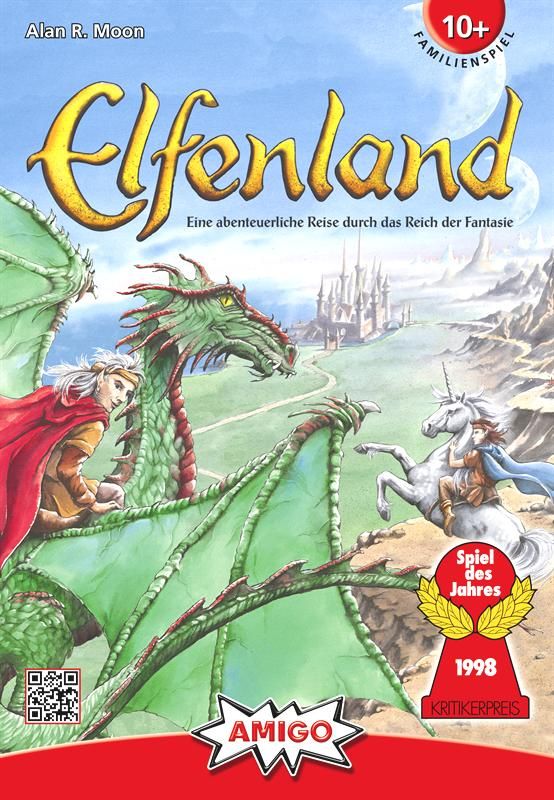
The Elven king is dead, and players are competing to become the next king. This game is similar in nature to Elfenroads/Elfenland in that players try to visit as many cities as possible using optimal transportation cards; what's different is that the lay of the land is also dictated by card play. Other players may interfere with your journey through the use of thieves, obstacles, and sea serpents.

Qué sensaciones ofrece

Hand Management Income Open Drafting Investment Point to Point Movement Travel Card Game Fantasy

Explora estas mecánicas en Cardboard

Crea un prototipo original con patrones de diseño reutilizables, no con el contenido de este juego.

Abrir el taller de mecánicas

Inteligencia del juego

Aprende el juego

100% de cobertura de conocimiento

Preparación

1. Shuffle the full 120-card deck.\n2. Deal 10 cards to each player.\n3. Give each player 12 gold as their starting treasury.\n4. Determine the first player (the player who holds or receives the dragon marker goes first).\n5. Play proceeds through a number of rounds equal to the number of players, up to a maximum of 5 rounds.

Flujo del turno

Each round consists of two phases for each player: Planning and Journeying.\n\nPLANNING PHASE – On their turn, a player must take exactly one of the following actions:\n • Play 1–2 village cards to the table (or up to 3 if there are only 2 players).\n • Declare "No Village Card!" (opting out of placing villages).\n • Draw 3 cards, then discard 4 cards from their hand.\n • Buy a card.\n • Play a Gold, Thief, Tree, or Monster card.\n • Remove a village card from the table (for a price).\n • Pass.\n\nJOURNEYING PHASE – After all players have completed their Planning actions, each player journeys:\n • Start at your own first village and travel to the left.\n • Collect gold for each village visited along the route.\n • Special cards (Tree, Monster) grant extra moves.\n • A Gold card doubles gold collected.\n • Visiting all villages earns 10 extra gold.\n • Pay 2 gold to the owner when landing on a Thief.\n • An Escort card protects you in one realm.\n\nENDING A ROUND:\n • Remove all cards from the table.\n • Shuffle used cards back together with the remaining deck.\n • Deal 8 new cards to each player.\n • Pass the dragon marker (first player token) to the next player.\n • Repeat for a total number of rounds equal to the number of players (maximum 5 rounds).

Puntuación y victoria

The player with the most gold at the end of the final round wins. Fuentes de puntuación: Gold collected per village visited during each Journeying phase (amount varies by village type: Lake=7, Desert=6, Mountains=5, Forest=4, Plains=3, River=2), Double gold from playing a Gold card during Planning, 10 bonus gold for visiting all villages in a single journey, Starting gold of 12 (maintained across rounds unless spent)

Fuente: Rulebook

Reglas que debes conocer

Las reglas más útiles para jugar bien la primera partida.

Setup

Each player starts with 10 cards.

During preparation, deal 10 cards from the shuffled deck to each player. This is the starting hand size, which differs from the 8 cards dealt at the start of subsequent rounds.

Setup

Each player starts with 12 gold.

During preparation, give each player 12 gold coins (or tokens) as their starting treasury. Gold is the primary currency and victory resource of the game.

Setup

Play one round per player, with a maximum of 5 rounds.

The total number of rounds played equals the number of players in the game, to a maximum of 5. For example, a 3-player game lasts 3 rounds; a 5-player game lasts 5 rounds.

Card play

A player may play up to 2 village cards during Planning (3 in a 2-player game).

During the Planning phase, one valid action is to play village cards to the table. In games with 3 or more players, a player may play a maximum of 2 village cards. In a 2-player game, a player may play a maximum of 3 village cards. Village cards form the route that players travel during the Journeying phase.

Turn structure

A player may declare 'No Village Card!' to skip playing villages.

If a player does not wish to play any village cards during their Planning phase, they may declare 'No Village Card!' as their action. This is a distinct, explicit action and counts as that player's Planning action for the round.

Drawing

A player may draw 3 cards, then must discard 4 cards.

As a Planning action, a player draws 3 cards from the deck, adding them to their hand, and then discards 4 cards from their hand (net loss of 1 card). This allows hand refinement at the cost of one card.

Card play

A player may buy a card as their Planning action.

During the Planning phase, one valid action is to buy a card. The specific cost and source of bought cards are governed by the card acquisition rules. Buying a card counts as the player's entire Planning action for the round.

Card play

A player may play a Gold, Thief, Tree, or Monster card during Planning.

As a Planning action, a player may play one of the following special card types to the table: Gold, Thief, Tree, or Monster card. These cards have effects that trigger during the Journeying phase. Playing one of these cards is the player's entire Planning action for the round.

Informe estratégico

Maximizing the All-Villages Bonus

The 10-gold all-villages bonus is one of the largest single gold gains in the game. Prioritize playing Tree and/or Monster cards during Planning to gain extra moves, increasing your chances of reaching every village. In a 2-player game, also leverage the higher village-play limit (3 cards) to control more of the route.

Gold Card Timing

The Gold card doubles all gold collected from villages visited. Use it in rounds where many high-value villages (Lake=7, Desert=6, Mountains=5) are on the table and when you have extra-move cards to visit more villages. The doubling effect stacks multiplicatively with the number and value of villages visited.

Thief Placement as Taxation

Playing a Thief card forces opponents who journey through that location to pay you 2 gold. Placing it in a high-traffic position—ideally on a route opponents cannot avoid—generates passive income across multiple journeys.

Hand Management via Draw-Discard

The draw-3-discard-4 action costs you a net card but can dramatically improve hand quality. Use it when your hand lacks key cards (village types, Gold, or movement cards) heading into a pivotal round. Remember your hand drops to 8 cards each round, so card efficiency matters.

Village Card Value Selection

High-value village cards (Lake at 7, Desert at 6) are scarce (only 2 and 3 copies respectively), making them disproportionately powerful to play and journey through. Prioritize holding and playing these when combined with a Gold card for maximum returns.

Escort as Insurance

The Escort card protects against one realm's hazard (most notably Thieves). In rounds where multiple Thief cards are on the table, an Escort can save you 2+ gold and is worth playing before your journey to protect against the most costly toll.

Preguntas frecuentes y casos límite

A player plays a Gold card and also visits all villages. Do they get double gold AND the 10-gold bonus?

Yes. The Gold card doubles all gold collected from villages visited, and the 10 bonus gold for visiting all villages is awarded separately and in addition to the doubled gold.

A player visits a Thief card but has an Escort card played. Do they still pay 2 gold?

No. The Escort card protects the journeying player in one realm, which includes protection from the Thief's 2-gold toll. Once the Escort's protection is used for that realm, it is spent.

Can a player use Tree or Monster extra-move cards to reach all villages and claim the 10-gold bonus?

Yes. Extra move cards (Tree, Monster/Sea Monster) extend the journey by additional steps. If using these extra moves allows the player to visit every village on the table, they qualify for the 10-gold bonus.

How many cards does a player receive at the start of round 2 onward compared to round 1?

Players start round 1 with 10 cards (dealt during setup). At the end of each round, only 8 new cards are dealt for the next round. So from round 2 onward, players begin with 8 cards, not 10.

In a 2-player game, how many village cards can a player place during Planning?

In a 2-player game, a player may play up to 3 village cards during their Planning phase, compared to the standard maximum of 2 for games with 3 or more players.

If I choose to draw 3 cards and discard 4, what is the net change to my hand size?

Drawing 3 and discarding 4 results in a net loss of 1 card from your hand. This action refines your hand at the cost of one card overall.

Pregunta Sobre Este Juego

Juegos similares