1996 Puesto n.º 13318 en BGG

Luftschiff

1–2 jugadores 60 min A partir de 12 años 3.4/5 de complejidad 5.5/10 de valoración

Acerca de este juego

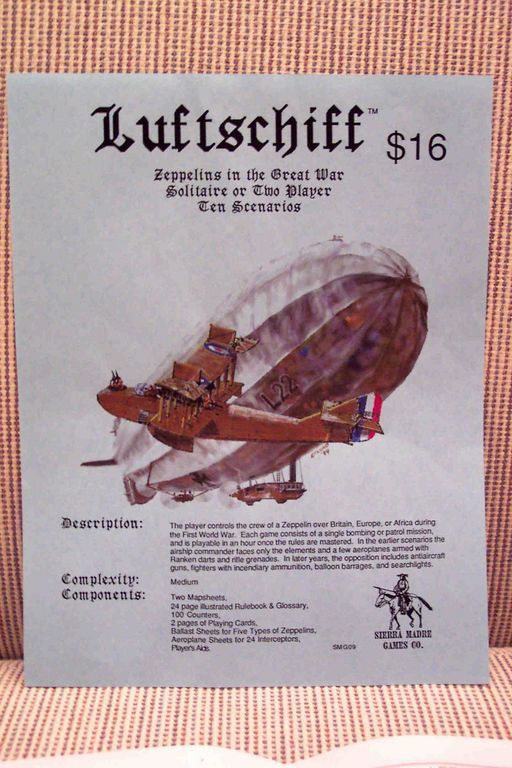
Solitaire game of German Zeppelin operations in WWI that plays like a really sophisticated side-scrolling arcade game. The board shows a side view of the airspace over war-torn Europe (or in one scenario, Africa). The counter representing your Zeppelin remains in a central "Zeppelin corridor," or column, shifting up or down as it gains and loses altitude; forward movement is marked by moving every other card and counter on the board left or right relative to your Zepp. A typical scenario has you playing through 30 randomly dealt "Situation Cards," which represent enemy units, weather conditions, and the odd mountain encountered on the way to and from your primary target. The first 10 cards represent the trip out; the second 10, time over the target area; and the final 10, the trip home, by which point you will likely be damaged and running low on ballast and gas. A separate "ballast sheet," or Zeppelin schematic, is used to keep track of the condition of your craft and crew. Five different Zeppelin models are provided, from the Type M converted passenger liner to the mammoth Type X "war Zeppelin." The game's components are a step above desktop publishing quality; cards and counters must be cut apart before play. The game provides ten scenarios, plus a campaign game and variant rules for two players. An expansion set, featuring Riesenflugzeugabteilungen oversized bomber planes in place of Zeppelins, is also available. A second expansion set ZRCV which introduces US airships in the pacific as well. Sierra Madre Games combind Luftschiff and ZRCV into a single game called Airships at War 1914-1941 as a 2nd edition of the game in 2005. A 3rd edition of the game is published by Sonic Quill Publications and is currently available for sale as of 2023 from rjwargames.com. Expanded by Riesenflugzeugabteilungen Airships at War 1914-1941

Qué sensaciones ofrece

Simulation Grid Movement Solo / Solitaire Game Dice Rolling Events Scenario / Mission / Campaign Game World War I Wargame Aviation / Flight Airships / Blimps / Dirigibles / Zeppelins Weather

Explora estas mecánicas en Cardboard

Crea un prototipo original con patrones de diseño reutilizables, no con el contenido de este juego.

Abrir el taller de mecánicas

Inteligencia del juego

Aprende el juego

60% de cobertura de conocimiento

Preparación

1. Set up the Situation card deck according to the scenario: begin with 10 Maritime (Day) cards, then shuffle all cards together with 10 Hostile (Night) cards, followed by 10 Maritime (Day) cards as specified by the scenario.\n2. Place the Zeppelin board with all sections (Control Car, Gas Cells, Engine sections, Keel, Stabiliser, etc.) laid out.\n3. Assign crew tokens to their starting sections.\n4. Place Ballast Coins, Petrol Coins, and Equipment tokens in their designated starting sections.\n5. Set the Air Speed counter and Inertia marker to their starting values.\n6. Set the Elevator position as required by the scenario.\n7. Place any Dynamo/Wireless counters and Spares tokens as specified.\n8. Shuffle and prepare Enemy Aircraft cards if applicable to the scenario.

Flujo del turno

Each turn, players manage their zeppelin through the following phases:\n1. **Weather & Situation Cards**: Draw Situation Cards (1 or on a d6 roll depending on conditions) and resolve any weather effects in play.\n2. **Movement**: Calculate Air Speed from available engine horsepower, apply Wind Card modifiers to final movement, and resolve Elevator/Inertia for vertical movement.\n3. **Crew Actions**: Each crew member may perform one action (move, operate controls, repair, fire weapons, etc.) per turn.\n4. **Combat**: Resolve any weapon fire (machine guns, bombs, flares) and enemy attacks (aircraft, flak).\n5. **Damage Resolution**: Roll dice and apply damage effects to gas cells, engines, crew, and controls as needed.\n6. **Enemy Aircraft**: Move and act according to their rules (fuel, speed, maneuvers, firing).\n7. **End of Turn**: Check for ongoing effects (cell leakage, dynamo failure, crew disruption, etc.) and advance any counters.

Puntuación y victoria

false

Fuente: Rulebook

Reglas que debes conocer

Las reglas más útiles para jugar bien la primera partida.

Movement

Air Speed is determined by the total Horsepower of available (running) engines.

The Zeppelin's Air Speed is based on the combined Horsepower of all currently active and undamaged engines. Wind Cards in play do not affect the Air Speed counter itself; they only modify the final movement distance or direction at the point of resolution. Running Silent sets Horsepower to 0, meaning the Zeppelin has no engine-driven movement.

Movement

Running Silent sets the Zeppelin's Horsepower to 0 for movement purposes.

When the Zeppelin is Running Silent, all engines are considered to produce 0 Horsepower, resulting in no engine-driven Air Speed. Wind Cards may still affect final movement. Running Silent also reduces the Situation Card draw threshold: in Hostile Night conditions, Running Silent causes a card to be drawn only on a roll of 1 (instead of 1–2).

Movement

Wind Cards modify the Zeppelin's final movement but do not change the Air Speed counter.

Wind Cards currently in play affect the Zeppelin's final movement distance or direction at the time of movement resolution. They do not alter the Air Speed counter, which is set solely by engine Horsepower. The net movement is the combination of Air Speed and the Wind Card effect.

Movement

The Elevator changes the Zeppelin's lift when Air Speed is 2 or greater.

The Elevator position contributes to the Zeppelin's lift (vertical movement), but only when the current Air Speed is 2 or higher. At Air Speeds below 2, the Elevator has no effect on lift.

Movement

Static Lift is the base lift value, affected by ballast, petrol, equipment weight, crew position, and pressure/altitude.

Static Lift represents the Zeppelin's inherent buoyancy and is modified by: (1) Ballast Coins — dropping ballast increases lift; (2) Petrol Coins — petrol adds weight, reducing lift; (3) Equipment weight — every token removed grants 1 step of static lift; crew, equipment, petrol, and spares tokens may only be dropped (jettisoned) after the Zeppelin has been damaged for the first time; Breeches may be dropped at any time without a crew action; (4) Crew position — moving a crew member between sections changes static lift by 1 step; (5) Altitude/pressure changes — crossing valve barriers permanently reduces lift in those sections.

Movement

The Inertia marker moves 2 spaces toward Total Lift each turn; the Zeppelin's vertical movement is based on the Inertia marker position.

Each turn, the Inertia marker moves 2 spaces toward the current Total Lift value. The Zeppelin then moves up or down based on where the Inertia marker sits, not the Total Lift directly. This creates a lag in altitude changes, reflecting realistic airship inertia.

Movement

Crossing valve barriers at altitude permanently reduces lift in those sections.

When the Zeppelin crosses altitude valve barriers, gas is vented from the corresponding cells. This permanently reduces the lift contributed by those sections. The reduction cannot be reversed by normal repair actions.

Special

Breeches can be dropped at any time without requiring a crew action.

Unlike other equipment tokens, Breeches may be dropped at any point during the game without expending a crew action. Each Breeches token dropped contributes 1 step of static lift. This is an exception to the general rule that jettisoning equipment requires the Zeppelin to have been damaged first.

Pregunta Sobre Este Juego

Juegos similares