2010 Puesto n.º 14984 en BGG

Mini FITS

1–4 jugadores 15 min A partir de 8 años 1.2/5 de complejidad 5.5/10 de valoración

Acerca de este juego

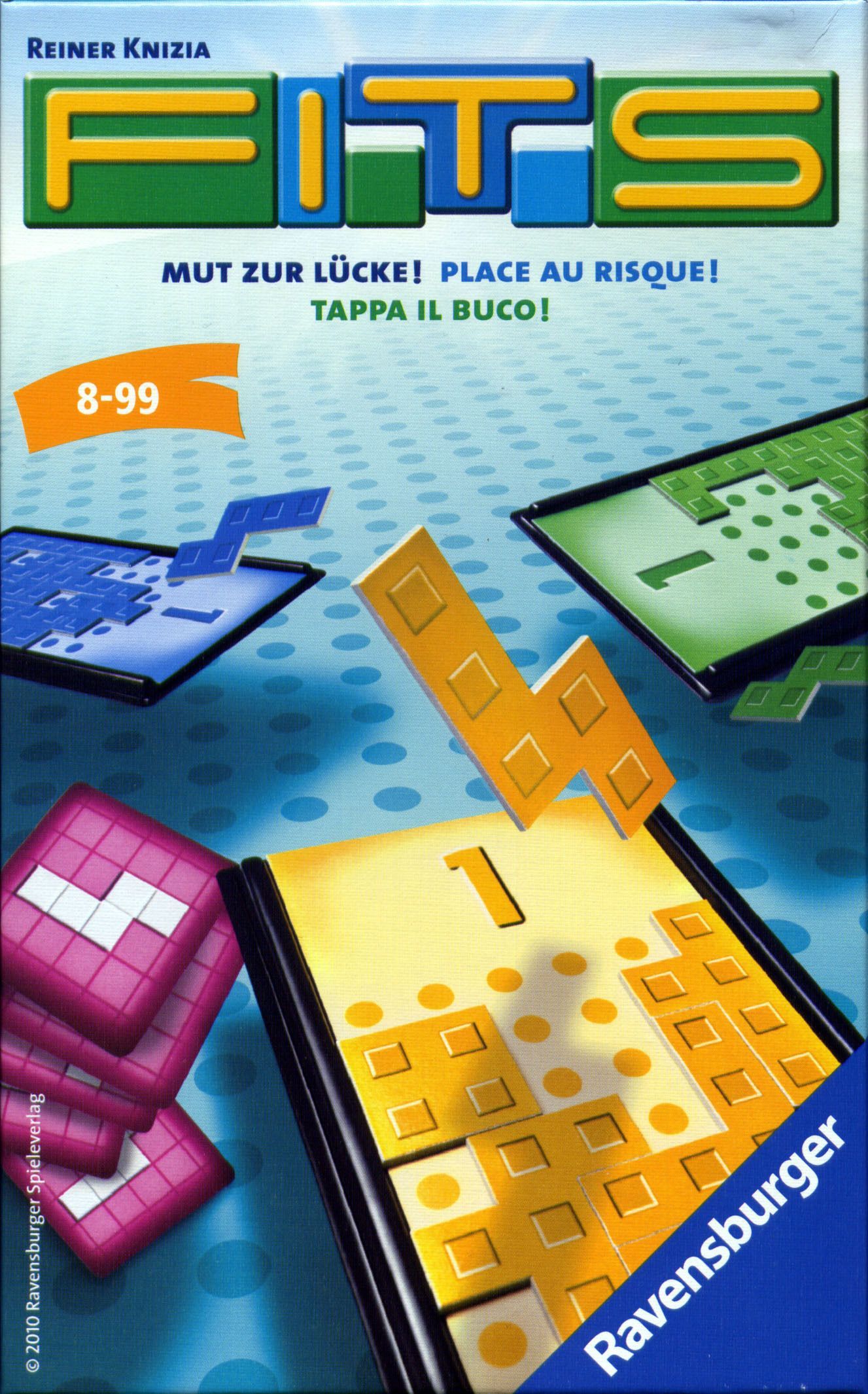
Travel or Mini FITS is a smaller version of FITS. The differences are: There are only 52 cardboard vs 64 plastic game tiles There are only 13 vs 16 building cards There are only 4 vs 8 game boards printed on both sides The 2nd board allows players to score bonus points if three of the same symbols are exposed. The height of the board is 10 vs 12 rows. There are no ramps or plastic covers just a place to mount the game boards. The box is so much smaller. Other than those differences, the gameplay is the same as in FITS. Each player has a board on which they place different polyominoes, with three, four, or five squares. Cards are drawn from a pile to tell the players which piece to take. But as every player has a different start tile to place first, the players will need different tactics to maximize their points. The pieces may be rotated and reversed before they slide down the board. Scoring is based on quantity and configuration of squares left uncovered. Reimplements: FITS

Qué sensaciones ofrece

Pattern Building Abstract Strategy Puzzle

Explora estas mecánicas en Cardboard

Crea un prototipo original con patrones de diseño reutilizables, no con el contenido de este juego.

Abrir el taller de mecánicas

Inteligencia del juego

Aprende el juego

100% de cobertura de conocimiento

Preparación

1. Carefully remove all elements from the pre-cut plates. 2. Each player receives one plastic frame, all pieces of their chosen color, and the corresponding board. With 1–3 players, unused material is returned to the box. 3. Separate the 4 purple (starting) cards from the 13 pink (piece) cards. Shuffle each deck independently and place both face-down in the center of the table. 4. Prepare a sheet of paper and a pencil for scorekeeping. 5. Each player inserts the board marked "1" (side 1) into their open plastic frame at the top. 6. Each player chooses one of the four purple starting cards and keeps it face-up in front of them for the entire round. Place the piece shown on that starting card onto your tray as your first piece.

Flujo del turno

The game is played in two rounds. Each round proceeds as follows: (1) Each player selects a starting card and places the indicated piece on their board. (2) The top card of the pink piece deck is flipped face-up. All players simultaneously take the matching piece from their reserve and place it on their board by sliding it down from the top. (3) Players choose which column to drop their piece into and may rotate it in any direction (up to 8 orientations) before placement. The piece slides down until it hits the bottom edge or is blocked by an already-placed piece. (4) A player who cannot or does not want to place a piece may set it aside (skip it); there is no penalty, but each piece appears only once per round so skipped pieces are lost. (5) The used card is placed on a discard pile and the next card is revealed. This continues until the pink piece deck is exhausted, ending the round. After Round 1, scores are recorded, boards are flipped to side 2, all cards are reshuffled, and Round 2 begins under the same procedure with additional scoring rules for symbols.

Puntuación y victoria

After two rounds, each player totals their points from Round 1 and Round 2. The player with the highest combined total wins. Puntuación objetivo: 19 Fuentes de puntuación: Round 1: 1 point per complete row (no holes), maximum 10 points, Round 2: 1 point per complete row (no holes), maximum 10 points, Round 2 bonus: 3 points for each set of 3 visible symbol boxes of the same color, maximum 9 bonus points

Fuente: Rulebook

Reglas que debes conocer

Las reglas más útiles para jugar bien la primera partida.

Setup

Each player receives a plastic frame, all pieces of their chosen color, and the matching board.

Before the game, carefully remove all elements from the pre-cut plates. Each player receives one plastic frame, a full set of pieces in their chosen color, and the corresponding board insert. With 1 to 3 players, any unused player materials are returned to the box.

Setup

Shuffle the 4 purple starting cards and 13 pink piece cards into two separate face-down decks.

There are two separate card decks: 4 purple starting cards and 13 pink piece cards. These must be shuffled separately and placed face-down in the center of the table. They are never mixed together. Also prepare a sheet of paper and pencil to track scores.

Setup

For Round 1, insert the board marked '1' into your plastic frame at the top.

At the start of Round 1, each player inserts the board side marked '1' into their open plastic frame, inserting it from the top. This board does not have symbol boxes and is used for Round 1 only.

Setup

Each player selects one of the four purple starting cards and places the indicated piece as their first piece.

At the beginning of each round, each player chooses one of the four purple starting cards. This card remains face-up in front of the player for the entire round. The player immediately places the piece depicted on the starting card onto their tray as their first piece, following the same placement rules as all other pieces.

Turn structure

After the starting piece is placed, flip the top pink piece card; all players place that piece.

Once all players have placed their starting piece, the top card of the pink piece deck is flipped face-up. All players simultaneously take the matching piece from their personal reserve and place it on their board. The flipped card is then placed on a discard pile. This process repeats until the pink piece deck is empty.

Movement

Each player is free to choose any column on their board to drop a piece into.

When placing a piece, a player may choose any column on their board. There is no restriction on which column must be used. The choice is entirely up to the individual player.

Movement

A piece may be rotated in any direction before placement, offering up to 8 orientations.

Before dropping a piece, a player may rotate it in any direction. Each piece offers up to 8 possible orientations (4 rotations × 2 flips). The player chooses the orientation before sliding the piece down.

Movement

Pieces are placed at the top of the board and slid straight down; no lateral movement during descent.

To place a piece, position it at the top of the board above the chosen column and slide it straight down. It is forbidden to move or rotate the piece left or right into a different column once it has begun descending. The piece comes to rest when it reaches the bottom edge of the board or is blocked by an already-placed piece.

Informe estratégico

When to skip a piece

Skipping a piece is a legitimate and often correct tactical choice. Because complete rows are the primary scoring mechanism (1 point each, max 10), a piece that would create multiple holes in multiple rows can cost more in lost line points than it contributes. Since each piece only appears once per round and cannot be retrieved after skipping, evaluate whether placement actually helps more rows than it harms before committing.

Starting card selection

Your starting card choice dictates the first piece on your board and removes that piece type from the pink deck for you (any matching pink card is discarded). Choose a starting piece that fits easily into your opening strategy and consider that the pink deck has 13 cards — losing one piece type due to a match could be a minor advantage or disadvantage depending on the piece shape.

Round 2 symbol strategy

In Round 2, the optimal score (19 points) requires both complete lines AND visible symbols. These goals are in direct tension: covering symbol boxes helps complete lines but destroys bonus potential. Focus on leaving 3 matching-color symbol boxes uncovered while still filling surrounding cells to complete as many rows as possible. Deliberately leave symbol boxes of the same color uncovered to maximize the 3-point bonus per matching set.

Rotation and column selection

Each piece has up to 8 orientations, giving significant flexibility. Always evaluate all rotations before committing to a column. Prioritizing placements that keep the board surface flat (minimizing irregular gaps) makes future pieces easier to place cleanly and increases the number of completable rows.

Avoiding inaccessible gaps

Since pieces can only enter the board from the top and must slide straight down, any enclosed gap becomes permanently unfillable. Prevent overhangs — where one piece juts over empty space below — as these create inaccessible holes that will prevent row completion for the rest of the round.

Preguntas frecuentes y casos límite

The pink piece card flipped this turn shows the same piece as one player's purple starting card. What happens?

That pink piece card is discarded without being played, and a new card is drawn from the top of the pink deck. This ensures no piece type is placed twice by the same player in the same round. Note: only the player whose starting card matches is affected; if another player has a different starting card, the same piece card is valid for them (but the card is discarded for everyone since all players must use the same card).

In Round 2, a row is fully covered except for one symbol box. Does the row score a point, and does the visible symbol count toward bonus points?

No, the row does not score a point — a complete line requires zero holes, and an uncovered symbol box counts as a hole in that row. However, that visible symbol box does count toward the end-of-round symbol bonus if 3 symbols of the same color are visible.

In Round 2, a player covers all 9 symbol boxes with pieces and completes all rows. How many points do they score?

They score 10 points for 10 complete lines, but 0 bonus points, since all symbol boxes are covered and none are visible. The maximum of 19 points is only achievable if rows are complete AND the right symbol boxes remain visible.

Should I always place a piece or sometimes skip it?

Placing a piece that creates many holes may prevent several rows from ever scoring. Since each piece appears only once per round, skipping wastes the piece but avoids creating permanent holes. The rules explicitly advise that skipping can be preferable when a piece would leave many holes. Players should weigh whether the piece can be placed without harming complete-line potential.

My board is nearly full and the piece I must place extends above the top edge. Is this allowed?

Yes. Pieces are not allowed to extend past the left or right edges, but they may overflow above the top edge of the grid. The piece is still considered legally placed as long as it does not protrude from the sides.

There is a gap in my board that is surrounded on all sides by pieces. Can I maneuver a new piece into it?

No. It is strictly forbidden to insert a piece into any hole or gap that is not accessible by sliding straight down from the top of the board. If a space cannot be reached from above, it cannot be filled. The only legal placement method is a straight downward slide from the top edge.

Pregunta Sobre Este Juego

Juegos similares