2004 Puesto n.º 11124 en BGG

Oceania

1–2 jugadores 10–30 min A partir de 10 años 1.5/5 de complejidad 5.6/10 de valoración

Acerca de este juego

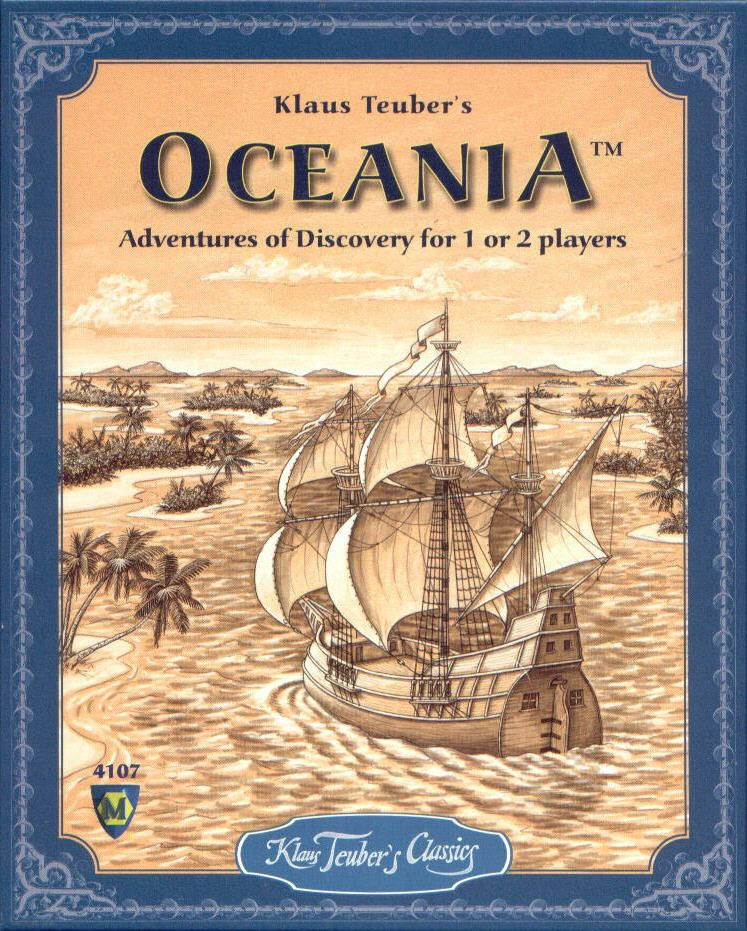
On your turn place an explorer ship on a circle field on one of the three sides of the game board and draw a sea tile. Place the tile if it fits, i.e. when water borders water and land borders land. Throughout game-play a fascinating seascape unfolds before your eyes. The size and arrangement of the islands on the board is different in each game! From the back of the box: Experience the adventure of exploring unknown islands! Each game presents new and unique challenges, for the board is different every time you play. In the 2-player variant, you and your opponent seek to claim the biggest islands in Oceania. The most successful explorer is the victor. Or you can be your own opponent in the solo variant. You will seek out larger, more valuable islands as the game challenges you to beat your own record score.

Qué sensaciones ofrece

Tile Placement Area Majority / Influence Exploration Nautical

Explora estas mecánicas en Cardboard

Crea un prototipo original con patrones de diseño reutilizables, no con el contenido de este juego.

Abrir el taller de mecánicas

Inteligencia del juego

Aprende el juego

100% de cobertura de conocimiento

Preparación

1. Remove the 4 all-water reserve tiles from the reserve tile pool and set them aside (they are still available for filling surrounded areas, but not drawn during normal scout exploration).\n2. Shuffle all remaining reserve tiles together and arrange them into face-down stacks.\n3. Shuffle all sea tiles together and arrange them into separate face-down stacks.\n4. Set up the board and any starting tiles per the base game rules.\n5. Each player begins with their scouts available to place on islands as normal play progresses.

Flujo del turno

On your turn you may either (A) explore with your ship by following water paths to place a sea tile, or (B) explore with a scout currently on an island by drawing a reserve tile and placing it on an adjacent land-connected space. You may also play any tile (sea or reserve) from your personal hand/display at any time during exploration without penalty. If a drawn tile cannot legally be placed, it goes in front of you (your hand/display) and your turn ends. The game ends when no further exploration is possible by either ship or scout.

Puntuación y victoria

Islands are scored at game end based on completeness and size per base game rules. Islands connected to the top border of the board are incomplete and score zero. Fuentes de puntuación: Completed islands (per base game scoring rules), Reserve tile placement combos (indirect scoring benefit)

Fuente: Rulebook

Reglas que debes conocer

Las reglas más útiles para jugar bien la primera partida.

Setup

Remove the 4 all-water reserve tiles before shuffling reserve stacks.

Before the game begins, find the 4 reserve tiles that contain only water and set them aside separately. Do NOT shuffle these into the regular reserve tile stacks. They are kept available exclusively for filling surrounded areas later in the game.

Setup

Shuffle sea tiles and reserve tiles into separate face-down stacks.

All sea tiles are shuffled together and formed into face-down stacks. All reserve tiles (minus the 4 all-water tiles set aside) are shuffled together into separate face-down stacks. Sea tiles and reserve tiles are never mixed into the same stack.

Special

An area is surrounded if it has 1 empty space enclosed by tiles or board edges.

A surrounded area is created (Condition A) when exactly 1 empty space on the board is completely enclosed by already-placed tiles or by any side of the board. When this condition is met, the gap may be filled with a reserve tile of the active player's choice.

Special

An area is surrounded if all of its land-accessible sides are blocked by tiles (no dotted-line ship access).

A surrounded area is also created (Condition B) when an empty region is enclosed by tiles on all sides that feature land connections, meaning there is no dotted-line water path through which a ship could reach the empty space. The only way to place a tile in such a region is with reserve tiles, not ship exploration.

Special

When an area is surrounded, fill it from reserve tiles including the all-water tiles.

When a surrounded area is identified (via Condition A or B), any player may look through all reserve tiles — including the 4 all-water tiles set aside during setup — pick the tile(s) needed to fill the gap, and then shuffle the remaining tiles face-down again. The player filling the area chooses which reserve tile to use, allowing for tactical placement.

Turn structure

Instead of exploring by ship, a player may explore with a scout on an island by drawing a reserve tile.

On your turn, as an alternative to ship exploration, you may choose to explore with one of your scouts that is currently placed on an island. Scout exploration targets adjacent tiles connected to the scout's current island by land (not water). When you explore with a scout, you draw 1 reserve tile (from the face-down reserve stacks). You may only perform 1 exploration per turn (either ship or scout, not both). You cannot place additional scouts during the same turn in which you perform scout exploration.

Turn structure

If a scout-drawn tile cannot be placed, it goes in front of the player and the turn ends.

When exploring with a scout, if the drawn reserve tile cannot legally be placed in the target adjacent space, the tile is placed face-up in front of the player (added to their personal hand/display). The player's turn then ends immediately. No penalty is incurred.

Restriction

Scouts cannot cross water; they only explore land-connected adjacent tiles.

Scouts explore by land connection only. If a placed tile is split into 2 separate small islands (i.e., the land areas are divided by water on the tile), the scout can only explore the side of the tile on which it is currently placed. A scout may not cross water to reach a separate land mass, even on the same tile.

Informe estratégico

Prioritize scout combos to control reserve tile placement

Scout exploration combined with deliberately closing off surrounded areas lets you hand-pick which reserve tile fills the gap. Since you can look through all reserve tiles (including all-water tiles) when filling a surrounded area, engineering these combos gives you direct control over the board landscape rather than relying on random draws.

Bank tiles in your display for flexible deployment

Tiles drawn from exploration that can't be immediately placed go into your personal display. Since playing from your display is free (no scout cost, no penalty), stocking useful tiles is a strategic advantage. Intentionally drawing from scouts in low-priority areas can help you stockpile tiles for high-value placements later.

Use the top border as an offensive weapon

Connecting a rival's large, nearly complete island to the top border of the board renders it incomplete and worthless (zero points). This take-that move is most powerful late in the game when opponents have invested heavily in a single large island.

Control water path connectivity to lock out ship exploration

Since scouts rely on land connections and ships rely on water paths leading to the board's 3 sides, disrupting the water network (e.g., via reserve tiles that terminate or redirect paths) can prevent opponents from reaching certain areas by ship, funneling them toward less efficient scout exploration.

Manage scouts carefully — don't overcommit to scout exploration

Scout exploration prevents you from placing new scouts on the same turn. Since scouts are needed to maintain land-exploration reach, balance turns between placing scouts to expand your network and using existing scouts to draw reserve tiles.

Preguntas frecuentes y casos límite

A player uses scout exploration and places a reserve tile that contains a water path. Can they immediately place their ship on this new tile?

No. The ship may only be placed on the new reserve tile if its water path is directly connected to the existing water path network that leads to at least one of the 3 sides of the board. If the water segment is isolated or not connected to the main network, the ship cannot be placed there.

A scout is on a tile that contains two separate land areas divided by water. Can the scout explore from either side?

No. The scout can only explore from the specific land area (island side) on which it is currently placed. It cannot cross the water on the tile to reach the other land area.

A player chooses to explore with a scout but wants to use a tile from their personal display instead of drawing from the reserve stack. Is this allowed?

Yes. When exploring by scout (or ship), a player may play any tile — sea or reserve — from their personal display. There is no penalty for doing so, and no scout is lost.

A surrounded area needs an all-water tile to fill it. Can the player use one of the 4 all-water reserve tiles set aside during setup?

Yes. When filling a surrounded area, the player may look through all reserve tiles including the 4 all-water tiles set aside at setup. They pick the needed tile and shuffle the rest back face-down.

A scout places a tile that causes an adjacent area to become surrounded. Can the player immediately fill that surrounded area?

Yes. This is an intentional combo. When scout exploration closes off an area (triggering surrounding Condition A or B), the player may immediately look through the reserve tiles (including all-water tiles) and fill the gap with a tile of their choice.

Can a player deliberately connect an opponent's large island to the top border of the board to prevent it from scoring?

Yes. This is explicitly permitted. Any island that touches the top border of the board is considered incomplete and scores zero, regardless of its size or who built it. Connecting an opponent's island to the top border is a legal and intentional offensive strategy.

A player explores with a scout. Can they also place new scouts on the same turn?

No. When you perform scout exploration, you cannot place any scouts during that same turn. Scout placement and scout exploration are mutually exclusive actions within a single turn.

Pregunta Sobre Este Juego

Juegos similares