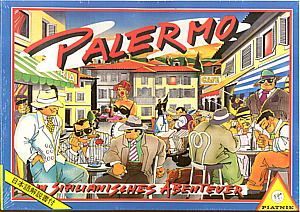
1992 Puesto n.º 21302 en BGG

Palermo

3–5 jugadores 60 min A partir de 10 años 1.9/5 de complejidad 5.5/10 de valoración

Acerca de este juego

This game is divided into two sub-games. The first part has players laying out street/business tiles. Each tile has one business on it and a colored chip corresponding to the player who placed it. Once the board is filled, play moves to the next stage. Each player has a pawn next to the fountain at the center of the board. The object is to visit each of the businesses that you laid out in the first phase. Each successive business you visit gives you more movement points, but the real goal of the game is to score the most points. Points are scored by forgoing remaining movement when you arrive at your businesses. In addition to a scoring pawn, players are each given a police token which can be used to hamper other players' movements. Players who have completed their circuit wait at the fountain until all players have finished, but finishing quickly gives you a point bonus for each turn you wait.

Qué sensaciones ofrece

Tile Placement City Building Mafia

Explora estas mecánicas en Cardboard

Crea un prototipo original con patrones de diseño reutilizables, no con el contenido de este juego.

Abrir el taller de mecánicas

Inteligencia del juego

Aprende el juego

100% de cobertura de conocimiento

Preparación

1. Place the game board in the center of the table and distribute city tiles around the table. 2. Each player selects a color and takes the pawn, police stone, scoring marker, turn-movement card, and chips in that color. 3. Distribute chips based on player count: 11 chips each (3 players), 8 chips each (4 players), 7 chips each (5 players). Set unused chips aside — they are out of the game. 4. Phase 1 (Building the city) begins: the youngest player goes first and places the Start/Finish tile on any board space, then lays a house tile and marks its business circle(s) with chip(s) of their color. 5. Players continue clockwise, each taking turns laying house tiles and marking businesses until all chips are placed. 6. Fill remaining empty board spaces with street tiles: 2 spaces with 3 players, 3 spaces with 4 players, 0 spaces with 5 players. 7. Phase 2 setup: Place all scoring markers on the Start space of the scoring track. All pawns begin on the Start/Finish tile; each player chooses which space on the Start/Finish tile to begin their first turn from.

Flujo del turno

Each turn has two parts, in order: PART 1 — POLICE STONE (optional move): The active player may move their police stone to any unoccupied street space (no other pawns or police stones present, and not adjacent orthogonally to another police stone). They must do this before moving their pawn. If they forget, the police stone stays put. PART 2 — PAWN MOVEMENT: The player consults their turn-movement card to determine their available movement points (starts at 3, increases by 1 for each chip collected so far). They move their pawn one street space per point, horizontally or vertically (not diagonally). All movement points must be used unless the pawn stops at one of the player's own business doorways. Bypass streets offer accelerated travel (see bypass street rules). Crossing opponent police stones costs 1 movement point each. Collecting income: when the pawn stops at one of its own business doorways, the chip is removed from the board and placed on the next free space of the turn-movement card. The player scores points equal to their remaining unused movement points for that turn.

Puntuación y victoria

The player with the highest score on the scoring track at the end of the game wins. Fuentes de puntuación: Income from businesses: score points equal to unused movement points when stopping at an owned business doorway, Returning to Start/Finish tile: score points equal to unused movement points when arriving at the finish, Bonus points per round waited after finishing: 5 pts/round (3 players), 4 pts/round (4 players), 3 pts/round (5 players)

Fuente: Rulebook

Reglas que debes conocer

Las reglas más útiles para jugar bien la primera partida.

Setup

Phase 1 is the city-building phase where players take turns laying house tiles and marking businesses with chips.

Phase 1 is called 'Building the City.' The youngest player goes first. On each turn, a player lays one city tile on the board and places chips of their color on the white business circles of that tile. Players take turns clockwise until all chips have been placed on the board. Each player freely chooses which type of house tile to lay — tiles with one, two, or three roof sections are all valid choices.

Building

A new house tile must join an already-placed tile to form an intact building; diagonal roof joins are not permitted.

When laying a house tile, a player must place it so that it joins an already-laid house tile and becomes part of an intact, contiguous building. Roofs must connect orthogonally (horizontally or vertically). Diagonal joining of roofs is explicitly not permitted.

Building

If no valid joining space exists, the player may place the tile on any free board space.

If it is impossible to fulfill the joining rule (for example, when no free spaces adjacent to existing tiles are available), the player may lay the tile on any free space on the board.

Building

Each business entrance must remain accessible from the street; entrances cannot be sealed off by roofs.

Every house entrance (represented by the white circle / chip position above the doorway) must be accessible from adjacent street spaces. A tile may not be placed in a way that seals off any entrance from street access.

Setup

After all chips are placed, remaining empty board spaces are filled with street tiles based on player count.

Once all players have placed all their chips, any remaining empty spaces on the board are filled with street tiles as follows: 2 empty spaces are filled with 3 players; 3 empty spaces are filled with 4 players; no empty spaces remain with 5 players (the board is completely filled by house tiles).

Turn structure

Phase 2 is the income-collection phase where players move pawns through the city, collect chips from their businesses, and score points.

Phase 2 is called 'Collecting Income.' Scoring markers are placed on the Start space of the scoring track and all pawns begin on the Start/Finish tile. On their turn, each player first optionally moves their police stone, then moves their pawn using their available movement points. The goal is to visit all of one's own businesses (collect all chips) and return to the Start/Finish tile.

Turn structure

Each player starts Phase 2 with 3 movement points per turn, gaining 1 additional point permanently for each business chip collected.

At the start of Phase 2, each player has 3 movement points available per turn. Each time a player collects a chip from one of their businesses, their movement point total increases by 1, permanently. This is tracked by placing collected chips on the turn-movement card. For example: after collecting 1 business, the player has 4 points/turn; after 2 businesses, 5 points/turn, and so on. The increased point total takes effect starting on the player's NEXT turn after collecting the chip.

Movement

A pawn moves one street space per point, horizontally or vertically only; all points must be used unless stopping at an owned business.

For each movement point, a pawn moves one street space horizontally or vertically. Diagonal movement is not permitted. A pawn must use ALL of its movement points on a turn UNLESS it stops at one of the player's own business doorways (to collect income). The pawn cannot voluntarily stop early for any other reason.

Informe estratégico

Efficiency of income collection

Since income scored equals leftover movement points when stopping at a business, it is most efficient to plan routes that arrive at businesses with as many points remaining as possible. A player who visits a business on the very last step scores 0 income from it — arriving with points to spare is always preferable.

Snowballing movement advantage

Movement points permanently increase with each chip collected. Players who visit businesses quickly early gain more points per turn, enabling them to reach further businesses faster. Prioritizing clustering businesses during Phase 1 (tile placement) creates shorter, more efficient routes in Phase 2.

Clustering businesses during Phase 1

Since you earn income based on leftover movement points, having businesses close together means you can chain visits quickly and accumulate extra points per turn sooner. Try to form compact neighborhoods with your tiles rather than spreading them across the board.

Strategic police stone placement

Police stones are most disruptive when placed on choke points — narrow street spaces opponents must pass through to reach their businesses. Since passing over a stone costs 1 point and landing on it costs 2 points (across two turns), well-placed stones can significantly slow opponents and reduce their income.

Bypass streets for fast travel

Jumping from corner to corner on bypass streets costs only 1 movement point per jump, making the perimeter a high-speed highway. If your businesses are spread out, routing through bypass streets rather than interior streets can save many points — leaving more points to score as income.

Finishing first bonus

Finishing before opponents earns bonus points each round while waiting (5/4/3 depending on player count). In a close game, being the first to finish and waiting through several rounds can yield a significant score advantage, making a fast-completion strategy viable even if individual income scores are lower.

Police stone as endgame interference

Even after finishing the game yourself, you may still move your police stone. This allows you to harass opponents who are still collecting chips, slowing them down and denying them income efficiency — while you continue collecting bonus waiting points.

Preguntas frecuentes y casos límite

A player uses all their movement points to arrive exactly at one of their businesses. Do they still benefit?

Yes. They collect the chip (removing it from the board and placing it on their turn-movement card), and their movement point total for future turns increases by 1. However, they score 0 income points for this visit, since no movement points were left over.

A player's pawn ends its turn on an opponent's police stone. What happens this turn and next turn?

The player pays a 1-point penalty on the current turn (for landing on the stone). At the start of their next turn, they pay another 1-point penalty. Additionally, the police stone is blocked — its owner cannot move it on their next turn. The pawn may land on a police stone even though pawns cannot normally share a space with other pawns.

A player has 2 movement points left and a police stone of a different color is exactly 2 spaces away. Can they land on it?

No. If the last movement point would place the pawn exactly on the opponent's police stone, the pawn must remain one space back. To intentionally land on an opponent's police stone, the pawn must reach it on the second-to-last point, with the last point consumed as the penalty.

A pawn is resting on top of a police stone. Can the police stone's owner move it?

No. If a pawn is resting on a police stone, that police stone cannot be moved by its owner until the pawn vacates the space.

A player has 5 movement points and doesn't want to visit any business this turn. Must they use all 5 points?

Yes. A pawn must use all of its movement points on a turn unless it stops at one of its own businesses. There is no other legal reason to stop early.

How many movement points does it cost to jump from one bypass street corner to the next?

Only 1 movement point, regardless of how many individual spaces lie between the two corners. This is what makes bypass streets efficient for traversal.

A player must use all their movement points but the only landing space is occupied by another pawn. What happens?

The pawn must remain back one space (it cannot end its move on a space already occupied by a pawn). The pawn may only stop early if it is stopping at one of its own businesses. If no valid final space is available, the pawn remains one space back.

A player has returned to the Start/Finish tile with all chips collected. Can they still affect the game?

Yes. A finished player may still move their police stone on each subsequent turn while waiting for opponents to finish. They also score bonus points for each round they wait (5/4/3 pts depending on player count).

A player collects a chip this turn. Do they get an extra movement point immediately on this same turn?

No. The increased movement point total takes effect starting on the player's NEXT turn. For the remainder of the current turn, the old point total applies.

Pregunta Sobre Este Juego

Juegos similares