2023 Puesto n.º 22909 en BGG

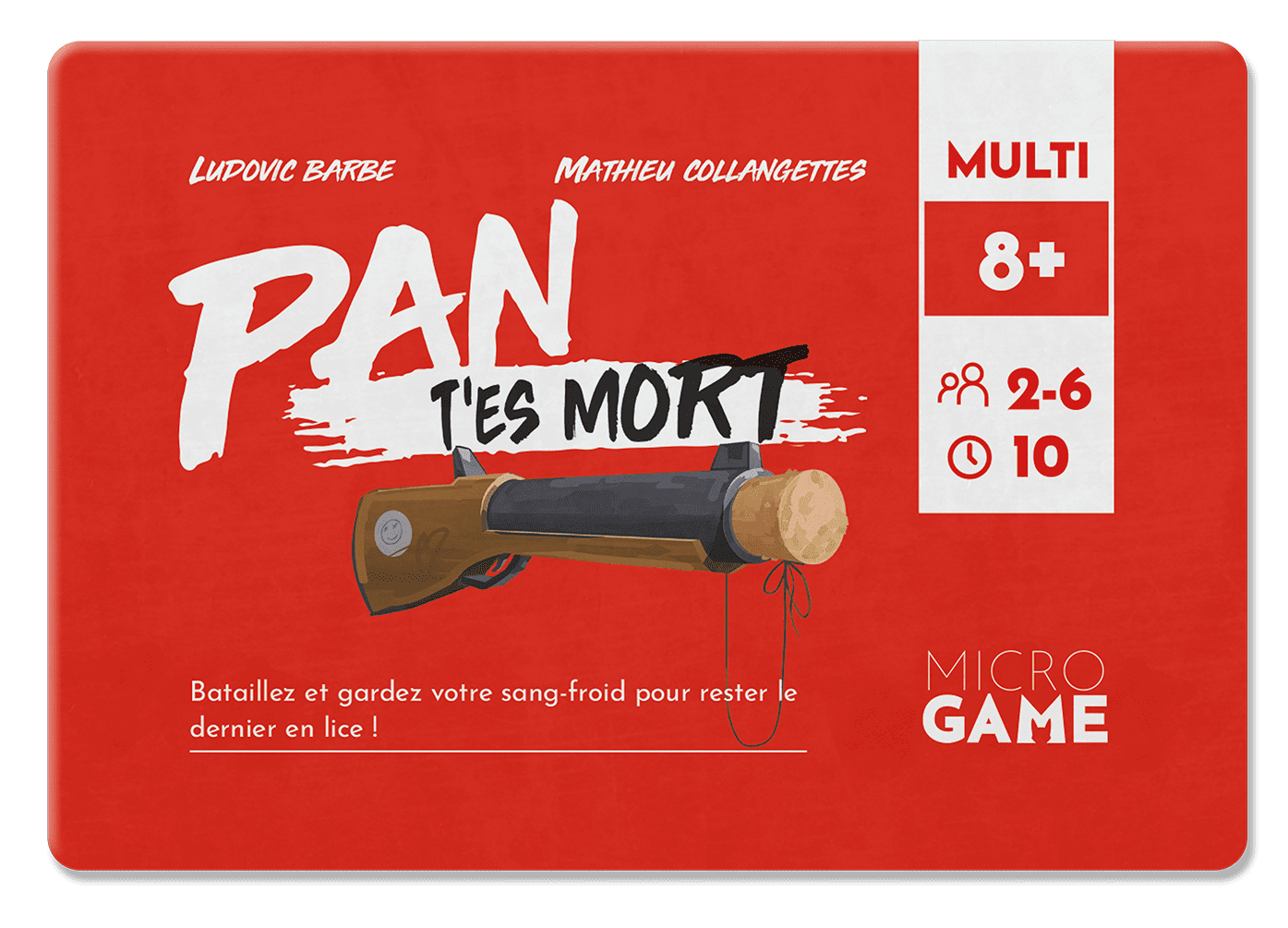
Pan T'es Mort

2–6 jugadores 10–15 min A partir de 10 años 1.0/5 de complejidad 5.5/10 de valoración

Acerca de este juego

The last shall be first... Make sure to be the last!!! Pan t'es Mort is back with a new edition, improved artworks and a new mechanism: The "double draw". The game is separated into two phases. Phase one is a trick-taking game with simultaneous card selection. First we check for ties. The tie numbers are gone and then the highest card wins. Cards are 1 to 6. Four times per card. If after the first check we have a 1 card and a 6, then the 1 card wins the trick. So now all keep the winning trick cards and we are ready for phase 2. Phase 2 is Russian roulette, a game of chance. We have 6 cards (bullet cards) in the middle of the table, as a revolver. 5 "Clic" cards and one with a bullet... On your turn (beginning with the player with the most cards from phase one): You can draw a card (pull the trigger) or you can discard one card from that you collect before, to shuffle all open bullet cards back together and then draw one, you just spin the cylinder of the revolver, (no point to do it if you have to draw the first bullet) or you can discard as many cards as alive players in the game to pass your turn to the next player. Finally, you can also choose to reveal two consecutive open bullet cards: If you survive, you'll be able to steal cards from other players! When you draw we check if you die or live from the bullet card. If you stay alive the game continues to the next player. If you die we shuffle the bullet cards and continue with the player with most cards. Last man standing is the winner. —description from the publisher

Qué sensaciones ofrece

Player Elimination Trick-taking Card Game

Inteligencia del juego

Aprende el juego

100% de cobertura de conocimiento

Preparación

3+ PLAYERS: 1. Shuffle all 24 character cards and deal 4 face-down character cards to each player. 2. Set aside any character cards not dealt. 3. Shuffle all 6 gun cards into a face-down pile and place it at the center of the table. 2 PLAYERS: 1. Deal 4 face-down character cards to each of the 2 players. 2. Also deal 4 face-down character cards to a "ghost" player (a virtual third participant). 3. Shuffle all 6 gun cards into a face-down pile and place it at the center of the table.

Flujo del turno

The game is played in two repeating steps: FIRST STEP – Trick-Taking Phase: All players simultaneously choose one character card from their hand and place it face-down on the table. All cards are then revealed simultaneously. Cards of the same value cancel each other out — players who played tied values do not win anything. The player who played the highest unique value wins all cards in play and places them face-up in front of them. '1' beats '6' (special rule). Repeat until all players have emptied their hands. SECOND STEP – Risk-Taking Phase (clockwise order): The first player is whoever has the most face-up character cards (ties broken by highest total value, then most '6's, then most '5's, etc.). On their turn, each player must choose one action: A) Flip the top gun card of the pile. B) Discard one of their face-up character cards to shuffle ALL gun cards into a new face-down pile, then flip the top card. C) Discard as many face-up character cards as there are active players — this lets the player skip their turn entirely. D) (Only if they have no face-up cards left) Attempt a "Double CLIC": flip the top gun card; if it's a CLIC, optionally flip a second card; if both are CLICs, take face-up character cards from other players equal to the number of active players. When a player flips a gun card: - "CLIC": nothing happens; the next player in turn order must flip the top gun card (unless that player also attempts a Double CLIC). - "PAN T'EST MORT": the flipping player is eliminated. A new turn order is determined, all gun cards are reshuffled, and the Second Step continues.

Puntuación y victoria

Last player standing — no points are tracked. Players are eliminated one by one when they flip the 'PAN T'EST MORT' gun card. The sole survivor wins. Puntuación objetivo: Be the last player not eliminated Fuentes de puntuación: Survival — outlasting all other players

Fuente: Rulebook

Reglas que debes conocer

Las reglas más útiles para jugar bien la primera partida.

Setup

Shuffle and deal 4 character cards to each player (3+ player game).

In a 3+ player game, shuffle all 24 character cards and deal 4 face-down cards to each player. Any character cards not dealt are set aside and not used. The gun cards are shuffled into a face-down pile placed at the center of the table.

Setup

In a 2-player game, a ghost player also receives 4 character cards.

In a 2-player game, deal 4 face-down character cards to each of the two real players, and an additional 4 face-down character cards to a 'ghost' player — a virtual third participant. The ghost player's cards are interacted with during the First Step only.

Turn structure

All players simultaneously choose and reveal one character card each round of the trick-taking phase.

During the First Step (Trick-Taking Phase), each player simultaneously selects one character card from their hand and places it face-down on the table. Once all players have chosen, all cards are revealed at the same time. This continues until all players have no character cards remaining in their hand.

Turn structure

Cards of the same value cancel each other; tied players do not win the trick.

If at least two players play cards of the same value, those cards (and the players who played them) are excluded from winning that trick. Only cards with a unique value among all played cards are eligible to win. If all played cards share the same value, no one wins and all cards are discarded.

Turn structure

The player with the highest unique card value wins the trick and collects all cards face-up.

After cancellation of tied cards, the player who played the highest remaining (unique) value wins the trick. That player collects all cards that were played in that round (including cancelled ones) and places them face-up in front of them. The special rule is that '1' beats '6'.

Special

'1' beats '6' — the lowest face value is actually the highest in terms of trick-winning.

The card with value '1' has special priority and beats the card with value '6'. In all other respects, higher numeric value beats lower. So the ranking from strongest to weakest is: 1, 6, 5, 4, 3, 2.

Resource management

Face-up character cards won in tricks serve as the player's resource/life buffer in the Second Step.

Character cards won during the First Step are placed face-up in front of the winning player. In the Second Step, these face-up cards are the player's resource: they can be discarded to trigger special actions. Having more face-up cards also determines turn order in the Second Step.

Turn structure

In the Second Step, the player with the most face-up character cards goes first.

The first player in the Second Step is the one with the most face-up character cards. In case of a tie in card count, the player with the highest total combined value of their face-up cards goes first. If still tied, the player with the most '6' cards goes first, then the most '5' cards, and so on. If there is still a tie after all tiebreakers, players decide among themselves who starts.

Informe estratégico

Timing the reshuffle

Discarding a face-up card to reshuffle the gun pile (Action B) is most valuable when several CLICs have already been flipped, making PAN T'EST MORT more likely on upcoming turns. Resetting the pile statistically 'buries' the lethal card back among five CLICs, giving you the safest possible flip immediately after the reshuffle.

Hoarding face-up cards for turn order

Having the most face-up character cards makes you go first in the Second Step. Going first means you flip the gun before others, when PAN T'EST MORT is least likely (it's 1-in-6 at the start). Prioritize winning tricks to control your position in the Second Step.

The skip action as a shield

Discarding cards equal to active players to skip your turn is expensive but can be life-saving when the gun pile is 'hot' (most CLICs have been flipped). Carefully count remaining CLICs to decide if skipping is worth the card cost.

Double CLIC as a comeback mechanic

A player with no face-up cards is not necessarily doomed. A successful Double CLIC refills their hand from opponents, potentially stealing cards from the leader. However, the Double CLIC carries double the risk — two chances to hit PAN T'EST MORT in a single turn.

Trick-taking: avoiding '1' cancellation

Since '1' beats '6' and is the most powerful card, multiple players holding and playing '1' simultaneously will cancel each other out. In a large game, consider whether using your '1' is likely to be cancelled before committing it.

2-player ghost manipulation

In the 2-player game, the duty of revealing a ghost card rotates. When it's your turn to choose the ghost's card, you can influence the trick outcome by picking a ghost card that cancels your opponent's likely play or boosts your own winning chances — though the ghost's cards are face-down, so this involves memory and deduction.

Preguntas frecuentes y casos límite

A player with no face-up cards attempts a Double CLIC, flips the first card and it's a CLIC — do they HAVE to flip a second card?

No. After the first CLIC in a Double CLIC attempt, flipping the second card is optional ('if they wish to do so'). The player may choose to stop after the first CLIC and simply pass the turn.

A player with no face-up cards attempts a Double CLIC and flips 'PAN T'EST MORT' on the first or second card — are they eliminated?

Yes. Whether the PAN T'EST MORT appears on the first or second flip of a Double CLIC attempt, the player is immediately eliminated, just as with any other gun flip.

A player discards a character card to reshuffle the gun pile, then flips PAN T'EST MORT — do they still lose the discarded card AND get eliminated?

Yes. The discard happens as the cost of the action (reshuffling the pile). The player then must flip the top card. If it's PAN T'EST MORT, they are eliminated. Both the discard and the elimination stand.

All players play the same value card in the First Step — what happens?

All cards cancel each other out. No player wins the trick. All played cards are discarded (removed from the game). No one gains any face-up cards from this trick.

One player plays '1' and another plays '6' — who wins?

'1' beats '6'. The player who played '1' wins the trick (assuming no other unique card of higher effective rank is in play — and since '1' is the highest, that player wins). All played cards go to the '1' player.

A player wants to skip their turn but doesn't have enough face-up cards to discard (equal to the number of active players) — can they still skip?

No. The skip action requires discarding a number of face-up cards equal to the number of active players. If the player doesn't have enough face-up cards, they cannot perform this action. They must either flip a gun card or, if they have no face-up cards at all, attempt a Double CLIC.

After a player flips a CLIC, does the next player have to flip a gun card, or can they choose any action?

The next player in turn order must flip the top gun card — this is the direct consequence of a CLIC result. However, if that next player has no face-up character cards, they may instead attempt a Double CLIC (which starts with flipping the top gun card anyway). They cannot use the discard-to-reshuffle or skip actions as a way to avoid the forced flip caused by the previous CLIC.

In a 2-player game, if the ghost player's card wins the trick — what happens to those cards?

The rulebook states the rules for winning a trick are the same in the 2-player game, but the ghost player does not participate in the Second Step. Cards won by the ghost are implicitly not awarded to any active player — they are set aside with the ghost's hand. Neither real player benefits from a ghost-winning trick.

During a successful Double CLIC, can a player take all cards from a single opponent rather than spreading them?

Yes. The player taking cards during a Double CLIC may freely choose how to distribute the taking among opponents — taking all cards from one player is valid, as long as the total taken does not exceed the number of active players (or the total available if opponents have fewer cards combined).

Pregunta Sobre Este Juego

Juegos similares