1999 Puesto n.º 265 en BGG

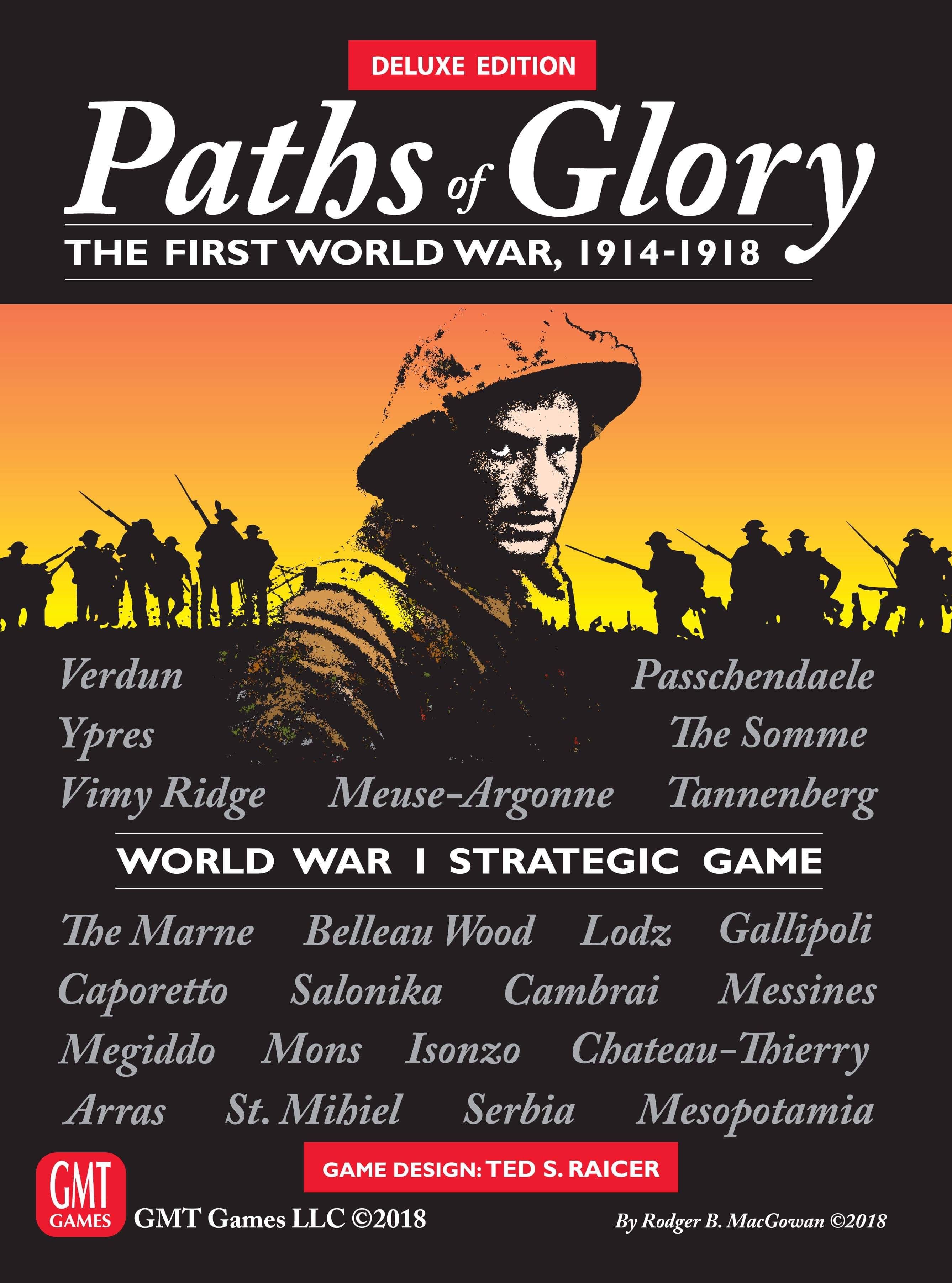
Paths of Glory

2 jugadores 480 min A partir de 14 años 3.9/5 de complejidad 7.3/10 de valoración

Acerca de este juego

(from GMT Games' website:) They called it the Great War. In over four years of titanic struggle, the ancient Europe of Kings and Emperors tore itself to pieces, giving birth to our own violent modern age. The bloody battles fought in the trenches of the Western Front, the icy plains of Poland, the mountains of the Balkans, and the deserts of Arabia, shaped the world we know today. We are all orphans of the Great War. Paths of Glory: The First World War, designed by six-time Charles S. Roberts awards winner, Ted Raicer, allows players to step into the shoes of the monarchs and marshals who triumphed and bungled from 1914 to 1918. As the Central Powers you must use the advantage of interior lines and the fighting skill of the Imperial German Army to win your rightful 'place in the sun.' As the Entente Powers (Allies) you must bring your greater numbers to bear to put an end to German militarism and ensure this is the war 'to end all wars.' Both players will find their generalship and strategic abilities put to the test as Paths of Glory's innovative game systems let you recreate all the dramatic events of World War I. Components: 316 full-color die-cut counters: 176 5/8” die cut counters 140 1/2” die cut counters One 22x34" full-color mapsheet showing most of Europe and the Near East 110 Strategy Cards 32-page Rule Book including sample game replay (21 pages of actual rules) Two Player Reference Cards DESIGNER: Ted Raicer DEVELOPER: Andy Lewis ART DIRECTOR: Rodger B. MacGowan MAP ART: Mark Simonitch CARDS & COUNTER ART: Mark Simonitch (BGG description:) Following in the footsteps of We the People, Hannibal: Rome vs. Carthage, Successors: The Battles for Alexander's Empire (First/Second Edition), and For the People, Paths of Glory utilizes a similar card-driven system. The game covers WWI from its outbreak to American intervention and spans all of Europe and the Middle East. Not only is the game innovative, but it also plays fast, usually within just an evening. While the game itself has all of the normal expectations of a wargame, with various units, CRT charts and period chrome, at heart the game rests within the card play. Players are given a hand of cards to play out six sub-phases of a turn. Each sub-phase allows for the use of a card or a pass with a minimal movement of units. Each card has four possible uses: operational movement, strategic movement, special events, and replacement points. The cardplay forces players to constantly make tough decsions as they feel that they need to do a little bit of everything but they can only do one thing at a time. How you play your cards will decide to a large degree the outcome of the war.

Qué sensaciones ofrece

Campaign / Battle Card Driven Point to Point Movement Dice Rolling World War I Wargame

Explora estas mecánicas en Cardboard

Crea un prototipo original con patrones de diseño reutilizables, no con el contenido de este juego.

Abrir el taller de mecánicas

Inteligencia del juego

Aprende el juego

100% de cobertura de conocimiento

Preparación

THREE PLAYERS: 1. Separate Allied cards into two decks: Britain/France (28 cards) and Russia & Serbia (27 cards) using the card number lists provided. The Central Powers player retains the standard 55-card deck divided into Mobilization, Limited War, and Total War phases as usual. - Britain/France: Mobilization (7 cards): 13,14,9,10,6,2,1 | Limited War (11 cards): 28,18,30,31,21,24,15,20,19,33,34 | Total War (10 cards): 42,53,39,36,48,51,50,41,37,49 - Russia & Serbia: Mobilization (7 cards): 11,8,5,4,3,7,12 | Limited War (9 cards): 23,26,22,17,29,27,32,16,25 | Total War (11 cards): 35,55,43,40,38,54,47,44,45,46,52 FOUR PLAYERS: 1. Allied decks remain the same as in the 3-player option (Britain/France 28 cards, Russia & Serbia 27 cards). 2. Split the Central Powers cards into two decks: Germany (30 cards) and Austria-Hungary/Turks (25 cards). - Germany: Mobilization (8 cards): 5,1,12,7,11,8,3,13 | Limited War (9 cards): 17,27,25,19,26,21,22,29,33 | Total War (13 cards): 43,41,49,46,36,38,54,50,47,55,40,39,44 - Austria-Hungary/Turks: Mobilization (7 cards): 9,14,10,4,18,6,2 | Limited War (10 cards): 15,30,32,24,23,20,31,16,34,28 | Total War (8 cards): 51,37,35,45,48,52,53,42 NOTE: Some cards are assigned to a player whose historical country does not match, in order to balance deck sizes as closely as possible. 3. Each player draws their starting hand from their individual deck.

Flujo del turno

The turn structure follows the base Paths of Glory rules, with the following modifications for multi-player games: THREE PLAYERS: - The Central Powers player draws 8 cards per turn from the standard deck. - Each Allied player draws 4 cards per turn from their individual deck. - During the 6 Allied action phases, only ONE Allied player may act per phase (either Britain/France or Russia/Serbia, not both simultaneously). Each Allied player may act a maximum of 3 times per turn (3 of the 6 phases each). CC (Combat Cards) do not count toward this limit. - Exception: A player who has already used all 3 of their action phases may still take a free action (1 Ops without a card), but doing so consumes one of their faction partner's remaining action phases. - Who acts in each phase is decided by mutual agreement or randomly at the moment the phase is played. FOUR PLAYERS: - Each Central Powers player draws 4 cards per turn from their individual deck. - During the 6 Central Powers action phases, only ONE Central Powers player may act per phase (either Germany or Austria-Hungary/Turks, not both). Each Central Powers player may act a maximum of 3 times per turn. CC cards do not count toward this limit. - The same free-action exception applies: a player who has exhausted their 3 phases may still take a free 1-Ops action, consuming one of their faction partner's remaining phases. - Who acts in each phase is decided by mutual agreement or randomly. - All Three Player rules that do not contradict the Four Player rules remain in effect.

Puntuación y victoria

Standard Paths of Glory faction-level victory conditions apply. Optionally, individual Victory Points may be tracked per player within a faction to determine an individual winner inside the winning side. Puntuación objetivo: Standard Paths of Glory win conditions (faction-level). For optional individual tracking, highest VP among players of the winning faction. Fuentes de puntuación: Standard Paths of Glory Victory Point sources (unchanged), Optional individual VP tracking starting at 15 VP per player per country

Fuente: Rulebook

Reglas que debes conocer

Las reglas más útiles para jugar bien la primera partida.

Setup

Split Allied cards into two separate decks for the 3-player option.

In the 3-player game, the Allied cards are divided into two individual player decks instead of one combined deck. Britain/France receives 28 cards: Mobilization cards 13,14,9,10,6,2,1 (7 cards); Limited War cards 28,18,30,31,21,24,15,20,19,33,34 (11 cards); Total War cards 42,53,39,36,48,51,50,41,37,49 (10 cards). Russia & Serbia receives 27 cards: Mobilization cards 11,8,5,4,3,7,12 (7 cards); Limited War cards 23,26,22,17,29,27,32,16,25 (9 cards); Total War cards 35,55,43,40,38,54,47,44,45,46,52 (11 cards). Each player draws from and plays only their own deck.

Setup

Central Powers player uses the standard undivided deck in the 3-player option.

In the 3-player game, the Central Powers is controlled by a single player who uses the complete standard 55-card deck, divided into Mobilization, Limited War, and Total War phases exactly as described in the base game rules. No changes are made to the Central Powers deck composition.

Turn structure

Central Powers player draws 8 cards per turn in the 3-player game.

In the 3-player game, the single Central Powers player draws a hand of 8 cards at the start of each turn, as per the standard base game hand size for the Central Powers.

Turn structure

Each Allied player draws 4 cards per turn in the 3-player game.

In the 3-player game, each Allied player (Britain/France and Russia/Serbia) draws a hand of 4 cards per turn from their own individual deck. The combined Allied hand is therefore 8 cards total, matching the Central Powers hand size.

Turn structure

Only one Allied player may act per action phase; each player is limited to 3 phases per turn.

During the 6 Allied action phases in a turn, only one Allied player may act in each phase — the Britain/France player or the Russia/Serbia player, but never both in the same phase. No Allied player may act more than 3 times per turn, meaning each player uses exactly 3 of the 6 available Allied action phases. Combat Cards (CC) do not count toward this 3-phase limit. The decision of which Allied player acts in a given phase is made by mutual agreement or randomly at the moment that phase is played.

Special

A player who has used all 3 phases may still take a free 1-Ops action, consuming a partner's phase.

The only exception to the 3-action-phase-per-player limit is the use of a free action to perform 1 Ops without playing a card. A player who has already used all 3 of their allotted phases may still take this free action, but doing so consumes one of the action phases assigned to their faction partner. This exception applies to both Allied players in the 3-player game and to both Central Powers players in the 4-player game.

Special

Mandated Offensive rolls are made once per faction, not once per player.

In the 3-player game, the Mandated Offensive rule is applied as in the base game: only one roll is made per faction. Even though the Allied side has two players, they share a single Mandated Offensive roll. It is not rolled separately for each Allied player.

Card play

Replacement point cards may only be used for countries controlled by the card's player.

When a player plays a card to gain Replacement Points, those Replacement Points may only be used to bring replacements for the countries under that specific player's control. An Allied player cannot use a Replacement Point card to benefit the other Allied player's countries, and vice versa.

Informe estratégico

Coordinating Allied Action Phases

Since each Allied player only gets 3 of the 6 action phases, planning which player acts in which phase is critical. The decision is made by mutual agreement or randomly at the moment of play — so pre-game coordination about general priorities (e.g., Russia focuses on the Eastern Front, Britain/France on the West) is essential, since in-phase decisions may be random.

Preserving Partner Phases with the Free Action Exception

The free 1-Ops action exception allows a player who has exhausted their 3 phases to still act, but at the cost of a partner's phase. Use this sparingly — burning your partner's phase for a 1-Ops free action is usually a poor trade unless the situation is critical, since your partner loses a full card-play opportunity.

Deck Size Imbalance Awareness

In the 4-player game, the Germany player's deck (30 cards) is significantly larger than the Austria-Hungary/Turks deck (25 cards), and Russia/Serbia (27) is slightly smaller than Britain/France (28). Players with larger decks have more card options across the game but must manage their deck progression through Mobilization, Limited War, and Total War phases accordingly.

Neutral Country Entry as a Control Decision

Since the player who plays a neutral country's entry card gains control of that country, both players on a faction should discuss who should play neutral entry cards. Assigning a neutral country to the right player ensures that the player best positioned to support those units can also use Replacement Point cards for them.

Using Ally Units in Multinational Attacks

The ability to conduct Multinational Attacks with your faction ally's units (at the normal Ops cost) enables powerful cross-player coordination without requiring both players to act in the same phase. A single player can orchestrate a large combined assault by spending the appropriate Ops points, effectively amplifying the value of a well-timed card play.

AH Card Substitution in 4-Player Games

The Austria-Hungary/Turks player must remember that GE unit references on their cards become AH unit references. Some of those cards may have been historically designed for German operations, so their geographic or operational scope may be better suited to German fronts — the AH player should assess whether the card's event still makes strategic sense for AH units before playing it for its event rather than for Ops.

Optional Individual VP Tracking

If using the optional individual VP rule, players start at 15 VP each regardless of faction VP. This creates an intra-faction competition: both players on the same side want their faction to win, but also want to outperform their ally. This incentivizes players to pursue VP-earning plays for their own countries even when a more cooperative move might be better for the faction overall.

Preguntas frecuentes y casos límite

An Allied player has already used all 3 of their action phases this turn. Can they still do anything?

Yes. The only permitted action is a free 1-Ops action without playing a card. However, taking this free action consumes one of the faction partner's remaining action phases. If the partner also has no phases left, this exception cannot be used.

The Russia/Serbia player plays a card that grants Replacement Points. Can those points be used to replace Britain/France units?

No. Replacement Points gained from a card may only be used for countries under the control of the player who played that card. The Russia/Serbia player can only use those points for Russian and Serbian units.

The Britain/France player plays the entry card for a neutral country. Who controls that country, and can the Russia/Serbia player use Replacement Points for it?

The Britain/France player controls that neutral country, since they played the entry card. Only the Britain/France player may use Replacement Point cards to replace that neutral country's units.

Can the Germany player use Austria-Hungary units (controlled by the other Central Powers player) in a Multinational Attack?

Yes. A player may conduct Multinational Attacks using units belonging to nations controlled by their faction ally, as long as they pay the corresponding Ops point cost for a Multinational Attack as normal.

The Austria-Hungary/Turks player plays a card whose event text references GE (German) units. Which units are affected?

When the Austria-Hungary/Turks player plays such a card, all references to GE units in the card's event text are treated as AH (Austria-Hungary) units instead.

Does playing a Combat Card (CC) count as one of a player's 3 action phases for the turn?

No. Combat Cards (CC) do not count toward the 3-action-phase-per-player limit. A player may play CC cards in addition to their 3 regular action phases.

With two Allied players, do both players roll separately for the Mandated Offensive?

No. The Mandated Offensive produces only one roll per faction, not one per player. The entire Allied side shares a single Mandated Offensive roll, regardless of how many players control Allied nations.

Do the 3-player additional rules still apply in the 4-player game?

Yes. All 3-player additional rules remain in effect during the 4-player game, unless a specific 4-player rule directly contradicts them. In cases of contradiction, the 4-player rule takes priority.

Pregunta Sobre Este Juego

Juegos similares