2003 Puesto n.º 30409 en BGG

Redneck Life

2–6 jugadores 60 min A partir de 13 años 1.4/5 de complejidad 5.5/10 de valoración

Acerca de este juego

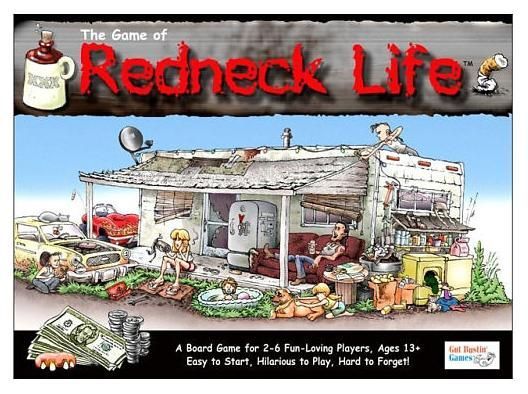
Do you say Redneck like it's a bad thing? A roll of 2 dice determines the grade you complete in school, which sets you up for one of 11 fabulous careers such as Mullet Salon Operator or Monster Truck Announcer. Journey through Blue Collar Americana by going into debt to purchase a vehicle, get married, divorced, re-married, purchase a home, and raise a passel of young'ens. Through accidents and brawls, players lose teeth during the game. Buy some back if you can... as the player with the most teeth remaining at the end of the game wins! Some card examples: New business venture: Steal and sell wheelchairs. Collect $300. Accidentally break industrial scale at feed store while weighing yourself. Pay $200 for repairs. You need more time to watch TV You may divide your young'uns between the other players. Expanded by: Redneck Life: Bustin' A Gut! Expansion

Qué sensaciones ofrece

Roll / Spin and Move Humor

Inteligencia del juego

Aprende el juego

100% de cobertura de conocimiento

Preparación

1. Each player takes a score sheet to track all life stats (career, payday amount, spouse, young'ens, insurance, etc.). 2. All players begin at age 18 and must complete Chart 1 (Education, Career & Vehicle) before anything else. 3. Chart 1 – Step 1: Each player rolls 2 dice to determine their School Grade Completed and Career, which sets their Payday Amount (ranging from $200 for 2nd Grade to $400 for 11th Grade; 12th Grade uses Chart 2). 4. Chart 1 – Step 2: Each player chooses and purchases a vehicle ("Rig") from "Uncle Clem's Rig Rodeo" using Uncle Clem's Check N' Scrams. Remove the chosen Rig from its plastic sleeve and keep it in front of you. 5. All players then complete all 5 steps of Chart 2 (Set Hitched & Housed): - Step 1: Roll 2 dice to determine new spouse's name; note it on your score sheet. - Step 2: Roll 1 die for Wedding Expense (1=Free, 2=$100, 3=$200, 4=$300 + add son "Cooter", 5=$400 + roll for red-headed step kids named "Darryl" and reduce payday, 6=$500). - Step 3: Take the top Title Deed card, pay the listed amount, and keep the card as your home. - Step 4: Pay $100 to The Goodwill to furnish your entire home. - Step 5: One-time opportunity to purchase insurance. Check "Yep" or "Nope" for each insurance option on your score sheet and pay chosen amounts.

Flujo del turno

Players take turns rolling dice and moving through life events on the board. Each turn, a player moves their piece, lands on a space, and resolves the event indicated. Key recurring events include receiving Payday income, paying bills, acquiring young'ens (children), dealing with vehicle issues, and drawing event cards. The game proceeds through various life stages until an end condition is triggered, after which players tally their financial standings to determine the winner.

Puntuación y victoria

Player with the best financial standing (most net worth or least debt) at game end wins. Fuentes de puntuación: Net cash/Check N' Scrams on hand, Value of Title Deed (home) property, Vehicle (Rig) value, Insurance payouts (if applicable), Young'ens and other life event outcomes

Fuente: Rulebook

Reglas que debes conocer

Las reglas más útiles para jugar bien la primera partida.

Setup

At age 18, roll 2 dice to determine School Grade Completed, Career, and Payday Amount.

During initial setup (Chart 1, Step 1), each player rolls 2 dice. The sum determines their School Grade Completed and Career, which sets their base Payday Amount for the entire game. Results: 2 = 2nd Grade, Honey Bucket Engineer, $200/payday; 3 = 3rd Grade, Fry Cook at The-All-You-Can-Eat, $220/payday; 4 = 4th Grade, Flea Market Merchant, $240/payday; 5 = 5th Grade, Ciggy Shack Attendant, $260/payday (some sources list $280); 6 = 6th Grade, Beer A Bait Mart Clerk / Taxidermist, $300/payday; 7 = 7th Grade, Monster Truck Announcer, $320/payday; 8 = 8th Grade, Gas N' Grub Manager, $340/payday; 9 = 9th Grade, Ice Hockey Referee, $360/payday; 10 = 10th Grade, Mullet Salon Operator, $380/payday; 11 = 11th Grade, Shop Teacher/Wrestling Coach, $400/payday; 12 = 12th Grade (proceed to Chart 2 for further detail). All of this information is recorded on the player's score sheet.

Setup

At age 18, choose and purchase a vehicle ('Rig') from Uncle Clem's Rig Rodeo using Check N' Scrams.

During initial setup (Chart 1, Step 2), each player selects a vehicle (called a 'Rig') from Uncle Clem's Rig Rodeo. The player pays the listed price for their chosen Rig using Uncle Clem's Check N' Scrams (the game's currency/check system). The player then removes their Rig from its plastic sleeve and keeps it in front of them for the rest of the game. The Rig represents the player's vehicle throughout the game.

Setup

Roll 2 dice at setup to determine your spouse's name; record it on your score sheet.

During Chart 2 (Set Hitched & Housed), Step 1, each player rolls 2 dice. The result determines their new spouse's name from a lookup table. The spouse's name is recorded on the player's score sheet and is kept for the remainder of the game.

Setup

Roll 1 die at setup to determine wedding expense, ranging from free to $500, with possible additional consequences.

During Chart 2 (Set Hitched & Housed), Step 2, each player rolls 1 die to determine their wedding expense and event: 1 = Hitched by Rev'rend Uncle Pappy at the Family Reunion — Free; 2 = Elope at 'The Church of Elvis' — Pay $100; 3 = Married at The Hitchin' Post with a trip to The DQ — Pay $200; 4 = Wedding at the hospital delivery room, it's a boy — Pay $300 and add a son named 'Cooter' to your young'ens list; 5 = Justice of the Peace & Hoe Down — Pay $400, then roll dice to determine how many red-headed step kids named 'Darryl' are added to your young'ens list, and reduce your Payday Amount accordingly; 6 = Big Fat Redneck Wedding with the whole fam-damly — Pay $500. All costs are paid from the player's starting funds.

Setup

At setup, take the top Title Deed card, pay the listed amount, and keep it as your home.

During Chart 2 (Set Hitched & Housed), Step 3, each player takes the top card from the Title Deed card stack. They pay the amount listed on that card and keep it. This Title Deed card represents the player's home for the game. The cost and property value vary by which deed is drawn.

Setup

At setup, pay $100 to The Goodwill to furnish your home.

During Chart 2 (Set Hitched & Housed), Step 4, each player must pay $100 to The Goodwill. This is a mandatory flat cost representing furnishing the player's newly acquired home. There is no choice involved — all players pay exactly $100.

Setup

Setup includes a one-time-only opportunity to purchase insurance; check 'Yep' or 'Nope' for each type and pay chosen amounts.

During Chart 2 (Set Hitched & Housed), Step 5, players have their one and only chance during the entire game to purchase insurance. On the score sheet, players review each available insurance option and mark either 'Yep' (purchasing it) or 'Nope' (declining it). Players pay the listed amount for each insurance they choose to purchase. Insurance cannot be purchased at any other point in the game, so this is a critical one-time decision.

Resource production

Each player's Payday Amount is set at game start by their career roll and can be reduced by certain events (e.g., extra step-children).

A player's Payday Amount is determined during setup by their Chart 1 dice roll (ranging from $200 to $400). This amount is received each time a player lands on or passes a Payday space during the game. Certain events, such as rolling a 5 on the Wedding Expense table (gaining red-headed step kids named 'Darryl'), reduce the Payday Amount permanently. Players record the current Payday Amount on their score sheet and update it as changes occur.

Informe estratégico

Insurance Purchase Timing

The setup phase is the only time insurance can be purchased. Players who anticipate risky life events (particularly those with lower education/career rolls and lower paydays) should strongly consider purchasing insurance during Chart 2, Step 5, as there is no second chance.

Wedding Roll Risk Management

The Wedding Expense roll (1 die) has asymmetric consequences. A roll of 5 is arguably worse than a roll of 6 long-term: while 6 costs $500 upfront, a roll of 5 costs $400 AND permanently reduces your Payday Amount for every step-kid added. Players have no control over this roll, making it the highest-variance single event in setup.

Setup Expenditure Planning

Setup requires multiple mandatory expenditures in sequence: a Rig purchase, wedding costs (up to $500), a Title Deed (variable), $100 to The Goodwill, and optional insurance. Players with lower career rolls (e.g., $200-$260 payday) need to be especially conservative with optional insurance purchases to avoid starting the game with dangerously low funds.

Career Roll and Long-Term Income

The Chart 1 career roll sets your Payday Amount for the entire game. The difference between a roll of 2 ($200/payday) and a roll of 11 ($400/payday) is significant over many turns. Higher-income players can absorb setup costs and future life events more easily, making the career roll the single most impactful dice roll in the game.

Preguntas frecuentes y casos límite

A player rolls a 5 on the Wedding Expense table and gains red-headed step kids named 'Darryl'. How does this affect their Payday Amount?

Rolling a 5 on the Wedding Expense table requires paying $400 AND rolling dice to determine how many 'Darryl' step-kids are added to the young'ens list. Each step-kid added reduces the player's Payday Amount by a set amount. The player must update their Payday Amount on their score sheet immediately. This makes a roll of 5 potentially the most expensive long-term wedding outcome, even though a roll of 6 costs more up front.

A player forgot to purchase insurance during setup. Can they buy it later in the game?

No. Insurance can only be purchased during Chart 2, Step 5 of the setup phase. If a player marked 'Nope' or forgot to decide, they cannot purchase insurance at any later point in the game. This is explicitly the 'one and only chance' to purchase insurance.

A player rolls a 4 on the Wedding Expense table. Do they also have to pay the $300 AND add 'Cooter' to their young'ens?

Yes. Rolling a 4 results in both consequences simultaneously: the player pays $300 AND adds a son named 'Cooter' to their young'ens list on their score sheet. Both effects are mandatory.

A player has a high Payday Amount from their career roll but then rolls a 5 on the Wedding Expense table. Does the Payday reduction eliminate all their income advantage?

Potentially yes. The Payday reduction from gaining Darryl step-kids applies regardless of the player's starting Payday Amount. A player who rolled an 11 (Shop Teacher/Wrestling Coach, $400/payday) could see their income reduced significantly if they roll a 5 on the wedding table and gain several step-kids. Players should factor this risk into how they approach game events.

What currency is used to buy a Rig during setup, and does it come from the player's starting funds?

Rigs are purchased using Uncle Clem's Check N' Scrams, which is the game's standard currency. The purchase is made from the player's available Check N' Scrams during Chart 1, Step 2 of setup. Players should be mindful that setup involves multiple required expenditures (vehicle, wedding, housing, furnishing, and optional insurance), all drawing from the same pool of starting funds.

Pregunta Sobre Este Juego

Juegos similares