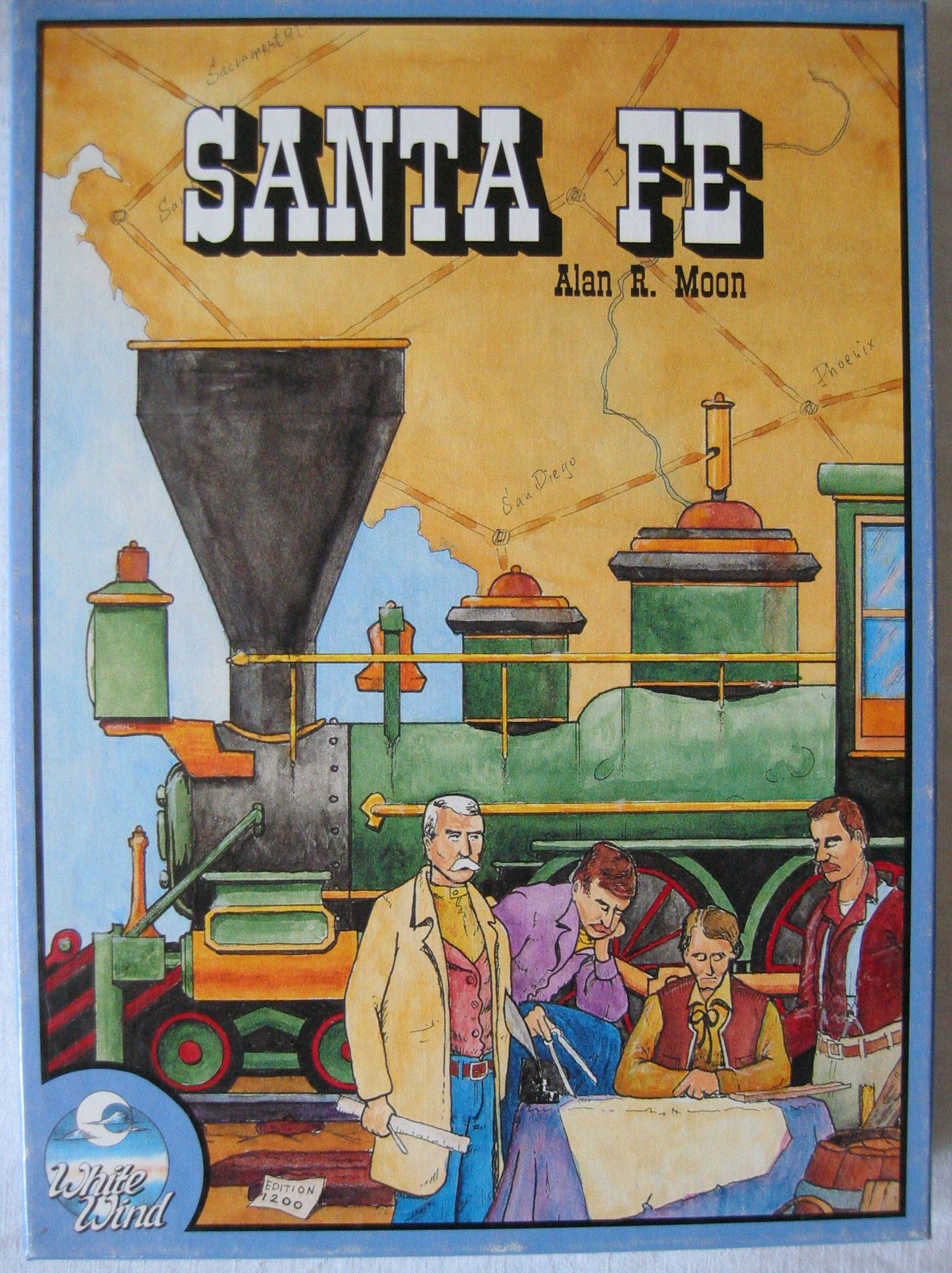
1992 Puesto n.º 7959 en BGG

Santa Fe

2–5 jugadores 70 min A partir de 10 años 2.2/5 de complejidad 5.6/10 de valoración

Acerca de este juego

Each game is made up of rounds. A round begins with all players playing one card from their hands and placing it face down on the table. Then, all cards are exposed simultaneously. There are 66 City Cards and each carry a name of a city along with a number value (ranging from 2 to 7). Since the trains begin their expansion from the easternmost part of the board, the farther west the city, the higher its number value. Players score points only for City Cards that are played and placed face up. Cards that remain unplayed in hands have no value. The numerical value of a City Card is multiplied by the number of railroads connected to it. Players may also play a Double turn Card, a combination of a City Card with a Branch Line card or a combination of a Double Turn Card and a Branch Line Card. A Double Turn Card allows a player to place two pieces of track in both track phases of a turn (although only one piece of track may be placed if desired). Furthermore, all bonuses are doubled during the round that card is played. Each Railroad has two Branch Line Cards and a player may pay $1 and draw one of them. (Players may only hold one Branch Line Card in their hands at any one time.) If held, the Branch Line Card must be played immediately on the next round in conjunction with either a City or Double Turn Card. Play of a Branch Line Card allows a player to start a new route of track for the named railroad from any city that railroad connects, thereby extending the railroad. After exposing a card, the round continues with two turns of laying track. Players do not control any specific rail line. Each player can place track on any color provided that the played track connects to an existing corresponding rail network on the board. Once all track is placed, all players replenish their hands (up to five cards). The First Player passes the First Player Train to the player on the left (who becomes the First Player for the subsequent round) and the next round begins. The first player to connect the first railroad to any city earns $2. Certain cities are marked with colored squares (matching the colors of certain railroads). Should a corresponding color railroad enter that city, the player making that connection gets a bonus of $4. Double Turn Cards double all bonuses in a round. When all track pieces of all the railroads have been played or if a player is unable to play any piece of track because all playable railroads are "dead-ended", the game ends and points are tallied. Points are received in two ways. First, players receive 1 point for each $1 they have. Second, each City Card is worth its value times the number of different rail lines connected to it. The player with the highest total wins! (In case of a tie, the player with the most City Cards valued at "7" is declared the victor.)

Qué sensaciones ofrece

Network and Route Building Open Drafting Trains

Inteligencia del juego

Aprende el juego

100% de cobertura de conocimiento

Preparación

1. Set up the board (use the Santa Fe map, or the Santa Fe Rails map — if using the SFR map with the SF rules, ignore all one-way arrows on the map).\n2. Each player selects or is assigned a Major Railroad (MR) identity.\n3. Short Line cards are separated; when a Short Line card is drawn by a player, it is placed face-up in front of that player and a replacement card is drawn immediately.\n4. Each player starts the game with 4 cards in hand.\n5. The deck is prepared according to player count: the 2x cards use n-1 copies (where n = number of players), so adjust the deck accordingly. Cards marked '( )' (parenthetical counts) are substitutes used in the Santa Fe base game.

Flujo del turno

Each Round proceeds in the following phases:\n1. **Hand Refresh (Start of Round):** Draw cards up to 4 (or 5 in Santa Fe Rails) at the start of the round.\n2. **Play Card(s):** On your turn, play one or more eligible cards from your hand as permitted by card rules.\n3. **Lay Track – Track Lay 1 (TL1):** Lay the number of track segments indicated for TL1 (default 1, or more if a multiplier card is in effect).\n4. **Lay Track – Track Lay 2 (TL2):** Lay the number of track segments indicated for TL2 (default 1, or more if a multiplier card is in effect).\n5. **Hand Refresh (End of Round):** Draw cards up to 4 (or 5 in SFR) at the end of the round.\nCertain cards (marked ↻) are returned to the side of the board at round end rather than discarded (SFR only). Cards marked ✖ are removed from the game after use.

Puntuación y victoria

The player with the most money ($) at game end wins. Points/money are scored from City cards, first-connection bonuses, and colored-square bonuses throughout the game. Fuentes de puntuación: City cards: (number of city cards played) × (city value) × (number of distinct MRs/SLs connected to that city), $2 bonus: first MR/SL to connect to a non-ML-base city (SLs excluded for their own base), $4 bonus: first time a MR connects to its matching colored-square city, 2x card doubles all bonuses scored in the round it is played

Fuente: Rulebook

Reglas que debes conocer

Las reglas más útiles para jugar bien la primera partida.

General

Players start with 4 cards and refresh their hand to 4 (or 5 in SFR) at the start and end of each round.

Each player begins the game with 4 cards in hand. At both the start and end of each round, players draw cards back up to a hand size of 4 (in the base Santa Fe game) or 5 (in Santa Fe Rails). Hand refresh is in addition to any card plays during the round.

Turn structure

Each round has two track-laying opportunities: TL1 and TL2.

Every round, a player has two track-laying turns: Track Lay 1 (TL1) and Track Lay 2 (TL2). By default, one segment may be laid per track lay. Multiplier cards (2x, 3x, 4-in-1) modify the number of segments that may be laid. The sequence each round is: play card(s), lay track TL1, lay track TL2.

Scoring

City cards score points equal to (number of city cards played) × (city value) × (number of distinct MRs/SLs connected to that city).

There are 66 City cards in the deck. When scored, a City card's value is calculated as: (count of City cards played for that city) × (the city's printed value) × (the number of distinct Major Railroads and/or Short Lines currently connected to that city). City cards have no special play restrictions beyond the standard card-play rules.

Special

When drawn, a Short Line card is immediately placed in front of the drawing player; that player draws a replacement card.

There are 4 Short Line cards. Short Line cards are unique: when a player draws a Short Line card, it is immediately placed face-up in front of that player (it does not go into the hand) and the player draws a replacement card to maintain hand size. Once a player holds a Short Line, they may use it to build the corresponding Short Line's track. Short Line track may always branch. Short Lines do not score the first-connection bonus ($2) for their own base city. No play restriction symbol (∅) means it can be played at any time; the draw note (⇓) means draw a replacement upon drawing it.

Building

Short Line track may always branch from any point.

When building track for a Short Line (using its Short Line card), the track may branch at any point — there is no restriction on branching for Short Lines, unlike Major Railroads which may have different branching rules.

Card play

The 2x card lets a player lay two segments per track lay, doubles all bonuses for the round, and (before TL2) may be removed from game to redraw any in-hand city cards.

The deck contains (n-1) copies of the 2x card, where n is the number of players (e.g., 3 cards in a 4-player game; counts are 3, 5, 7, or 9 depending on player count as listed). Effects: (1) The active player may lay two track segments per track lay (TL1 and TL2) this round. (2) All bonuses scored this round are doubled in value. (3) Before TL2, the player may optionally remove the 2x card from the game entirely to redraw any number of city cards currently held in hand. The 2x card is returned to the side of the board at end of round (↻, SFR only) and is removed from the game after use (✖).

Card play

The 3x card lets a player lay three segments per track lay, but no bonuses are scored this round.

There is 1 copy of the 3x card. Effects: (1) The active player may lay three track segments per track lay (TL1 and TL2) this round. (2) No bonuses of any kind are scored during this round. Play note: must be played in the turn it is drawn (⬇) and is returned to the side of the board at end of round (↻, SFR only). Draw note (➀): only one of the three special card types (3x, 4-in-1, Branch Line) may be drawn in a single round.

Card play

The 4-in-1 card lets a player lay 4 segments in one track lay and 0 in the other.

There is 1 copy of the 4-in-1 card. Effect: the player lays 4 track segments in one track lay (either TL1 or TL2, player's choice) and 0 segments in the other track lay this round. Play note: must be played in the turn it is drawn (⬇) and is returned to the side of the board at end of round (↻, SFR only). Draw note (➀): only one of the three special card types (3x, 4-in-1, Branch Line) may be drawn in a single round.

Informe estratégico

Timing the 2x Card

The 2x card doubles all bonuses in the round it is played and also allows two segments per track lay. Ideally, play it in a round where you can claim one or more first-connection bonuses ($2→$4) or a colored-square bonus ($4→$8), effectively making it a high-value turn. Remember it must be removed from the game after use, so don't waste it on a low-bonus round.

Branch Line Combo Requirement

Branch Lines must be played the turn they are drawn AND in conjunction with a City or 2x card. Always ensure you have a City or 2x card in hand before drawing into the Branch Line, or you risk being unable to satisfy the conjunction requirement.

3x vs. Bonuses Trade-off

The 3x card grants powerful track extension (3 segments per lay) but cancels ALL bonuses for the round. Use it when you need pure geographic expansion and are not in a position to claim any first-connection or colored-square bonuses, to avoid sacrificing scoring opportunities.

Boomtown City Value Optimization

Upgrading a city via Boomtown (2→4 or 3→5) has a multiplying effect on City card scoring, since the formula multiplies by city value. Prioritize upgrading cities to which multiple MRs/SLs are connected, or cities you plan to play many City cards for, to maximize the score multiplication.

Short Line Branching Advantage

Unlike Major Railroads, Short Line track may always branch freely. This makes Short Lines flexible network-builders that can reach multiple cities quickly, helping their controller rack up first-connection bonuses ($2 each) in new territories.

Endgame Awareness

The game ends when no Main Line can extend any of its lines. Track when MLs are close to being fully extended, and prioritize playing City cards for high-value, well-connected cities before the game ends, since unplayed City cards score nothing.

Preguntas frecuentes y casos límite

I drew a Branch Line card. Can I save it for next round?

No. Branch Line cards are marked ⬇ and must be played in the same turn (round) they are drawn. Additionally, they must be played together with a City card or a 2x card (⇊). If you cannot meet those conditions, you still cannot hold the card.

I played the 3x card and connected to a new city for the first time this round. Do I get the $2 first-connection bonus?

No. When the 3x card is played, no bonuses of any kind are scored for that entire round. This includes the $2 first-connection bonus and the $4 colored-square bonus.

I played a 2x card and also connected to a new city for the first time. How much do I score?

The $2 first-connection bonus is doubled to $4 (and/or the $4 colored-square bonus is doubled to $8) because the 2x card doubles all bonuses scored in the round it is played.

A Short Line connects to its own base city for the first time. Does it score the $2 first-connection bonus?

No. Short Lines are explicitly excluded from scoring the $2 first-connection bonus for their own base city. They may still score it for other non-ML-base cities they reach first.

I already drew a Branch Line card this round. Can I also draw a 3x card in the same round?

No. The ➀ restriction means only one card among the 3x, 4-in-1, and Branch Line types may be drawn in a single round. Drawing a second special card of these types in the same round is not permitted.

I played a 2x card. When exactly can I use its option to redraw city cards from my hand?

The option to remove the 2x card from the game and redraw any number of in-hand city cards must be exercised before TL2 (the second track-laying phase of the round). Once TL2 begins, this option is no longer available.

A Boomtown card upgrades a city from value 2 to value 4. Does this affect how City cards score for that city?

Yes. City card scoring uses the city's current value. After a Boomtown upgrade, that city's value is now 4 instead of 2, so all future City card scoring for that city will use the upgraded value in the formula: (cards played) × (new city value) × (distinct MRs/SLs connected).

After I use a 2x card in SFR, does it go back into the deck or is it gone?

The 2x card is both marked ↻ (return to side of board at end of round, SFR only) AND ✖ (remove from game after use). The ✖ instruction takes precedence for the 2x card: it is permanently removed from the game after use, regardless of the SFR return rule.

Pregunta Sobre Este Juego

Juegos similares