2018 Puesto n.º 22643 en BGG

Staka

1–4 jugadores 20–60 min A partir de 7 años 0.0/5 de complejidad 5.5/10 de valoración

Acerca de este juego

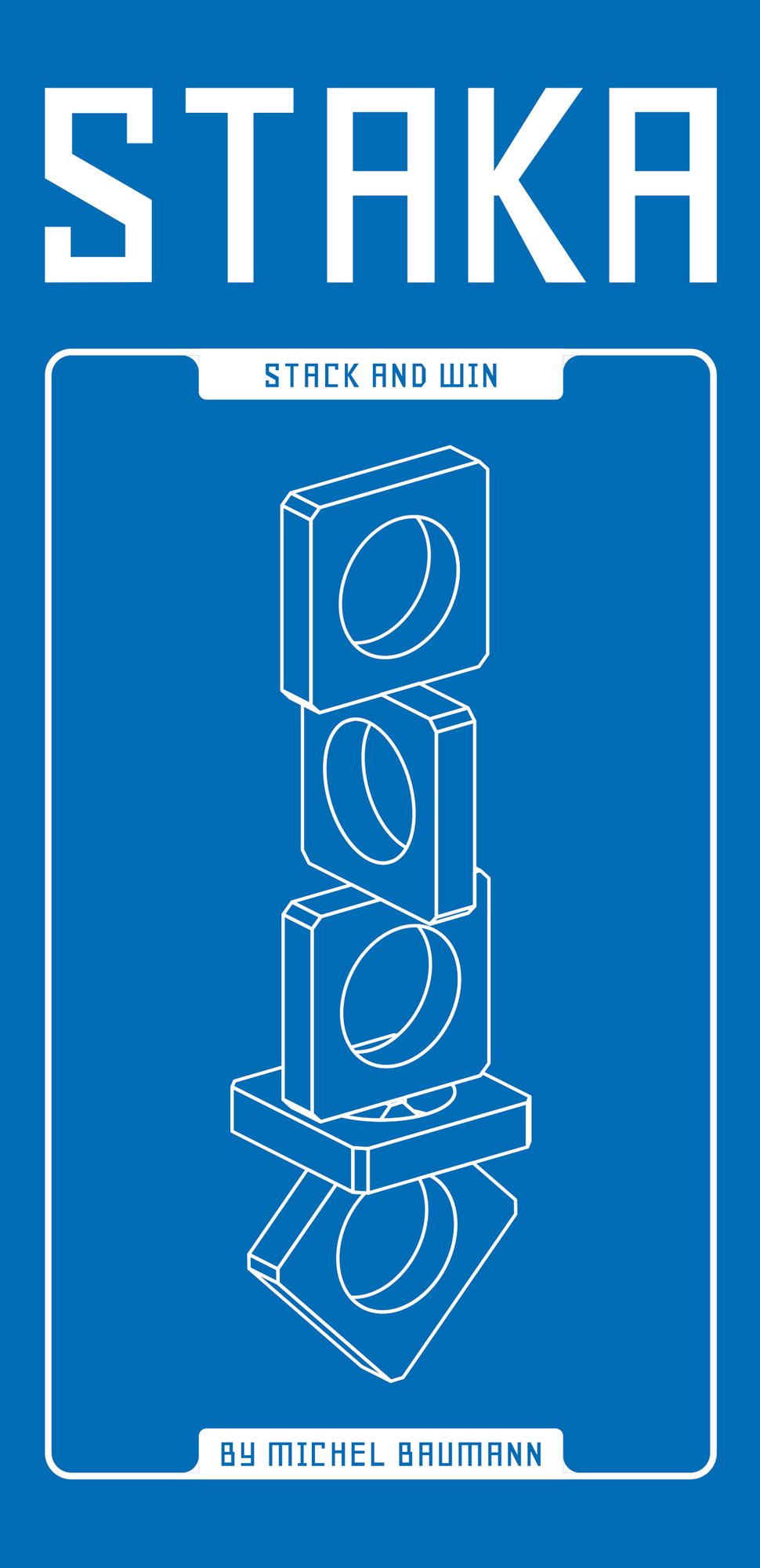
The general idea of the wooden game Staka is to stack and win, and the game comes with five modes of play: In Duel mode, two players compete to stack figures before their opponent. The first with five figures completed wins the game. In Flash mode, the players try to complete the figure against the clock, which is represented by a die that opponents roll and add up. In Crash mode, it's the first to crash the construction that loses. In Zen mode, take your time, put on your noise-cancelling headsets, and try to complete the twenty challenges in the game. In Art mode, unleash your creativity and build new figures. —description from the publisher

Qué sensaciones ofrece

Pattern Building Action Queue Action / Dexterity Card Game Dice Educational

Explora estas mecánicas en Cardboard

Crea un prototipo original con patrones de diseño reutilizables, no con el contenido de este juego.

Abrir el taller de mecánicas

Inteligencia del juego

Aprende el juego

100% de cobertura de conocimiento

Preparación

General: Place the storage column with Staka rings and any required cards within reach of all players. Choose a game mode before starting. Duel Mode (2 players): Each player receives 6 Staka rings. Shuffle all 39 cards into a single face-down draw pile and place it in the center of the table. Flash Mode (2–4 players): Place the storage column with Staka rings and the die within reach of all players. Separate the 39 cards into two face-down draw piles — one with the 20 easy cards and one with the 19 trickier cards. Place both piles in the center of the table. Have paper and pen (or a phone) ready to track scores. As a group, decide which pile(s) to use. Zen Mode (1+ players): Use the rulebook, which contains 20 figure diagrams. No special setup beyond having the rings available. Crash Mode (2–4 players): No specific setup required beyond having the Staka rings available. Players invent their own figures. Art Mode (1+ players): No specific setup. Players freely create their own figures.

Flujo del turno

Turn structure varies by mode: DUEL MODE: There are no turns — both players stack simultaneously. A card is flipped face-up revealing a figure diagram. Both players race to stack their 6 rings to match the figure exactly. The first to succeed wins the duel and takes the card. All other players stop stacking and the next duel begins with a new card. FLASH MODE: Play proceeds in rotating turns. The player who most recently dropped something goes first as the "stacker." They draw a card and show it to all players. The game starts the moment the stacker picks up a ring. The player to the stacker's left is the "counter," who continuously rolls the die, calling out and accumulating the running total aloud (e.g., 4, then 4+2=6, then 6+0=6, then 6+6=12, etc.). When the stacker completes the figure, the counter stops rolling and records the stacker's score (capped at 50 points). The counter then becomes the new stacker, and the player to their left becomes the new counter. This rotation continues until the end condition is triggered. ZEN MODE: One or more players take turns stacking rings one at a time to attempt to build the 20 figures shown in the rulebook diagrams. No competition or scoring required. CRASH MODE: Players take turns adding Staka rings to a shared growing stack using freely invented figures. The player who causes the stack to fall loses. ART MODE: Free creative play. Players create new figures of their own invention with no structured turns or rules.

Puntuación y victoria

Varies by mode. Duel: first to 5 cards wins. Flash: lowest cumulative die-roll score wins when any player hits 200+ points. Crash: last player standing (others eliminated by knocking the stack over). Zen and Art: no scoring. Puntuación objetivo: Duel: 5 cards. Flash: game ends when any player reaches 200 points; lowest score wins. Fuentes de puntuación: Duel — winning a duel earns the player the card; 5 cards wins the game, Flash — each round the stacker earns points equal to the counter's cumulative die total when the figure is completed (max 50 per round); lowest total wins, Crash — no points; the player who knocks the stack over loses

Fuente: Rulebook

Reglas que debes conocer

Las reglas más útiles para jugar bien la primera partida.

Setup

Each player receives 6 rings; all cards form one draw pile in the center.

In Duel mode, both players each receive exactly 6 Staka rings — this is all that is needed for this mode, as figure diagrams use at most 6 rings. All 39 cards are shuffled into a single face-down draw pile placed in the center of the table.

Turn structure

Duel mode is simultaneous — both players stack at the same time, not in turns.

In Duel mode, there is no first player and no turn order. Both players compete at the same time. The round begins when a card is drawn and placed face-up on the table, revealing the figure diagram. Both players immediately begin trying to stack their rings to match the diagram.

Scoring

The first player to correctly match the figure diagram wins the duel and takes the card.

In Duel mode, the first player who successfully stacks their rings exactly according to the figure diagram shown on the card wins that duel. They take the card and add it to their score pile. All other players must immediately stop stacking. The game then proceeds to the next round with a new card.

Endgame

The first player to collect 5 cards wins the Duel mode game.

In Duel mode, the first player to win 5 duels (and thus collect 5 cards) wins the overall game.

Setup

Separate cards into two piles (20 easy, 19 tricky); place rings, die, and score tracking materials within reach.

In Flash mode, the 39 cards are split into two separate face-down draw piles: one pile of 20 easy cards and one pile of 19 trickier cards. Both piles are placed in the center of the table. The storage column with Staka rings and the die are placed within reach of all players. Players also need paper and pen or a phone to track scores.

General

Before Flash mode begins, the group decides which card pile(s) to use and keeps that consistent within each round.

Before starting Flash mode, all players agree as a team whether to use the easy cards, the trickier cards, or a combination (e.g., alternating each round, or 3 rounds easy then switching to tricky on round 4). The critical rule is that all players must draw from the same pile of cards throughout any given round.

Turn structure

The player who most recently dropped something goes first as the stacker in Flash mode.

In Flash mode, the first stacker is determined by who most recently dropped something (any object). That player draws a card, shows it to all other players, and becomes the stacker for the first round.

Turn structure

The stacker draws a card and attempts to build the figure; the game starts the moment they pick up a ring.

In Flash mode, the stacker draws a card and shows it to all players. The card shows a figure diagram that must be built by stacking Staka rings. The game (and die rolling by the counter) begins the instant the stacker picks up a wooden ring.

Informe estratégico

Duel Mode — Speed vs. Accuracy

Because both players stack simultaneously and the first to exactly match the figure wins, rushing without precision is counterproductive. A near-correct stack does not win the duel — only an exact match counts. Focus on accuracy first; speed is secondary.

Flash Mode — Minimizing Your Score

Since lower scores are better and the score is determined by how many cumulative die rolls occur while you stack, completing the figure as quickly as possible is paramount. Practice figures from the easy pile before moving to the tricky pile, as faster completions mean far fewer die rolls and thus a lower score.

Flash Mode — Card Pile Selection

The group's choice of easy vs. tricky cards dramatically affects score distribution. If all players are roughly equal in skill, using trickier cards compresses the score range (everyone scores higher). Weaker stackers benefit from agreeing to use easy cards to keep scores low and the game fast.

Flash Mode — Pacing Near 200 Points

Because the game ends only after the full round is completed once the 200-point threshold is crossed, a player with a low score benefits from the game ending quickly. If you are losing (high score), consider whether the card pile choice can be adjusted in future rounds to slow down rivals.

Two-Ring Technique

For complex or top-heavy figures, placing two rings simultaneously (as officially suggested) can stabilize precarious configurations. Practicing this technique in Zen or Art mode before applying it in competitive Duel or Flash modes can give a significant speed and stability advantage.

Crash Mode — Forcing Mistakes

Since the only losing condition is knocking the stack over, placing rings in increasingly precarious positions forces opponents into harder and harder stacking challenges. Using the rulebook's 20 figures as inspiration can help you introduce legitimately difficult (but buildable) configurations.

Preguntas frecuentes y casos límite

In Flash mode, the counter has rolled a cumulative total of 47 when the stacker completes the figure. On the very next roll before the stacker finishes, the total would have gone over 50. Does the cap apply?

The score cap of 50 applies to the stacker's recorded score. The counter stops rolling the moment the stacker completes the figure, and the score recorded is whatever the running total is at that moment, capped at a maximum of 50. So if the total is 47 when the stacker finishes, the stacker scores 47. If the total were 53, it would be recorded as 50.

In Flash mode, Player A reaches 200 points mid-round. Does the game end immediately?

No. When any player reaches 200 or more points, the current round must be played to completion so that every player (including those who haven't yet had their final turn as stacker in that round) gets one more turn. Only after the round is fully complete do all players add up their totals. The player with the lowest total wins.

In Duel mode, one player completes the figure and wins the duel. Can the other player keep stacking to also try to complete it?

No. As soon as the first player successfully matches the figure diagram, all other players must immediately stop stacking. The winner takes the card and a new round begins.

In Flash mode, after a round ends, who becomes the stacker and who becomes the counter?

The player who was the counter in the just-completed round draws a new card and becomes the stacker for the next round. The player sitting to the left of the new stacker becomes the new counter. Roles rotate clockwise each round.

Can Zen mode be played competitively?

Zen mode has no built-in competitive rules or scoring. It is designed as a relaxed mode where players attempt to build the 20 figures either solo or cooperatively by taking turns placing one ring at a time. There is no winner or loser defined in this mode.

In Flash mode, the die shows 0. How does this affect the running total?

A roll of 0 adds nothing to the running total — the cumulative score stays the same. The rulebook explicitly shows this in its example: '6+0=6'. The counter continues rolling after a 0.

Pregunta Sobre Este Juego

Juegos similares