1976 Puesto n.º 4380 en BGG

Starship Troopers

1–2 jugadores 120 min A partir de 12 años 3.1/5 de complejidad 5.8/10 de valoración

Acerca de este juego

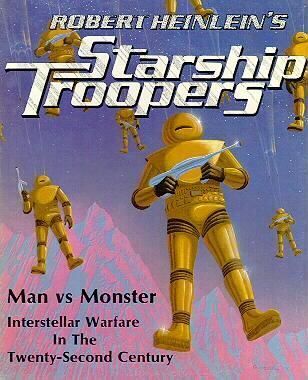
Starship Troopers is based upon the popular novel of the same name written by the dean of Science-Fiction writers, Robert A. Heinlein. In the novel, Heinlein describes a futuristic war involving homo sapiens from our Earth (Terrans) against a Humanoid race (nicknamed the 'Skinnies' for obvious physical attributes) and their cobelligerents, the totally alien Arachnids. Since this is a story of future wars and future advances in technology, much is changed in the fields of weaponry and tactics and strategy. One thing remains the same, however; the fighting still rests on the shoulders of the individual infantryman. Although great starships has shuttle men between the distant solar systems and the power of individual weapons has risen to awesome heights, wars still cannot be won unless men venture onto the face of alien planets and fight the enemy on their home ground. As Juan Rico, the protagonist of the novel, relates: "We are the boys who go to a particular place, at H-Hour, occupy a designated terrain, stand on it, dig the enemy out of their holes, force them then and there to surrender or die. We're the bloody infantry, the doughboy, the duckfoot, the foot soldier who goes where the enemy is and takes him on in person." Although the mission remains the same, future inventiveness has changed the method considerably. In a galaxy-wide war, manpower is at a premium. Platoons fight where entire armies once tred. But these platoons possess the firepower equivalence of a Twentieth-Century mechanized division. More importantly, each man in the platoon is provided with a piece of hardware that allows him to fight and survive in the holocausts of future combat—his powered armor suit. As Rico describes it: "A suit isn't a spacesuit — although it can serve as one. A suit is not a space ship but it can fly—a little . . . Suited up, you look like a big steel gorilla, armed with gorillasized weapons. But the suits are considerably stronger than a gorilla. If a Mobile Infantry man in a suit swapped hugs with a gorilla, the gorilla would be dead, crushed; the man and the suit wouldn't be mussed . . . The real genius in the design is that you don't have to control the suit, you just wear it, like your clothes, like skin . . . Even riding a bicycle demands an acquired skill, very different from walking. But a suit you just wear." With the suit and the incredible array of weaponry that go with it, the Mobile Infantry soldier is an exceedingly formidable opponent. He had better be. The enemies he faces are the most awesome adversaries in the galaxy. Of the two extraterrestrial races fighting the Terrans, the Humanoids are the least revolting. Rico describes them as " . . . humanoid, eight or nine feet tall, much skinnier than we are and with a higher body temperature; they don't wear any clothes and they stand out in a set of 'snoopers' like a neon sign." In early scenarios they are fighting on the side of the Arachnids. In later scenarios, after successful negotiations with Earth, they switch over to the Terran side. They're only effective fighters within the confines of their small city terrain and strong points on the board. But the 'Skinnies' were mild looking in comparison to the Arachnids: "The 'Bugs' are not like us. The Pseudo-Arachnids aren't even like spiders. They are arthropods who happen to look like a madman's concept of a giant, intelligent spider, but their organization, psychological and economic, is more like that of ants or termites; they are communal entities, the ultimate dictatorship of the hive . . . But don't make the mistake of thinking that they act purely from instinct . . . their actions are as intelligent as ours (stupid races don't build spaceships!) and were much better coordinated. It takes a minimum of a year to train a private to fight and to mesh his fighting with his mates; a Bug warrior is hatched able to do this ..." As the Arachnid Player, uses an Alien Control Pad sheet to record the placement of his underground central Hive cell complex and the attached tunnels radiating outward. Tunnels are used to move the Warrior units, along with Worker units mixed in as expendable decoys, to locations where they can pop up to the surface through a breach hole and attack the Terran units. Completely unseen, and only paper recorded, Engineer units are used to create the breaches and, later, to extend the tunnels. The game is set up in a "Programmed Instruction" system of scenarios to slowly introduce the game concepts. Scenarios range from Scenario I, which starts players off with a basic MI raid on a Skinny city (just like the book. "Flores died on the way up") to Scenario VII, The Battle of Klendathu: the final Terran assault on the Arachnid Homeworld. Warfare in the Twenty-second Century is the ultimate test of survivability of the human race. It was a very near thing. Avalon Hill Complexity rating - 5

Qué sensaciones ofrece

Simulation Ratio / Combat Results Table Secret Unit Deployment Hexagon Grid Grid Movement Line of Sight Dice Rolling Hidden Movement Movement Points Scenario / Mission / Campaign Game Science Fiction Novel-based Wargame

Explora estas mecánicas en Cardboard

Crea un prototipo original con patrones de diseño reutilizables, no con el contenido de este juego.

Abrir el taller de mecánicas

Inteligencia del juego

Aprende el juego

100% de cobertura de conocimiento

Preparación

1. Lay out the game board (sector grid), which is divided into numbered sectors (at least 1–25 across multiple rows and columns). 2. Separate the counter sheet into individual counters by type: Beam weapons (A–K), Missiles (A–F), Nuclear Missile Launchers (A–D), GEVs (A–F), Scouts (A–D), War Ships (A–B), and Transports (A–B). 3. Each player selects or is assigned a fleet of unit counters according to the scenario or agreed setup rules. 4. Players place their unit counters on designated starting sectors of the board according to the scenario instructions. 5. Determine the first player (e.g., by die roll or scenario specification). 6. Play proceeds in turns from the first player.

Flujo del turno

On each player's turn, they may move their unit counters to adjacent or reachable sectors on the numbered grid and then conduct combat with enemy units in range. Combat is resolved using the weapon systems equipped to (or associated with) each unit — Beams, Missiles, or Nuclear Missiles. After combat resolution, play passes to the next player. Specific turn phases (movement, combat, etc.) follow the order described in the scenario or core rules.

Puntuación y victoria

The player who achieves the scenario's victory conditions — typically by destroying enemy units, controlling key sectors, or eliminating the opponent's fleet — wins the game. Fuentes de puntuación: Destroying enemy unit counters, Controlling designated sectors, Surviving with Transport units (scenario-dependent), Eliminating enemy War Ships or key vessels

Fuente: Rulebook

Reglas que debes conocer

Las reglas más útiles para jugar bien la primera partida.

General

There are six unit types: Scout, GEV, War Ship, Transport, and associated weapon systems (Beam, Missile, Nuclear Missile Launcher).

The game features the following unit types, each represented by labeled counters: Scouts (A–D) are light reconnaissance vessels; GEVs (A–F) are fast attack craft; War Ships (A–B) are heavy combat vessels; Transports (A–B) are non-combat or support vessels. Weapons are represented by separate counters: Beam weapons (A–K), Missiles (A–F), and Nuclear Missile Launchers (A–D, value 10 each). Each unit counter has a front (active) and back side.

Combat

Nuclear Missile Launchers have a combat value of 10.

Each Nuclear Missile Launcher counter (A through D) is printed with a value of 10, indicating its combat strength or damage output when used in an attack. This is the highest printed weapon value in the game, making Nuclear Missiles the most powerful weapon available.

Movement

Units move across a numbered sector grid; sectors are numbered sequentially across rows.

The game board is divided into numbered sectors arranged in rows and columns. Sectors are numbered sequentially (e.g., 1–7 in the first row, 8–14 in the second, 15–21 in the third, 22–25 in the fourth visible row). Units occupy sectors and move between them according to their movement allowance. Adjacent sectors are those directly neighboring a unit's current sector on the grid.

Combat

Beam weapons (A–K, 11 total) are ship armaments used in direct combat.

Beam weapon counters are labeled A through K (11 counters total). They represent directed-energy weapons used in ship-to-ship combat. Beam weapons are assigned to or carried by ships and used during the combat phase to attack enemy units within range.

Combat

Standard Missiles (A–F, 6 total) are ranged armaments used in combat.

Missile counters are labeled A through F (6 counters total). They represent standard missile armaments available to ships. Missiles are used during the combat phase to attack enemy units, typically at range.

General

Transports (A and B) are support or cargo vessels, distinct from combat ships.

Transport counters (A and B) represent vessels designed for carrying troops or cargo rather than direct combat. There are two Transport counters in the game. Their specific combat capabilities (if any) are limited compared to War Ships or GEVs. Scenarios may assign special rules or victory conditions tied to the survival or destruction of Transports.

General

Scouts (A–D) are light reconnaissance ships.

Scout counters (A through D, 4 total) represent fast, lightly armed reconnaissance vessels. Scouts are typically used to probe enemy positions or provide intelligence. They are generally less powerful in direct combat than War Ships or GEVs but may have superior movement or special abilities depending on scenario rules.

General

GEVs (A–F) are fast attack craft, 6 total.

GEV (Ground Effect Vehicle) counters are labeled A through F (6 total). They represent fast, maneuverable attack craft capable of rapid movement and combat. GEVs may have higher movement allowances than heavier ships.

Informe estratégico

Prioritize Nuclear Missile Launchers on High-Value Targets

With a combat value of 10 — the highest in the game — Nuclear Missile Launchers (A–D) should be reserved for attacking War Ships or Transports rather than wasted on Scouts or GEVs. Their limited count (only 4) means efficient targeting is critical.

Use Scouts for Reconnaissance, Not Frontline Combat

Scouts are lightly armed and not suited for direct engagement with War Ships or GEV groups. Use them to probe enemy sector positions and gather information before committing heavier assets like War Ships or GEVs.

Protect Your Transports

Transports are likely high-value scenario targets. Keeping them in rear sectors, shielded by War Ships or GEVs, prevents opponents from achieving easy victory conditions by eliminating them.

Leverage GEV Mobility for Flanking

GEVs (A–F) are fast attack craft with presumed superior movement. Use them to outmaneuver slower War Ships, attack from unexpected sectors, and force opponents to split their defensive attention.

Beam Weapons for Close Engagements

With 11 Beam weapon counters (A–K), Beams represent the most numerous weapon type and are suited for close-range engagements. Cluster ships with Beam weapons in sectors adjacent to enemy units for maximum effect.

Preguntas frecuentes y casos límite

A player has both Nuclear Missile Launchers and standard Missiles available. Which should they use in combat?

Nuclear Missile Launchers have a printed combat value of 10, which is the highest weapon value in the game. Standard Missiles (A–F) do not show a comparable printed value in the available rulebook data, implying Nuclear Missiles are significantly more powerful. Use Nuclear Missile Launchers against high-value targets such as War Ships or Transports when available.

Does destroying an enemy Transport count toward victory?

Transports are distinct non-combat or support vessels. In many scenarios, destroying enemy Transports is a primary or secondary victory condition. Players should confirm the active scenario's victory conditions, as Transport destruction may award points or trigger an immediate win.

Can a Scout attack a War Ship in direct combat?

Scouts are light vessels and War Ships are heavy combat vessels. While Scouts can likely initiate combat if in the same or adjacent sector, their combat value is expected to be significantly lower than a War Ship's. Players should weigh the risk of losing a Scout against the chance of damaging a War Ship.

Is there a difference in range between Beam weapons and Missiles?

Beam weapons represent directed-energy weapons typically used at close range, while Missiles are ranged projectile weapons. Based on standard conventions for this genre, Missiles likely have greater range than Beams. Players should consult the specific scenario or weapon rules for exact range values.

Pregunta Sobre Este Juego

Juegos similares