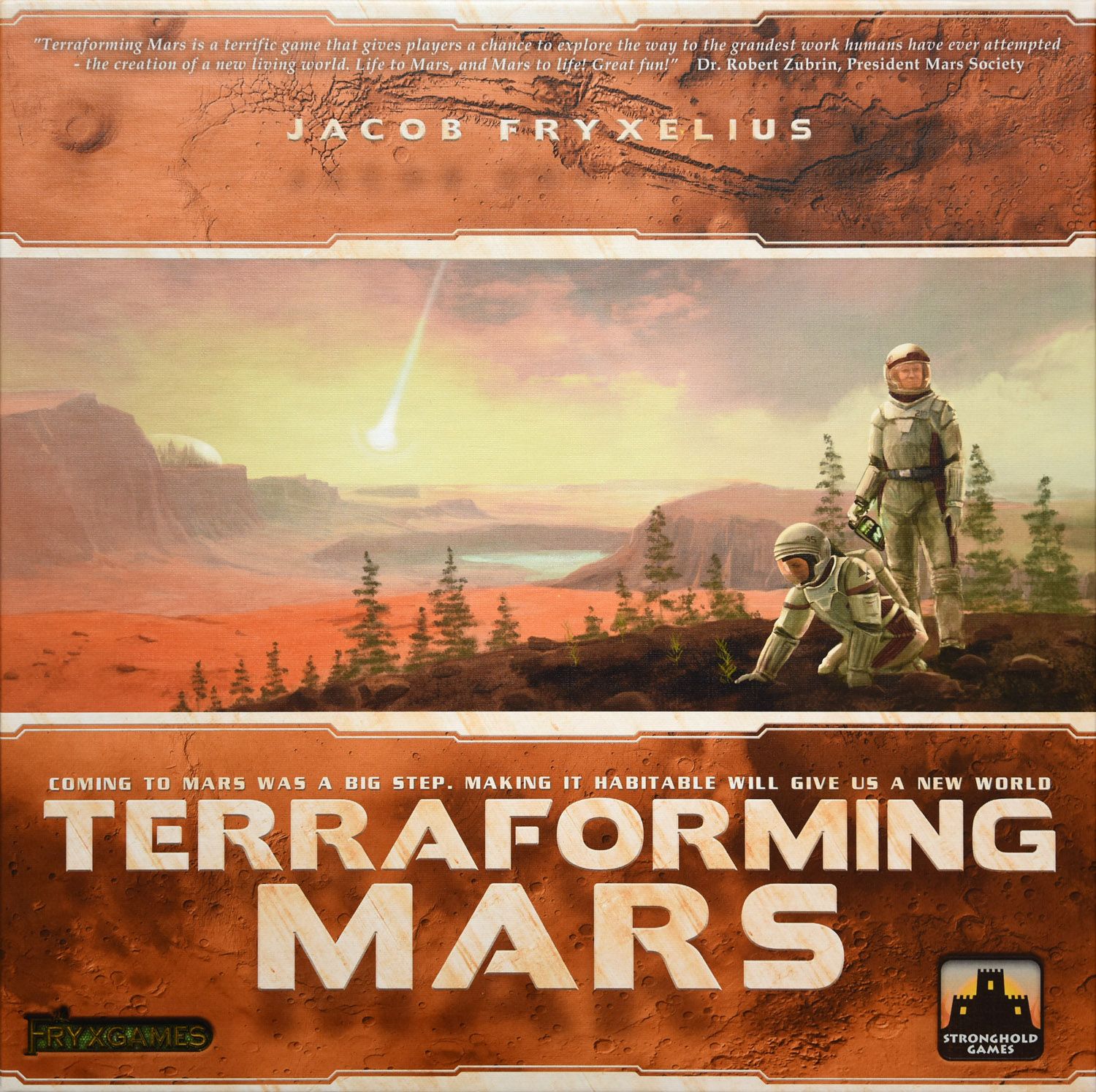
2016 Puesto n.º 9 en BGG

Terraforming Mars

1–5 jugadores 120 min A partir de 12 años 3.3/5 de complejidad 8.2/10 de valoración

Acerca de este juego

In the 2400s, mankind begins to terraform the planet Mars. Giant corporations, sponsored by the World Government on Earth, initiate huge projects to raise the temperature, the oxygen level, and the ocean coverage until the environment is habitable. In Terraforming Mars, you play one of those corporations and work together in the terraforming process, but compete for getting victory points that are awarded not only for your contribution to the terraforming, but also for advancing human infrastructure throughout the solar system, and doing other commendable things. As a player, you acquire unique project cards (from over two hundred different ones) by buying them to your hand. The cards can give you immediate bonuses, as well as increasing your production of different resources. Many cards also have requirements and they become playable when the temperature, oxygen, or ocean coverage increases enough. Buying cards is costly, so there is a balance between buying cards and actually playing them. Standard Projects are always available to complement your hand of cards. Your basic income, as well as your basic score, are based on your Terraform Rating. However, your income is boosted by your production, and VPs are also gained from many other sources. You keep track of your production and resources on your player board. The game uses six types of resources: MegaCredits, Steel, Titanium, Plants, Energy, and Heat. On the game board, you compete for the best places for your city tiles, ocean tiles, and greenery tiles. You also compete for different Milestones and Awards worth many VPs. Each round is called a generation and consists of the following phases: 1) Player order shifts clockwise. 2) Research phase: All players buy cards from four privately drawn. 3) Action phase: Players take turns doing 1-2 actions from these options: Playing a card, claiming a Milestone, funding an Award, using a Standard project, converting plant into greenery tiles (and raising oxygen), converting heat into a temperature raise, and using the action of a card in play. The turn continues around the table (sometimes several laps) until all players have passed. 4) Production phase: Players get resources according to their terraform rating and production parameters. When the three global parameters (temperature, oxygen, ocean) have all reached their required levels, the terraforming is complete, and the game ends after that generation. Combine your Terraform Rating and other VPs to determine the winning corporation!

Qué sensaciones ofrece

End Game Bonuses Tile Placement Tags Contracts Variable Player Powers Closed Drafting Hexagon Grid Solo / Solitaire Game Variable Set-up Take That Hand Management Turn Order: Progressive Income Science Fiction Industry / Manufacturing Territory Building Civilization Economic Space Exploration Environmental Science

Explora estas mecánicas en Cardboard

Crea un prototipo original con patrones de diseño reutilizables, no con el contenido de este juego.

Abrir el taller de mecánicas

Inteligencia del juego

Aprende el juego

100% de cobertura de conocimiento

Preparación

1. Place the Base board and Elysium board side by side, treating them as a single continuous planet surface. 2. Identify and mark the two seam hexes: Arsia Mons (appears on both boards, treated as one hex) and the rightmost 2 Plant hex on the Base board / leftmost 2 Plant hex on the Elysium board (treated as one hex each). When a tile is placed on one of these mirrored hexes, place a matching tile on the other board to represent it. 3. Remove Basic Corporations from the game. 4. Deal each player 6 Corporation cards. Players draft Corporations to the left. 5. Deal each player 6 Prelude cards. Players draft Preludes to the right. 6. Deal each player their 10 standard project cards. 7. Each player selects and keeps 1 Corporation and 3 Prelude cards from their drafted hands. 8. Collect all discarded/unused Corporation and Prelude cards and shuffle them back into their respective decks (available for in-game card effects such as Merger). 9. In player order: each player reveals and plays their Corporation card, then discards unwanted project cards or pays to keep them. 10. In player order, players play their Prelude cards one at a time. 11. Put all 11 Colonies into play. 12. Place all Milestones and Awards in play, including Venus Next ones. Cover the Terraforming Milestone on the Base Board with the Turmoil adjusted marker. There are 6 Milestone claim spots and 6 Award funding spots. 13. Set up doubled Global Parameters: place markers for Oxygen and Temperature on BOTH boards. Place two markers on the Venus Track. Set up 18 Ocean tiles (placeable on either map's appropriate hexes).

Flujo del turno

Turns follow standard Terraforming Mars rules with the following modifications: the Solar Phase follows the Turmoil rulebook but skips Step 2 (World Government Terraforming). During the Solar Phase and all other phases, both boards are active simultaneously. Players take actions using the full set of rules from the base game and all applicable expansions in play. Milestones may be claimed from either board (up to 6 total claim spots). Awards may be funded from either board (up to 6 total). Global Parameter advancement follows the doubled-parameter rules described in the rules section.

Puntuación y victoria

Standard Terraforming Mars scoring at game end: sum of Terraforming Rating (TR), Victory Points from cards, milestones, awards, greenery tiles, and city tiles. Highest score wins. Fuentes de puntuación: Terraforming Rating (TR) accumulated during the game, Victory Points printed on played project cards, Claimed Milestones (5 VP each for claimant, from up to 6 available milestones), Funded Awards (5/3/1 VP for 1st/2nd/3rd place, for up to 6 funded awards), Greenery tiles (1 VP each), Cities (1 VP per adjacent greenery tile), Other card-specific bonuses

Fuente: Rulebook

Reglas que debes conocer

Las reglas más útiles para jugar bien la primera partida.

Setup

Players draft 6 Corporation cards to the left, then keep 1.

Basic Corporations are removed from the game entirely before setup. Each player is dealt a number of Corporation cards equal to the number of players (6). Players draft these cards by passing them to the left. After the draft, each player keeps exactly 1 Corporation card. The remaining Corporation cards are collected, shuffled, and returned to the Corporation deck.

Setup

Players draft 6 Prelude cards to the right, then keep 3.

Each player is dealt a number of Prelude cards equal to the number of players (6). Players draft these cards by passing them to the right. After the draft, each player keeps exactly 3 Prelude cards. The remaining Prelude cards are collected, shuffled, and returned to the Prelude deck.

Setup

All discarded/unused Corporation and Prelude cards are reshuffled into their decks after selection.

After all players have selected their final Corporation and Prelude cards, all discarded and unused Corporation and Prelude cards are gathered and shuffled back into their respective decks. This ensures that cards like the Prelude card 'Merger', which require drawing from those decks during initial play, have cards available to draw.

Turn structure

Corporations are played in player order, then project cards are handled, then Preludes are played one at a time in player order.

After selection, cards are played in the following sequence: (1) In player order, each player reveals and plays their Corporation card. (2) Players then discard unwanted project cards or pay to keep them, per standard rules. (3) In player order, players play their Prelude cards one at a time (not all at once), cycling through players until all Preludes have been played.

Setup

The Base and Elysium boards are placed side by side and treated as a single continuous planet surface.

The Base board and Elysium board are placed side by side. Together they represent the full surface of Mars. All tile placement, adjacency, and area rules apply across both boards as if they were one seamless map. Players may place tiles and interact with hexes on either board unless otherwise restricted.

Special

Arsia Mons appears on both boards but is treated as a single hex.

Arsia Mons is a named location that appears on both the Base board and the Elysium board. In this variant, both instances are treated as the same single hex. When a tile is placed on Arsia Mons on one board, a matching tile must also be placed on the Arsia Mons hex of the other board to represent it. For all game rules (adjacency, bonuses, scoring, etc.), this hex is counted only once, not twice.

Special

The rightmost 2-Plant hex (Base board) and leftmost 2-Plant hex (Elysium board) are treated as the same hex.

The rightmost 2 Plant production hex on the Base board and the leftmost 2 Plant production hex on the Elysium board are treated as the same single hex. When a tile is placed on one of these hexes, a matching tile must also be placed on the corresponding hex on the other board. For all game rules, this hex is counted only once, not twice.

Restriction

Duplicated seam hexes and their tiles are counted only once for all game rules.

The duplicated hexes at the seam of the two boards (Arsia Mons and the two Plant hexes) are each treated as a single hex for ALL game rules. This means they count only once for adjacency checks, tile bonuses, milestone thresholds, award scoring, victory point calculations, and any other rule that counts hexes or tiles. The mirrored tile on the other board is a visual representation only.

Informe estratégico

Drafting Corporations and Preludes

With 6 cards drafted and only 1 Corporation kept, you will see every Corporation in your draft pod. Prioritize passing powerful synergistic Corporations away from opponents seated to your right (who drafted last before you) while securing the Corporation that best pairs with your 3 chosen Preludes. Preludes are drafted in the opposite direction, so the player to your left determines your last Prelude pick — plan your Prelude strategy around the first 4-5 picks.

Exploiting Cross-Board Adjacency

The seam between the Base and Elysium boards creates unique adjacency across boards (e.g., Pavonis Mons to Ulysses Patera). Early tiles placed near the seam can generate VP from greeneries placed on either board, effectively doubling the adjacency scoring opportunities compared to a single-board game.

Racing Global Parameters Strategically

With doubled global parameters (18 Oceans, two Oxygen/Temperature/Venus tracks), the game will last longer and TR from terraforming is harder to accumulate quickly. However, since rewards are only granted the FIRST time a level is reached, players who can consistently advance the trailing Venus marker or push the first Temperature/Oxygen track to key reward levels gain an advantage that cannot be repeated by opponents.

Milestone and Award Breadth

With 6 Milestones and 6 Awards drawn from two boards and Venus Next, there is far greater variety than in standard play. Funding awards early is especially powerful because with 6 players competing, award categories can be contested heavily. Prioritize awards where you have a structural engine advantage rather than ones requiring a late-game sprint.

Colony Utilization

All 11 Colonies are in play, providing more colony-building opportunities per player than in standard games. With 6 players, colonies will fill quickly; building early and diversifying across colony types maximizes resource income and trade opportunities throughout the longer game arc created by doubled global parameters.

Preguntas frecuentes y casos límite

A player wants to place a greenery tile adjacent to a city on the other board, near the seam. Does cross-board adjacency work?

Yes. The hexes above and below the duplicated seam hexes (Arsia Mons and the Plant hexes) are explicitly considered adjacent across boards. Pavonis Mons and Ulysses Patera, for example, are adjacent. Standard adjacency rules apply to these cross-board connections for all purposes including greenery placement and city VP scoring.

A player places a tile on the Arsia Mons hex. Do they receive placement bonuses twice (once per board)?

No. The duplicated seam hexes are counted only once for all game rules. The player receives the tile placement bonus once. The matching tile placed on the other board is purely representational.

Both Venus markers are at the same level. Which one must a player advance?

When both Venus markers are at the same level, the active player may choose which marker to advance. Only when one marker is behind the other is the choice forced — the trailing marker must be advanced first.

The second Temperature marker reaches -24°C. Does the player advancing it receive 1 heat production?

No. Rewards for reaching a global parameter level are granted only the first time any marker reaches that level. The second marker reaching -24°C confers no additional reward.

A player plays the Prelude card 'Merger' during the initial play phase, which requires drawing from the Corporation deck. Are there cards available?

Yes. After all players have selected their Corporations and Preludes, all discarded and unused cards are reshuffled back into their respective decks specifically to ensure cards are available for effects like Merger during initial play.

Can a player claim a milestone that is physically on the Elysium board while another player has claimed one from the Base board?

Yes. All milestones from both boards (and Venus Next) are in play as a single shared pool of 6 claim spots. Players may claim any unclaimed milestone from either board regardless of which board other milestones have been claimed from.

Can all 18 Ocean tiles be placed on a single board, or must they be distributed between boards?

Ocean tiles may be placed on any appropriate (reserved ocean) hex on either the Base board or the Elysium board. There is no requirement to distribute them between boards; placement is limited only by the availability of legal ocean hexes on each board.

During the Solar Phase, should World Government Terraforming (Step 2 from Turmoil) occur?

No. Although the Solar Phase otherwise follows the Turmoil rulebook, Step 2 (World Government Terraforming) is explicitly skipped and does not occur.

Pregunta Sobre Este Juego

Juegos similares