2005 Puesto n.º 26413 en BGG

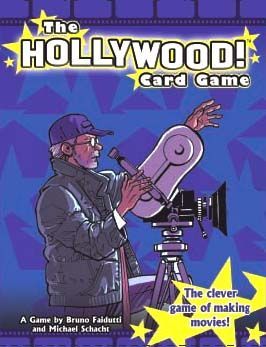
The Hollywood! Card Game

3–4 jugadores 15 min A partir de 12 años 1.3/5 de complejidad 5.5/10 de valoración

Acerca de este juego

The Hollywood Card Game is a fast and simple card game from Bruno Faidutti and Michael Schacht, designers of such games as Citadels, Coloretto and Fist of Dragonstones. This exciting and unique card game invites players to compete to get the best directors and most famous actors for their films. With an easily accessible theme, and simple but deep gameplay, The Hollywood Card Game appeals as much to casual gamers as it does to hardcore strategists. The game plays over 3-4 rounds (the same number as the number of players), with each player having one turn to play first. Each round a new Hollywood Area is created by shuffling 3 Star cards and 11 Movie cards together and dealing them out into 4 columns. Players take turns either placing a marker on the bottom card of a column (pushing the preceding markers up the column), or playing one of their Studio cards (Skip a turn, or take two turns in a row). Each studio card can only be used once per game. Once each card in a column has a marker on it, that column is closed, and no more markers have been played in this column. Once all players have run out of markers, the round is over, and cards are allocated to players based on the marker on the card, and starting from the TOP left corner. Cards are allocated one at a time, and must be used on a Project immediately. Film cards must be allocated to a Project of the same genre (Horror, Action, or Romantic Comedy), or allocated to a new project if the player does not already have a Project of that genre. Star cards must be allocated to any project, however this will immediately complete a Movie, which no more cards can be added to. If a Star card cannot be allocated to a project, they cannot be held to add to a later project. Movies score points for the number of Film cards in them (with Award Film cards counting twice), multiplied by the number of stars on the Star card. Blockbuster cards stand alone and are worth 2 points each. Additionally, each player scores one point for each Film card in their largest unfinished project (no ties allowed). The player with the most points wins. If players are tied, the player with the single most valuable movie is the winner. The Hollywood Card Game contains 64 cards, 16 film reel chips, and a rule sheet. The game is suitable for three to four players Ages 8 and up

Qué sensaciones ofrece

Card Game Movie Industry

Inteligencia del juego

Aprende el juego

100% de cobertura de conocimiento

Preparación

1. Separate the 12 Star cards from the rest of the deck and shuffle them to form the Star Deck. 2. Shuffle the 39 Film cards and 5 Blockbuster cards together to form the Movie Deck (44 cards total). 3. Place both decks face-down separately on the table (note: both decks share the same card backs). 4. Each player selects a color and takes the two Studio cards (Clap Board and Double Reel) plus the cardboard Movie Reel counters of that color. 5. In a 4-player game, each player takes only 3 Movie Reel counters and returns surplus counters to the box. (In a 3-player game, players take their full allotment of Movie Reel counters.) 6. Randomly determine the first player. 7. Before each round, create the Hollywood area: draw 3 cards from the Star Deck and 11 cards from the Movie Deck, shuffle these 14 cards together, then place them face-up one at a time in four adjacent columns, filling from the top of the leftmost column first.

Flujo del turno

The game is played over a number of rounds equal to the number of players (3 rounds for 3 players, 4 rounds for 4 players). Each round, players take turns in clockwise order starting with the first player. On your turn, you must either: (a) place one of your Movie Reel counters on one of the four bottom cards of the Hollywood area, following bumping rules, or (b) play one of your two Studio cards (Clap Board or Double Reel), each usable only once per game. If you have no Movie Reel counters remaining, you are skipped. The round ends when the 12th (last) Movie Reel counter is placed. Players then collect the cards their Movie Reels rest on (in order, top of left column downward), immediately assigning each card to their play area. Two cards in the Hollywood area will always go unclaimed each round. After all cards are claimed, players retrieve their Movie Reel counters and begin the next round. The first player of each new round is the player to the left of the previous round's first player, so every player is first player exactly once per game.

Puntuación y victoria

Most total points after the final round wins. Ties are broken by the player with the most valuable single finished movie. Fuentes de puntuación: 2 points per Blockbuster card in play area, Finished movies: Film card count × Star card rating (Award Film cards count twice), 1 point per Film card in your single largest unfinished project (only if you have a clear largest), Advanced Rules: multiply each movie's score by the number of unclaimed Film cards of the same color

Fuente: Rulebook

Reglas que debes conocer

Las reglas más útiles para jugar bien la primera partida.

Setup

Create the Star Deck (12 cards) and Movie Deck (44 cards) before play.

Before the game begins, separate the 12 Star cards (depicting actors and directors) to form the Star Deck. Shuffle the 39 Film cards and 5 Blockbuster cards together to form the Movie Deck (44 cards total). Shuffle each deck and place them separately on the table. Both decks share the same card backs, so be careful not to mix them.

Setup

Each player takes Studio cards and Movie Reel counters of one color.

Each player selects a color and takes: the two Studio cards of that color (the Clap Board card and the Double Reel card) and the cardboard Movie Reel counters of that color. In a 4-player game, each player takes only 3 Movie Reel counters and places surplus counters back in the box. In a 3-player game, players take their full allotment of Movie Reel counters.

Setup

Before each round, build the Hollywood area from 3 Star cards and 11 Movie cards arranged in four columns.

Before each round, draw 3 cards from the Star Deck and 11 cards from the Movie Deck. Shuffle these 14 cards together, then place them face-up one at a time into four adjacent columns, starting with the top of the leftmost column. The result is a grid of 14 cards in four columns used as the playing area for the round.

Turn structure

The game lasts a number of rounds equal to the number of players.

Hollywood! is played over a number of rounds equal to the number of players: 3 rounds in a 3-player game, 4 rounds in a 4-player game.

Turn structure

On your turn, you must either place a Movie Reel counter or play a Studio card.

When it is your turn, you must do one of the following: (a) Place one of your Movie Reel counters in the Hollywood area, or (b) Play one of your two Studio cards (Clap Board or Double Reel). If you have no Movie Reel counters remaining, you are out of the round and do not receive a turn; play skips you until the 12th Movie Reel counter is placed.

Movement

A Movie Reel counter must always be placed on one of the four bottom cards of the Hollywood area.

When placing a Movie Reel counter, you must place it on one of the four bottom cards of the Hollywood area (one per column). You may not place a Movie Reel counter in a full column (a column where every card already contains a Movie Reel counter). There can never be two Movie Reel counters on the same card.

Movement

Placing a reel on an occupied bottom card bumps all reels in that column up one card.

If another Movie Reel counter (yours or an opponent's) already exists on the bottom card of the column you choose, that counter is 'bumped' up one card toward the top of the column. All other preexisting Movie Reel counters in that column also advance one card toward the top. There can never be two Movie Reel counters on the same card at any time.

Restriction

A player may not place a Movie Reel counter in a full column.

A column in the Hollywood area is considered full when every card in that column already contains a Movie Reel counter. A player may not place a Movie Reel counter in a full column.

Informe estratégico

Card Collection Order

The order in which cards are collected at round end (top of left column downward, left to right) is strategically critical. Because each card must be assigned immediately, receiving a Star card before Film cards of a matching color results in the Star card being discarded. Try to position your Movie Reels so that you collect Film cards before Star cards in the collection order.

Bumping as Offense

Bumping is a powerful offensive tool. By placing your reel in a column where an opponent's reel sits on the bottom card, you push their reel toward the top (and toward less desirable or better cards). Conversely, bumping your own reel up can help you reach a Star card higher in the column.

Double Reel Timing

The Double Reel Studio card grants two placements in a single turn, effectively letting you claim two cards in one round. Use it when you can secure both a valuable Film card and a Star card (or two Film cards that establish and grow a project in one turn). Remember you must have at least two counters remaining.

Clap Board Defensive Use

The Clap Board Studio card skips your own turn. This is best used when all desirable bottom positions are already taken or when skipping lets you go later and react to opponents' moves — not a wasted action if used to deny opponents information about your plans.

Building High-Value Movies

Movie scoring is Film cards × Star rating, so both quantity of Film cards and quality of Star are important. A 4-film-card movie with a 3-star actor scores 12 points. Prioritize collecting Film cards of a single color to maximize the film count, and use Star cards with high ratings for your biggest projects.

Award Film Cards

Each color has exactly one Award Film card, which counts twice in the scoring formula. Securing the Award Film card for your largest project can significantly boost your score — effectively adding a free extra Film card to the count.

Managing Unfinished Projects

Your largest unfinished project scores 1 point per Film card at game end, but only if it is uniquely the largest. Avoid splitting Film cards evenly across two unfinished projects of the same size, as this eliminates the bonus entirely.

Star Card Risk

Receiving a Star card when you have no matching projects sends it to the box with zero benefit. Be mindful of your project status before the collection phase — consider sacrificing a better column position to ensure you have at least one project when a Star card comes your way.

Blockbusters as Safe Points

Blockbuster cards provide a reliable flat 2 points each with no conditions. They can be a good fallback when Film card opportunities are scarce, offering guaranteed scoring without the dependency on also having a Star card.

Advanced Rules — Unclaimed Cards Multiplier

Under Advanced Rules, the unclaimed Film cards of a color multiply your movie's score. Colors that appear less often in the Hollywood area (or that opponents ignore) will accumulate more unclaimed cards, making movies of those colors potentially far more valuable. Early investment in an undervalued color can pay off massively at game end.

Preguntas frecuentes y casos límite

A player receives a Star card but has no unfinished projects in their play area. What happens?

The Star card is worthless in this situation and is immediately placed back in the box. The player cannot hold it for later use.

A player receives a Star card but does not want to complete any of their current projects. Can they refuse to assign it?

No. A player must assign the Star card to one of their current projects, even if they do not wish to. Hollywood can be a ruthless place!

A player has a finished Horror movie. Can they start a new Horror project if they receive another Horror Film card?

Yes. A finished movie is no longer considered a project. A player may start a new project of the same color after completing a movie of that color.

A player wants to play the Double Reel Studio card but only has one Movie Reel counter remaining. Can they play it?

No. The Double Reel card requires the player to have at least two Movie Reel counters remaining. If they do not, they cannot play this card.

Can placing a reel cause the column to become full such that the bumped counter has nowhere to go?

No. A column is full when every card in it already contains a Movie Reel counter. A player may not place a reel in a full column to begin with, so this situation cannot arise through normal play. There can also never be two Movie Reel counters on the same card.

A finished movie contains one Award Film card and two regular Film cards with a Star rated 3 stars. How many points does it score?

The Award Film card counts as 2, so the Film card count is 2 + 1 + 1 = 4. Multiplied by the Star rating of 3, the movie scores 12 points.

At game end, a player has two unfinished projects each with 3 Film cards. Do they score points for the largest project?

No. If a player does not have a single largest project (i.e., two or more projects are tied for largest), they do not receive the largest project points.

Why does the order of card collection matter at the end of a round?

Because each card must be immediately assigned before the next is received, the order can matter significantly. For example, receiving a Star card before you have any Film cards of a suitable color results in the Star card being discarded. Conversely, receiving Film cards first builds up a project that the Star card can then complete.

Can a player with no Movie Reel counters still play their Clap Board Studio card?

No. If a player has no Movie Reel counters remaining, they are out of the round and are automatically skipped. The Clap Board card is a turn option only available when you would normally take a turn, which requires you to still be in the round. A player without counters does not take a turn at all.

In the Advanced Rules, how are the unclaimed Film cards (set aside each round) used in scoring?

The two Film cards set aside each round (the unclaimed ones) accumulate over all rounds. At game end, when scoring a movie, multiply its normal score (Film cards × Star rating) by the total number of unclaimed Film cards of the same color set aside across all rounds. Star cards and Blockbuster cards that go unclaimed do not affect this multiplier.

Pregunta Sobre Este Juego

Juegos similares