2013 Puesto n.º 5184 en BGG

The Witches

1–4 jugadores 90 min A partir de 13 años 1.7/5 de complejidad 5.8/10 de valoración

Acerca de este juego

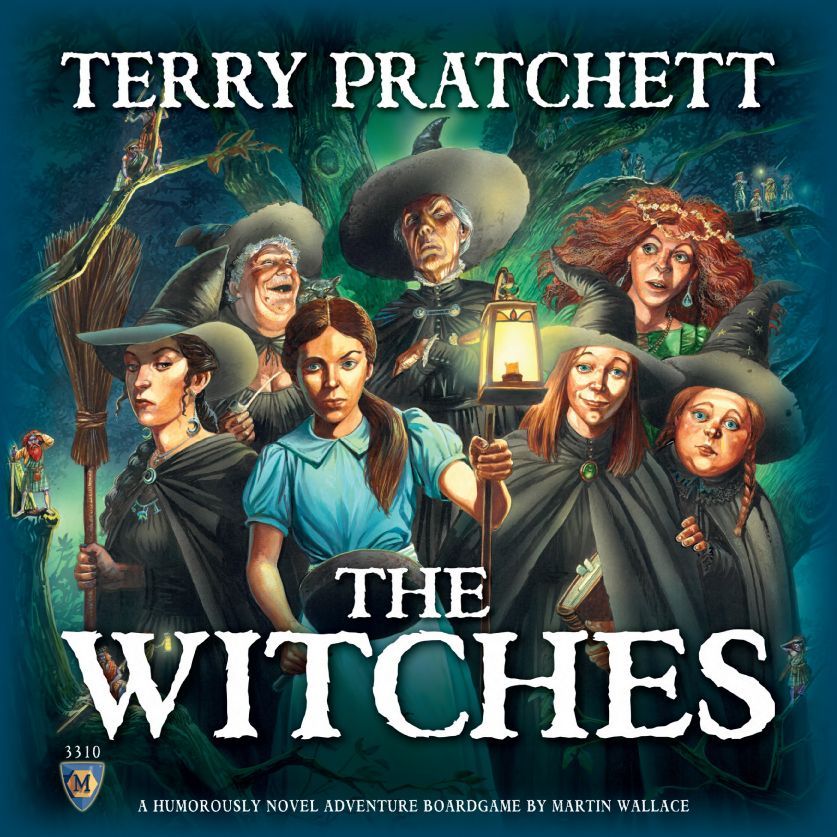
The Witches: A Discworld Game is the second of three games by Martin Wallace set in Terry Pratchett's Discworld, the first being Discworld: Ankh-Morpork. The Witches is set in the magically charged land of Lancre. Players take on the role of trainee witches, such as Tiffany Aching and Petulia Gristle, learning their craft and dealing with all the problems, both petty and serious, that life on Discworld can throw at them. A subtle blend of headology, magic and, of course, the all-important cup of tea will see our heroines tackle everything from a sick pig to a full-blown invasion of elves. Each player tries to be better at everything than the others, while also cooperating to prevent crises from escalating. Life can be tough for a young witch in Lancre. Fear not, however, as some of Terry Pratchett's most famous characters will be on hand to aid your quest. Along the way you'll meet Granny Weatherwax, Nanny Ogg and Magrat Garlick, as well as a rich supporting cast of familiar faces from the Discworld series. When things get really tough and you feel you are turning "Black Aliss", you can always have a cup of tea with one of your fellow witches. The Witches can be played competitively, cooperatively, or solo.

Qué sensaciones ofrece

Cooperative Game Set Collection Stat Check Resolution Point to Point Movement Solo / Solitaire Game Dice Rolling Events Critical Hits and Failures Novel-based Fantasy Witches

Explora estas mecánicas en Cardboard

Crea un prototipo original con patrones de diseño reutilizables, no con el contenido de este juego.

Abrir el taller de mecánicas

Inteligencia del juego

Aprende el juego

100% de cobertura de conocimiento

Preparación

1. Set up the Problem Box by placing Hard Problems (always hidden/face-down) and Easy Problems (always open/face-up) in their stacks according to the player count: - 1 Player: Hard — 1,1,1,0,0,0; Easy — 2,2,1,0,0,0 - 2 Players: Hard — 1,1,2,1,1,1; Easy — 2,2,1,2,1,1 - 3 Players: Hard — 2,2,2,2,2,2; Easy — 2,2,2,2,2,2 - 4 Players: Hard — 2,2,2,2,2,0; Easy — 4,4,4,3,3,0 2. Seed the board with problems as marked on the board. 3. Each player chooses a witch. 4. Shuffle the card deck and deal 3 cards to each player. 5. The first player is Dimity (if playing as her), otherwise the last witch chosen goes first. Place your witch on any location that does not currently have a problem. Play proceeds clockwise.

Flujo del turno

Each player takes a full turn consisting of four sequential steps: 1. Place the next Problem Tile — draw a card to determine the location; if a problem is already there, place a Crisis token on it (if none is there) and draw again; if the location is empty, place the top problem from the leftmost applicable stack and end the draw. 2. First Move & Action — move your witch and take one action. 3. Second Move & Action — move your witch again and take a second action. 4. Draw Cards — refill your hand up to your current hand-size maximum. After completing all four steps, play passes clockwise to the next player.

Puntuación y victoria

Highest Victory Points wins. Each player sums VP on their solved problem tiles and subtracts 1 VP per Black Aliss counter held. Ties broken by: fewest Cackle+Black Aliss counters, then most points from Hard Problems, then highest single Hard Problem score. Fuentes de puntuación: Victory Points printed on solved problem tiles, Penalty: -1 VP per Black Aliss counter held

Fuente: Rulebook

Reglas que debes conocer

Las reglas más útiles para jugar bien la primera partida.

Setup

Number of Hard and Easy Problems placed per stack varies by player count.

The number of Hard Problems (always hidden/face-down) and Easy Problems (always open/face-up) placed into each of the six problem stacks depends on the number of players: Hard Problems per stack: - 1 Player: 1, 1, 1, 0, 0, 0 - 2 Players: 1, 1, 2, 1, 1, 1 - 3 Players: 2, 2, 2, 2, 2, 2 - 4 Players: 2, 2, 2, 2, 2, 0 Easy Problems per stack: - 1 Player: 2, 2, 1, 0, 0, 0 - 2 Players: 2, 2, 1, 2, 1, 1 - 3 Players: 2, 2, 2, 2, 2, 2 - 4 Players: 4, 4, 4, 3, 3, 0

Setup

Hard Problems are always placed face-down (hidden).

Hard Problem tiles are always placed face-down on the board, meaning their difficulty and type are unknown to players until a witch attempts to solve one and flips it.

Setup

Easy Problems are always placed face-up (visible).

Easy Problem tiles are always placed face-up on the board, meaning their difficulty and type are visible to all players from the moment they are placed.

Setup

Dimity goes first; otherwise the last witch chosen starts. Witches begin on locations without a problem.

If a player is playing as Dimity, she takes the first turn. Otherwise, the last witch to be chosen by a player takes the first turn. Each witch is placed on a location that does not currently have a problem tile on it. Play then proceeds clockwise.

Setup

Shuffle the deck and deal 3 cards to each player.

After all witches have been chosen, shuffle the full card deck and deal 3 cards face-down to each player. These form each player's starting hand.

Turn structure

A turn has four steps: (1) Place Problem Tile, (2) First Move & Action, (3) Second Move & Action, (4) Draw Cards.

On your turn, you must complete all four steps in order: 1. Place the next Problem Tile on the board. 2. Take your first Move and Action. 3. Take your second Move and Action. 4. Draw cards to refill your hand. After completing all steps, play passes clockwise to the next player.

Turn structure

At the start of your turn, draw a card to determine where the next problem is placed.

At the beginning of your turn, draw a card from the deck. The card's location symbol indicates where the next problem tile is placed. Resolve as follows: - If there is already a problem at that location: place a Crisis token on that problem tile (if it does not already have one), then draw again to find a new location. - If the location is empty: place the top problem tile from the leftmost non-empty problem stack there. Stop drawing — the placement is complete.

Movement

Walk 1 or 2 locations along paths; must stop at a problem location (with exceptions).

When walking, a witch may move 1 or 2 locations along connected paths on the board. If a witch enters a location that contains a problem tile, she must stop there immediately and may not continue moving through it — unless the location is an empty location space (Lancre) or the witch is using Invisibility. Walking does not require discarding any card.

Informe estratégico

Hand Size Growth

Prioritize solving Easy Problems early. Each 2 Easy Problems solved permanently increases your hand size by 1 (up to max 7). A larger hand gives more flexibility to combine Magic, Headology, and Broomstick cards for difficult problems.

Cackle Management

Keep Cackle counters low to avoid triggering Black Aliss. Since Black Aliss counters cost 1 VP each at game end, accumulating them directly undercuts your score. Use Have Tea actions when multiple witches gather at the same location for a shared cackle-dump (up to 3 for you, 2 for each ally).

Card Timing

Play Magic and Headology cards only in the first card-play window (before the second roll). Save non-Magic, non-Headology Benefit cards for the second window to maximize your total. Never waste Magic on easy problems unless you need to recover from a bad first roll.

Broomstick Cards

Broomstick cards serve double duty: movement (bypassing problem-stop rules) and safe retreat (fly to any empty location instead of just adjacent). Hoard at least one for a difficult Hard Problem attempt in case of failure.

Crisis Prevention

The game ends in a collective loss if the Crisis token supply runs out. Actively prioritize locations where problems are about to stack up (i.e., locations already holding a problem) to prevent Crisis tokens from being placed and depleted.

Hard Problem Risk vs. Reward

Hard Problems are worth more VP and are the final tiebreaker. However, failing one triggers a special rule and always costs a Cackle plus retreat. Approach Hard Problems with a strong card hand and reserve Broomstick cards for retreating to the safest empty location.

Power of Three Setup

The Power of Three (three cards with three different witch characters) bypasses all dice rolling and solves any problem on the board. This is especially powerful for Hard Problems at distant locations or when your Cackle count is already dangerously high.

Preguntas frecuentes y casos límite

Can I play Magic or Headology cards after the second dice roll?

No. Magic and Headology cards may only be played during the first card-play window, between the first 2-dice roll and the second 2-dice roll. After the second roll, only non-Magic, non-Headology cards may be played.

When retreating after a failure or running away, does a Broomstick card let me go anywhere — not just adjacent?

Yes. Without a Broomstick card, retreat after failure or running away is limited to an adjacent empty location. With a Broomstick card, the witch may fly to any empty location on the board. The card is discarded after use.

What happens if there is no adjacent empty location to retreat to after a failed solve and I have no Broomstick card?

If no legal retreat is possible (no adjacent empty location and no Broomstick card), the witch takes an additional Cackle counter and may then fly to any empty location even without a Broomstick card.

The Cackle stock is empty and I need to take a Cackle — what happens?

Take a Cackle from the witch who currently holds the most Cackle counters. If that witch is you (you already have the most), take a Black Aliss counter instead.

A card draw lands on a location that already has a problem. What happens if there is no Crisis token to place?

If a Crisis token is needed but none remain in the stock, all players immediately lose the game.

How many cards can I hold at the end of my turn if I have solved 4 Easy Problems?

Your maximum hand size is 3 + 1 for every 2 Easy Problems solved. With 4 Easy Problems solved, that is 3 + 2 = 5 cards. The absolute maximum is 7 cards.

Can the Power of Three solve a problem at a different location than where my witch is standing?

Yes. The Power of Three allows a witch to solve any problem on the board during her action, regardless of the witch's current location.

I want to walk 2 spaces, but the first space has a problem on it. Must I stop?

Yes. When walking, a witch must stop upon entering a location that contains a problem tile. She cannot continue through it unless the location is an empty location space (Lancre) or she has Invisibility.

If I play a Magic card during a solve, do I take a Cackle even if I succeed?

Yes. Playing a Magic card always causes you to take 1 Cackle counter immediately, regardless of the outcome of the solve attempt.

Pregunta Sobre Este Juego

Juegos similares