2025 Puesto n.º 307 en BGG

Toy Battle

2 jugadores 15 min A partir de 8 años 1.5/5 de complejidad 7.2/10 de valoración

Acerca de este juego

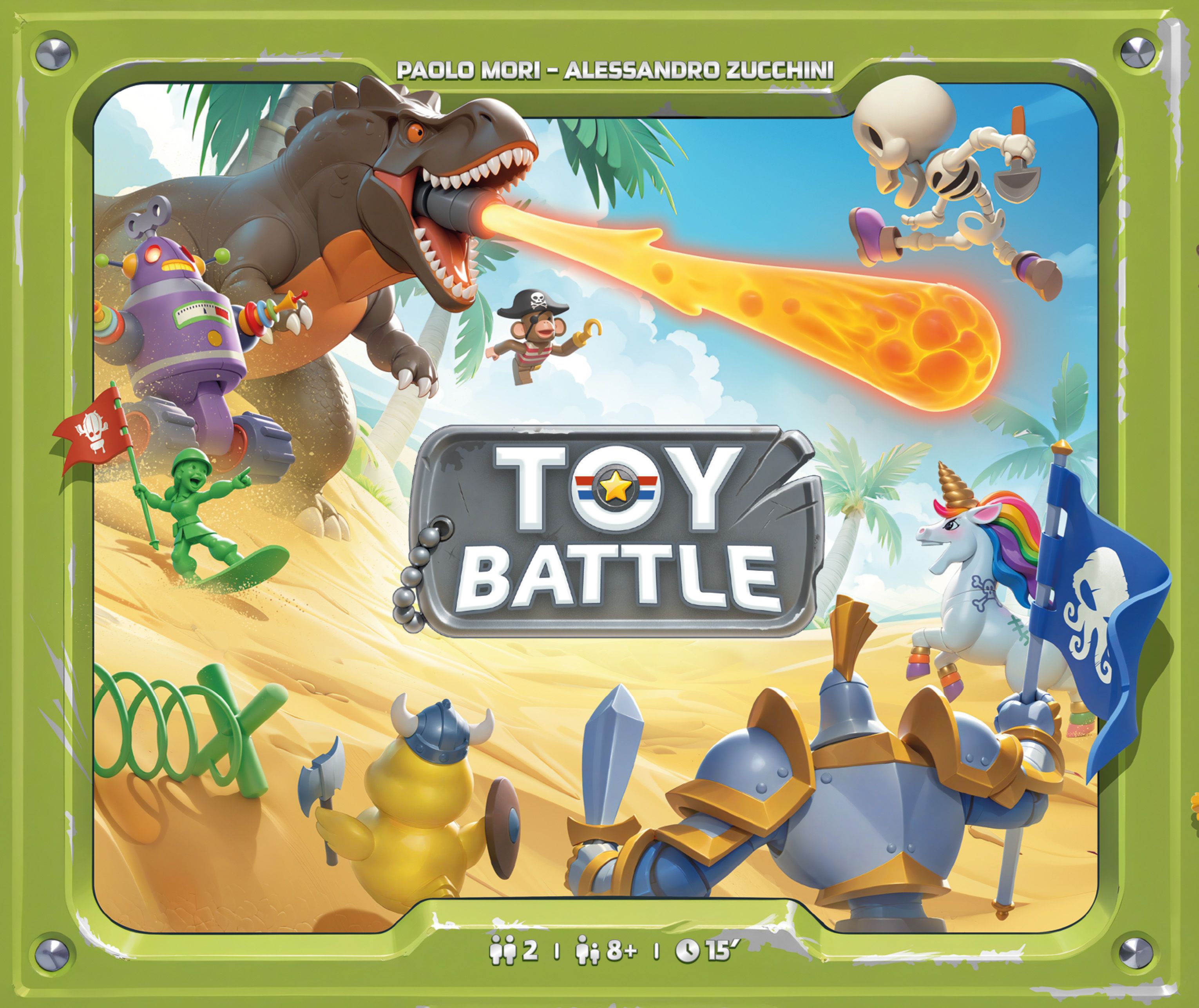
On land, on sea, in clouds, and even in space, battles are breaking out between toys. Your troops need your tactical talent to lead them to victory. Your mission? Be the first to reach the enemy headquarters or control more territories than your opponent. On your turn in Toy Battle, you either draw two toy troops or place a troop on the board and apply its effect. When you place a troop, you can place it on an empty base, a base that you control, a base that the enemy controls with a lower-valued troop than the one you're placing, or the enemy's headquarters; however, in all cases you must place on a location that has a continuous path to your own headquarters through bases that you occupy, that is, that have your troop on top. If you occupy bases that form a continuous path around a region, you claim the medals within this region. (You don't lose these medals if the enemy later occupies one of these bases.) The game ends as soon as you occupy your opponent's headquarters or win the required number of medals based on the current game board. If a player cannot draw or place a troop, the game ends, and whoever has the most medals wins. —description from the publisher

Qué sensaciones ofrece

Sudden Death Ending Zone of Control Area Majority / Influence Multiple Maps Wargame Toys / Plushies / Stuffed Animals

Explora estas mecánicas en Cardboard

Crea un prototipo original con patrones de diseño reutilizables, no con el contenido de este juego.

Abrir el taller de mecánicas

Inteligencia del juego

Aprende el juego

100% de cobertura de conocimiento

Preparación

1. Choose one of the 8 available Terrains. For your first game, Castle Field is recommended. Place the Terrain board between the two players so that each player has their designated symbol (and matching Medals objective and Troop color) in front of them. 2. Place one Medal marker on each Medal space (shown by a Medal symbol) on the board. Return any unused markers to the box. 3. Each player takes a rack and places it in front of themselves. 4. Each player shuffles all of their color's Troop tiles face-down to form their personal reserve (draw pile). 5. Each player removes 4 Troops from their reserve without looking at them and returns them to the box — these Troops will not be used this game. 6. Randomly choose the starting player. The starting player draws 3 Troops from their reserve and places them on their rack. The other player draws 4 Troops and places them on their rack. 7. Leave an empty space next to the board for the discard pile. (For first games, place the player aid nearby.)

Flujo del turno

The game proceeds in turns, alternating between players starting with the first player. On your turn, you perform exactly ONE of the following two actions: ACTION 1 — DRAW 2 TROOPS: Draw 2 Troops from your reserve and add them to your rack. Your rack holds a maximum of 8 Troops. You cannot take this action if you already have 8 Troops on your rack. If your reserve has only 1 Troop left, or you have only 1 empty space on your rack, you may still take this action to draw only 1 Troop. ACTION 2 — PLACE 1 TROOP ON THE TERRAIN: Choose 1 Troop from your rack and place it on a valid slot on the Terrain, following the placement rules. You now occupy that slot. Then apply the effect of your Troop (if any), followed by the effect of the base it was placed on if it is a special base. (For first games, ignore special base effects and treat all special bases as normal bases.) After placing and resolving effects, check for region control and victory conditions.

Puntuación y victoria

The winner is the first player to fulfill an immediate victory condition: capture the enemy H.Q. with a Troop, or accumulate Medals equal to or exceeding the Medals objective shown on the Terrain. If the game ends because a player cannot act, the player with more Medals wins; on a tie, the player who ended the game loses. Puntuación objetivo: Reach the Medals objective shown on the chosen Terrain board, OR place a Troop on the enemy H.Q. Fuentes de puntuación: Medal markers collected by capturing regions (taking control of all surrounding bases), Capturing the enemy H.Q. (instant win — no Medal count needed)

Fuente: Rulebook

Reglas que debes conocer

Las reglas más útiles para jugar bien la primera partida.

General

Each Troop tile has a strength value and usually a special effect.

Each Troop tile has a strength value ranging from 1 to 7, or a joker strength (depicted by a special symbol). Most Troops also have a printed effect that is applied immediately when the Troop is placed on the Terrain. There are 3 copies of each Troop type per player color. Players always play with their own color's Troops.

Restriction

A player's rack holds a maximum of 8 Troops at any time.

Each player's rack can hold a maximum of 8 Troop tiles at one time. A player cannot perform the DRAW 2 TROOPS action if they already have 8 Troops on their rack. If a player has only 1 space remaining on their rack, or only 1 Troop remains in their reserve, they may still perform the draw action but will draw only 1 Troop instead of 2.

Drawing

On your turn, you may draw 2 Troops from your reserve and place them on your rack.

When you choose the DRAW 2 TROOPS action, draw 2 Troops from your personal reserve (face-down pile) and place them face-up on your rack. This action is not available if you already have 8 Troops on your rack. If your reserve has only 1 Troop remaining, or you only have 1 space left on your rack, you may still take this action but only draw 1 Troop.

Turn structure

On your turn, you may place 1 Troop from your rack onto a valid slot on the Terrain.

When you choose the PLACE 1 TROOP ON THE TERRAIN action, select 1 Troop tile from your rack and place it on a valid slot on the Terrain (see placement rules). After placing, you occupy that slot. Then resolve: (1) the effect of the placed Troop, if any; (2) the effect of the base it was placed on, if it is a special base. Note: For introductory games, special base effects are ignored.

Placement

A Troop may be placed on an empty base, a base you already occupy, or an enemy base whose top Troop has strictly lower strength than yours.

When placing a Troop on the Terrain, you may choose one of the following valid slots: 1. An empty base. 2. A base currently occupied by one or more of your own Troops (you place on top). 3. A base occupied by an enemy Troop, provided the visible (top) enemy Troop has a strictly lower strength value than the Troop you are placing. 4. The opponent's H.Q. (capturing it wins the game immediately). You may NEVER place a Troop on your own H.Q.

Placement

Multiple Troops can occupy the same base in a stack; only the top Troop counts as occupying the base.

When placing a Troop on a base that already has one or more Troops, place the new tile on top of the existing stack. There is no limit to how many Troops can be stacked on a single base. Only the topmost (visible) Troop on a stack counts as occupying that base — it determines the base's current controller and the strength at that base. Players may look at the tiles in a stack at any time, but may never change their order.

Restriction

You may only place a Troop on a slot that is connected to your H.Q. via a continuous path through bases you occupy.

Before placing a Troop, you must verify the target slot is 'connected' to your H.Q. A slot is connected if there exists a continuous path of bases — all occupied by your own Troops — leading from your H.Q. to the target slot. Your H.Q. is the starting point of this chain. Empty bases and bases occupied by enemy Troops interrupt and break the connection. You may not place a Troop on any slot that is not connected to your H.Q. in this way.

General

The H.Q. is the player's headquarters tile on the Terrain; it is not a base.

Each player has an H.Q. (Headquarters) on the Terrain. The H.Q. serves as the anchor for a player's network — all Troop placements must trace a connected path back to it through friendly-occupied bases. The H.Q. is explicitly NOT considered a base for any game rule purposes. A player may never place a Troop on their own H.Q. Multiple enemy H.Q. may exist on some Terrains; capturing any single one wins the game.

Informe estratégico

Prioritize H.Q. connectivity

Every Troop placement must trace a connected path through your own occupied bases back to your H.Q. Spreading too thin or leaving gaps in your line means you cannot advance. Focus on building a solid connected front rather than isolated outposts.

Deny connections, not just bases

Because enemy-occupied bases break your opponent's H.Q. connection, placing Troops to cut into the opponent's network can freeze their expansion entirely — even without capturing regions yourself.

Medals are permanent — tempo matters

Once a player collects Medals from a region, those Medals are kept forever even if the region is lost. This means the first player to capture a contested region gains a permanent advantage. Prioritize capturing regions before your opponent can complete their surrounding base ring.

Manage your rack size strategically

The rack holds a maximum of 8 Troops. Drawing when full is impossible, so holding many Troops limits flexibility. Conversely, keeping a full hand gives you options. Balance between drawing for better options and placing to advance your position.

Use high-strength Troops offensively

You can only capture an enemy base if your Troop's strength is strictly greater than the enemy's top Troop. High-strength Troops are essential for breaking into enemy-held territory. Save strong Troops for critical offensive pushes.

Stack strategically to defend

Stacking your own Troops on your bases raises the strength threshold an opponent needs to capture that base. Using high-strength Troops as defensive caps on key strategic bases forces opponents to use their best Troops to break through.

First-player disadvantage offset

The second player starts with 4 Troops on their rack versus the first player's 3. This gives the second player more immediate options. First player should prioritize early positional advancement to offset the slower opening hand.

H.Q. capture as a threat vector

Threatening the enemy H.Q. with a connected Troop forces your opponent to divert resources to defense. An undefended H.Q. can be captured in one move for an immediate win, so always maintain pressure on it while protecting your own.

Remove 4 Troops wisely — or accept variance

At setup, 4 Troops are randomly removed from each player's reserve without being revealed. This introduces variance in which Troop types and strengths are available. Players cannot control this, but should keep it in mind — some Troops you plan around may simply not be in your reserve.

Preguntas frecuentes y casos límite

The Terrain has multiple enemy H.Q. tiles. Do I need to capture all of them to win?

No. Capturing any single enemy H.Q. immediately wins the game. You only need to place a Troop on one of them.

I captured a region and took its Medals, but my opponent then took all the surrounding bases. Do I give the Medals back?

No. Medals are kept for the rest of the game once collected, even if you later lose control of the region.

I recapture a region whose Medals were already taken. Do I gain anything?

No. When you take control of a region whose Medals have already been taken (by either player), you gain nothing.

Can I place my Troop on top of an enemy Troop that is itself on top of one of my Troops?

Yes, provided your Troop's strength is strictly greater than the visible (top) enemy Troop's strength. Only the topmost Troop on a stack determines who occupies the base and with what strength.

A base has a stack with my Troop on the bottom and an enemy Troop on top. Does this base count as connected to my H.Q.?

No. Only the topmost Troop on a stack occupies the base. Since the enemy Troop is on top, the enemy occupies that base, which cuts off your connection. You cannot use that base as part of your H.Q. connection path.

I want to draw Troops but I only have 1 Troop left in my reserve and 2 spaces on my rack. Can I still draw?

Yes. If only 1 Troop remains in your reserve, you may still take the DRAW 2 TROOPS action, drawing only 1 Troop instead.

All my Troops on the Terrain are cut off and I have no connected bases to place on. My reserve is also empty. What happens?

If you cannot perform either action (draw or place), the game ends. Both players compare Medals; more Medals wins. On a tie, the player who ended the game (you) loses.

Does the H.Q. count as a base when checking region control or H.Q. connection paths?

No. The H.Q. is explicitly not a base. It does not count toward surrounding bases for region control and is not part of a connection path.

How does a joker-strength Troop interact with placement rules — can it always capture enemy bases?

The rulebook defines the joker strength as a special value but does not fully specify its numeric comparison in the provided text. Treat it as described on the player aid. When in doubt, consult the player aid for joker strength interactions.

Can I take control of more than one region on the same turn?

Yes. If a single Troop placement causes you to occupy all surrounding bases of multiple regions simultaneously, you take control of all of them and collect Medals from each.

Pregunta Sobre Este Juego

Juegos similares