2019 Puesto n.º 2876 en BGG

Vegetable Stock

2–6 jugadores 15–20 min A partir de 6 años 1.1/5 de complejidad 6.1/10 de valoración

Acerca de este juego

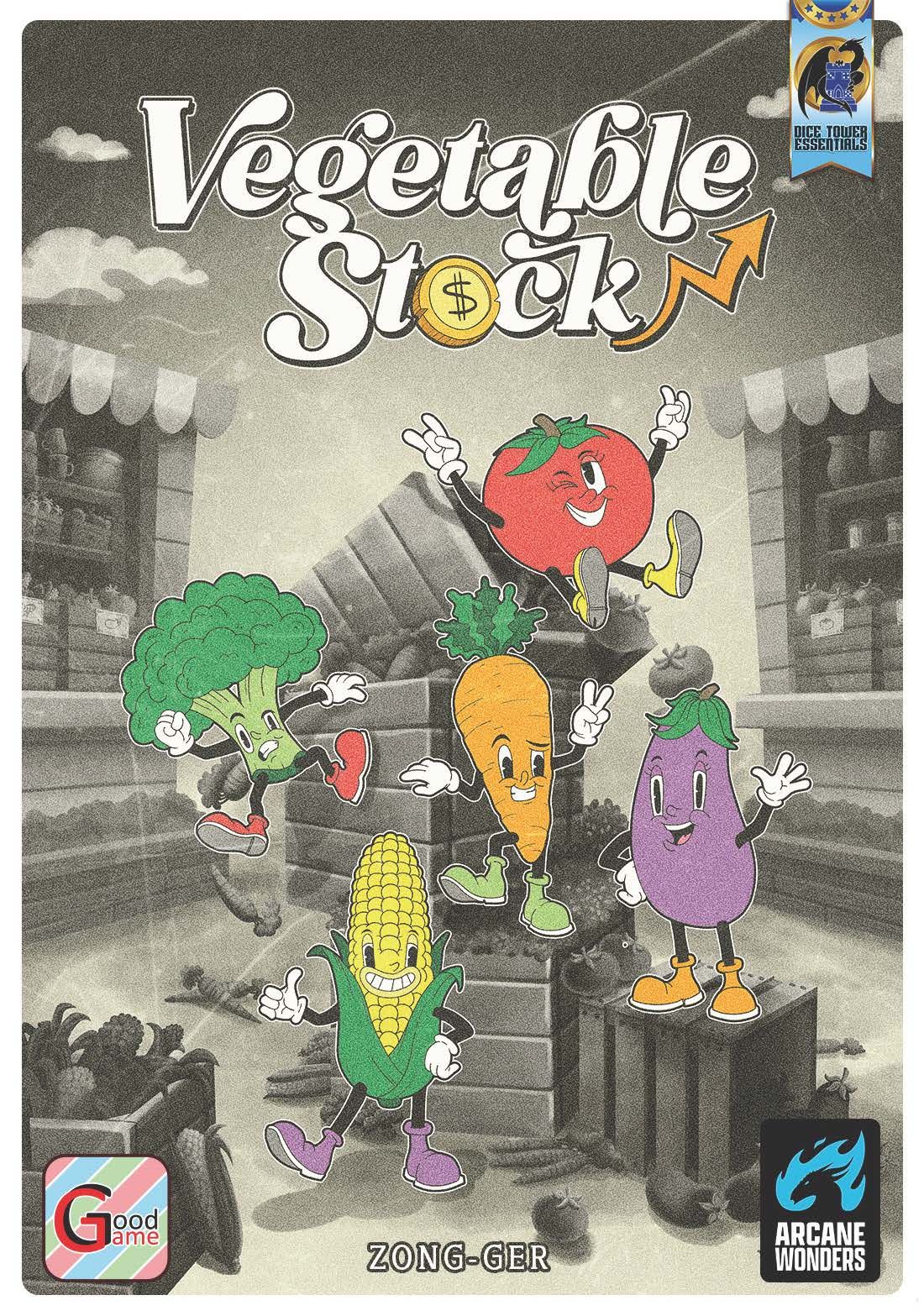
Grow the vegetables, raise the sale price, and make a fortune! Vegetable Stock, which debuted as Small Farmer, is a simple card game about vegetable economics. Each round, reveal one more card than the number of players on the table. Each card has three vegetable icons on it, with vegetables coming in five types. Players take turns choosing one of the cards and placing it in their harvest pile face down. The price of the vegetable(s) on the card not chosen goes up — but if the price goes too high, it crashes, although it can rise again next round. After six rounds, determine your score by multiplying the number of each vegetable you have harvested by the final price of that vegetable. The player with the highest score wins!

Qué sensaciones ofrece

Commodity Speculation Open Drafting Farming Card Game Economic

Inteligencia del juego

Aprende el juego

100% de cobertura de conocimiento

Preparación

1. Shuffle the card deck. 2. Set up a price track for each vegetable type, with all prices at their starting value. 3. Deal or lay out cards according to player count to begin the first round. 4. Determine a starting player and begin play.

Flujo del turno

Each round, players take turns selecting one card from those available to add to their personal harvest pile. The card that is left unchosen causes that vegetable's market price to increase by 1. If any price exceeds 6 after an increase, it instead drops by 1 (cycling back). This continues for 6 rounds total, after which final scoring occurs.

Puntuación y victoria

After 6 rounds, each player multiplies the total quantity of each vegetable in their harvest pile by that vegetable's final market price, then sums all products. The player with the highest total wins. Fuentes de puntuación: Harvested vegetable quantities multiplied by final vegetable market prices

Fuente: Rulebook

Reglas que debes conocer

Las reglas más útiles para jugar bien la primera partida.

General

Each card shows three icons representing quantities (1–5) of vegetables.

Every card in the deck displays exactly three vegetable icons, each icon representing a quantity of 1 to 5 of a specific vegetable type. These icons indicate both what a player would gain for their harvest and which vegetable's price is affected when the card is left unchosen.

Turn structure

On your turn, choose one card for your harvest pile; the unchosen card raises a vegetable's price.

Each turn, a player selects one card from those available and adds it to their personal harvest pile. The card that is NOT chosen determines which vegetable's market price increases. Only one card is left unchosen per selection; that card's vegetable triggers the price increase.

Resource production

The unchosen card causes the depicted vegetable's price to go up by 1.

When a card is not chosen by a player, its vegetable type has its current market price increased by 1. The price track reflects the current sale value of each vegetable, which is used when scoring at the end of the game.

Special

If a vegetable's price exceeds 6, it drops by 1 and cycles back.

Each vegetable's market price is tracked on a scale. If a price increase would push a vegetable's price above 6 (i.e., to 7 or higher), instead the price drops by 1 from its current value and the cycle begins again. This means the price wraps around rather than continuing to rise indefinitely.

General

The game lasts exactly 6 rounds.

Vegetable Stock is played over exactly 6 rounds. After all 6 rounds have been completed, the game ends and players proceed to final scoring.

Resource management

Cards added to your harvest pile accumulate the vegetables shown on them.

Each card a player selects is added face-up to their personal harvest pile. At the end of the game, the player counts the total quantity of each vegetable type across all cards in their harvest pile. These totals are used in the scoring calculation.

Scoring

Score = sum of (quantity of each vegetable harvested × that vegetable's final price).

After 6 rounds, each player scores by taking the total count of each vegetable type in their harvest pile and multiplying it by that vegetable's current (final) market price. The products for all vegetable types are summed to produce the player's total score. The player with the highest total score wins.

Endgame

The game ends after 6 rounds; the player with the highest score wins.

After exactly 6 rounds of play, the game concludes. Players calculate their final scores using the scoring calculation rule. The player with the highest score is the winner. Tiebreaker rules are not specified in the rulebook.

Informe estratégico

Balancing harvest quantity vs. final price

Because scoring multiplies harvest quantity by final price (scoring_calculation), it is not enough to collect many of a single vegetable — you must also ensure its price is high at game end. Prioritize vegetables whose prices are climbing and unlikely to cycle before round 6.

Manipulating prices via card rejection

Since the card you do NOT choose raises a vegetable's price (turn_structure_card_choice), you can deliberately leave cards unchosen to inflate the price of vegetables you've been harvesting. Conversely, you can deny opponents this benefit by choosing the card they want to leave behind.

Timing the price cycle

Prices that exceed 6 drop by 1 rather than continuing to rise (price_cycle). If a vegetable's price is near 6 late in the game, intentionally triggering the cycle could devastate an opponent's harvest value. Conversely, avoid harvesting vegetables whose prices are likely to cycle before the final scoring.

Diversification vs. specialization

Specializing in one or two vegetables maximizes multiplier gains if their prices stay high through round 6, but creates vulnerability to price cycling. Spreading across multiple vegetables reduces volatility but may result in lower peak scores. Weigh this based on the current price track state.

Preguntas frecuentes y casos límite

A vegetable's price is at 6 and the unchosen card would raise it again. Does it go to 7 then drop to 6, or does it drop to 5?

If a price increase would push the price above 6 (to 7), the price instead drops by 1 from its pre-increase value of 6, landing at 5. The price never actually reaches 7; it wraps to 5 and the cycle begins again.

A card shows icons for multiple different vegetables. When it is the unchosen card, which vegetable's price goes up?

The rulebook states the unchosen card determines which vegetable's price goes up, implying each card is associated with a specific vegetable type for price purposes, despite showing multiple vegetable icons. Based on available rules, only one vegetable's price increases per unchosen card — likely the primary or majority vegetable depicted.

A player has many carrots in their harvest pile, but the carrot price cycled back low. Do they still score based on the final price?

Yes. Scoring always uses the final market price at the end of round 6, regardless of how many times a price may have cycled. A large harvest of a low-priced vegetable yields fewer points than a smaller harvest of a high-priced vegetable.

Pregunta Sobre Este Juego

Juegos similares