2023 Puesto n.º 2698 en BGG

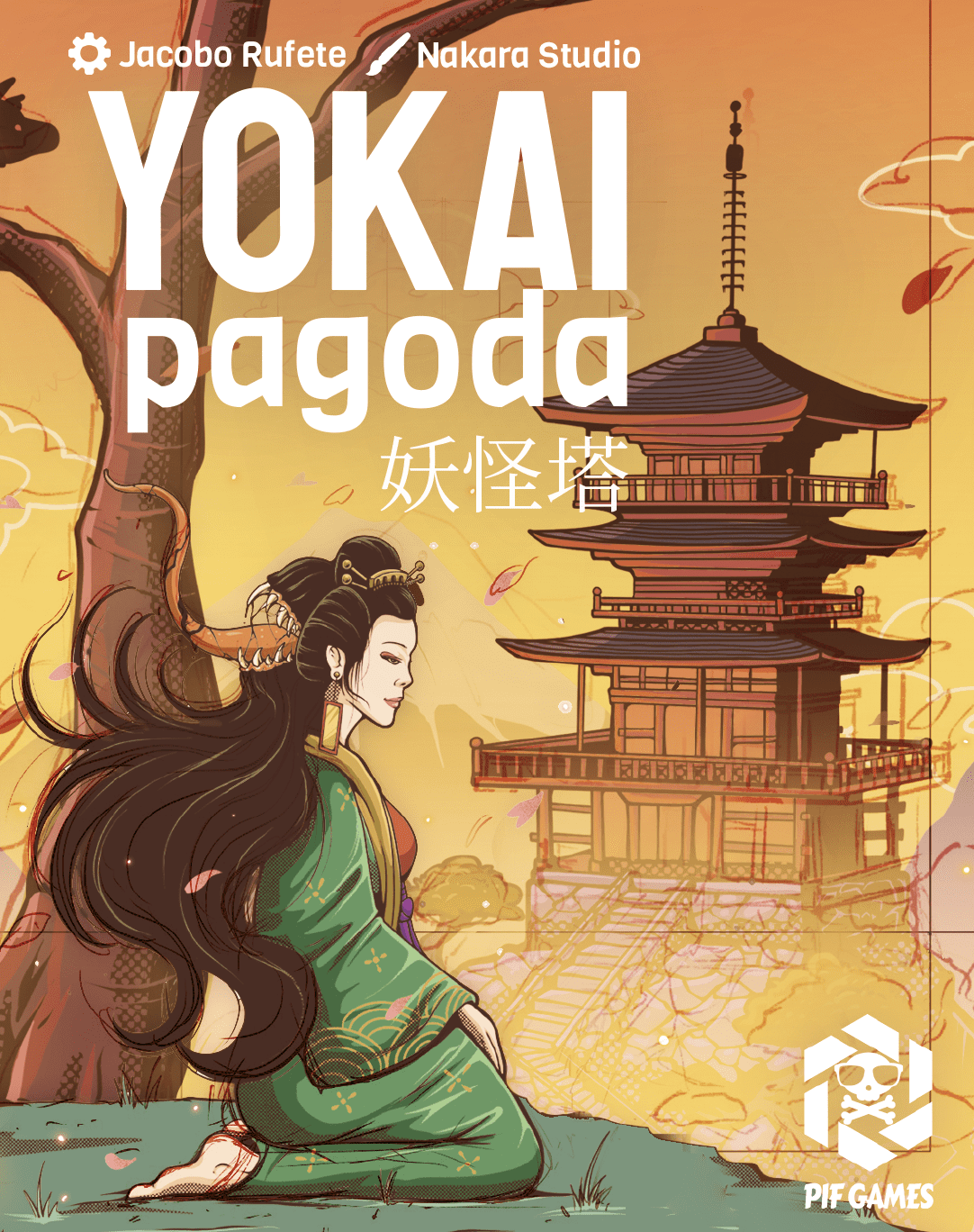
Yokai Pagoda

2–5 jugadores 10–15 min A partir de 8 años 1.5/5 de complejidad 6.1/10 de valoración

Acerca de este juego

A mysterious building rise over the hill, bathed with a crepuscular light. Astonished by the strange aura of the Pagoda, you decide to investigate it. Suddenly, a laugh, a shadow which is not yours and an eye with ominous pretensions turns alive. You have broken the peace of ten powerful Japanese spirits (called Yokai) who rested there! Will you find a way to calm their wrath? A game of Yokai Pagoda is played through 3 rounds, playing always one card per turn, until someone ends the current round. To play a game, you shuffle the 100 number cards (divided by 10 kinds of Yokai, numbered from 1 to 10), lay out two cards face-up to start the two discard piles, then deal seven cards to each player. Place the rest as the Pagoda deck, between the discard piles. When you play card, deal with one of the following effects: Playing the same Yokai or the same number allows you to give someone one card from your hand. With a different Yokai and a higher number you can take one random card from the deck -or- the first face-up card from the opposite dicard pile. With a different Yokai and a lower number you can go on with the round as nothing happened -or- end the current round, but only if you have a total amount of three or less points in your hands. But... you must take only into account the lowest card of each kind of Yokai you have! At that moment, everyone keeps the cards from their hand into a personal reserve. After 3 rounds, the one with less points in their reserve wins but... again you must take only into account the lowest card of each kind of Yokai you have. Try to match the balance between lose cards or keep the exact amount you need to reduce your score when other player ends the round. In Yokai Pagoda, knowing when to give a card, keep playing or end the round makes the difference!

Qué sensaciones ofrece

Hot Potato Hand Management Bluffing Abstract Strategy Card Game Fantasy Mythology

Explora estas mecánicas en Cardboard

Crea un prototipo original con patrones de diseño reutilizables, no con el contenido de este juego.

Abrir el taller de mecánicas

Inteligencia del juego

Aprende el juego

100% de cobertura de conocimiento

Preparación

1. Place the four Torii Gate cards in a separate pile. Lay Torii Gate 1 face up so all players can see it — this card indicates the current round number.\n2. Shuffle all 100 Yokai (offering) cards thoroughly and deal 7 cards to each player as their starting hand. Place remaining cards face down as the Pagoda deck, accessible to all players.\n3. Reveal the first and second cards from the Pagoda deck and place one on each side of the deck to form two face-up offering piles.\n4. The starting player is the last person to have seen a scary movie.

Flujo del turno

On your turn, play exactly one card from your hand onto one of the two face-up offering piles, then apply the effect that matches how your played card relates to the top card of that pile:\n\n(A) MATCH — If your card matches the pile's top card in Yokai type OR in number: hand one card from your hand face-down to any player of your choice. If you have no cards left, the chosen player draws the top card from the Pagoda deck instead (hidden from other players).\n\n(B) NO MATCH, HIGHER — If your card does not match in Yokai type and is higher in number than the pile's top card: choose either (i) draw the top card from the Pagoda deck, or (ii) draw the top card from the opposite offering pile. If drawing from the opposite pile leaves it empty, immediately reveal the top card of the Pagoda deck and place it where that offering pile was.\n\n(C) NO MATCH, LOWER — If your card does not match in Yokai type and is lower in number than the pile's top card: calculate your current hand's total point value. If it is higher than 3, the round continues normally. If it is 3 or lower, you may choose to show your hand to all other players and close the round — or let the round continue as normal.\n\nAfter resolving the effect, if you still have cards and the round has not been closed, play passes clockwise to the next player.

Puntuación y victoria

Lowest total score wins. Each player's score is the sum of the lowest-numbered card of each Yokai type in their pool of failed offerings. Tiebreaker 1: fewest different Yokai types in the pool. Tiebreaker 2: fewest total cards in the pool. Puntuación objetivo: 0 Fuentes de puntuación: Failed offerings pool: lowest card per Yokai type

Fuente: Rulebook

Reglas que debes conocer

Las reglas más útiles para jugar bien la primera partida.

Setup

Place Torii Gate cards separately; reveal Gate 1 to indicate Round 1.

Before the game begins, place the 4 Torii Gate cards in a separate pile. Lay Torii Gate 1 face up in view of all players to indicate the current round number. The Torii Gate card is updated each new round.

Setup

Shuffle all 100 Yokai cards and deal 7 to each player; remaining cards form the Pagoda deck.

Shuffle all 100 Yokai offering cards thoroughly. Deal exactly 7 cards to each player as their starting hand. Place the remaining cards face down in a central pile accessible to all players — this is the Pagoda deck.

Setup

Reveal the top two cards of the Pagoda deck to form two face-up offering piles, one on each side of the deck.

After dealing hands, reveal the first card from the Pagoda deck and place it face-up to one side of the deck, then reveal the second card and place it face-up to the other side. These form the two offering piles that players will play cards onto during the game.

Setup

The starting player is the last person to have seen a scary movie.

Determine the first starting player by asking who most recently watched a scary movie. That player takes the first turn of Round 1.

Turn structure

On your turn, play one card from your hand onto one of the two offering piles, then resolve the matching effect (A, B, or C).

On your turn, you must play exactly one card from your hand and place it on top of one of the two face-up offering piles. After placing the card, compare it to the card it was placed on (the previous top card) and apply the appropriate effect: (A) if it matches in Yokai type or number, (B) if it does not match in Yokai type and is higher in number, or (C) if it does not match in Yokai type and is lower in number.

Card play

Playing a matching card (same Yokai type or same number) lets you secretly hand one card to any player.

If the card you play matches the top card of the chosen offering pile either in Yokai type OR in number, you hand one card face-down from your hand to any player of your choice. That player cannot refuse it and other players cannot see which card was passed. If you have no cards remaining in your hand after playing, the chosen player instead draws the top card from the Pagoda deck; other players cannot see this card either.

Card play

Playing a non-matching card higher than the pile's top card lets you draw from the Pagoda deck OR take the top card of the opposite pile.

If the card you play does not match in Yokai type and its number is higher than the top card of the chosen offering pile, you must choose one of two options: (i) Draw the top card from the Pagoda deck and add it to your hand, OR (ii) Draw the top card from the opposite offering pile and add it to your hand. If you draw from the opposite pile and that was its last card, immediately reveal the top card of the Pagoda deck and place it face-up where that offering pile was, restoring it.

Card play

Playing a non-matching card lower than the pile's top card triggers a hand-point check; if 3 or fewer points, you may close the round.

If the card you play does not match in Yokai type and its number is lower than the top card of the chosen offering pile, calculate the total point value of your remaining hand (using the hand-calculation rule: only the lowest card per Yokai type counts). If your hand total is higher than 3, the round continues normally. If it is 3 or lower, you may choose to show your hand to all other players and immediately close the round, or you may choose to let the round continue as normal.

Informe estratégico

Minimizing Your Failed Offerings Pool

Since only the lowest card per Yokai type counts at final scoring, holding onto many cards of the same Yokai type is far less damaging than holding one card each of many different types. Prioritize passing away cards that introduce new Yokai types to your pool (via Effect A) rather than cards that are high-value duplicates of a type you already hold.

Strategic Use of the Card-Pass (Effect A)

Effect A lets you secretly give a card from your hand to any player. Use this to offload cards that would introduce a new Yokai type to your failed offerings pool, or to give a high-value card to a leading opponent. Since the pass is hidden, other players cannot easily track what is circulating.

Timing the Round Close

You can only voluntarily close the round via Effect C (playing a lower, non-matching card with a hand value of 3 or less). Engineer your hand to reach this condition when opponents still hold many cards — forcing them to add everything to their failed offerings pool. However, choosing not to close when eligible can also be strategic if you expect to reduce your hand further.

Drawing Decisions Under Effect B

When forced to draw under Effect B, weigh whether the unknown Pagoda deck top card or the visible opposite offering pile top card is better. The offering pile card is known, letting you make an informed choice about which Yokai types and values you add to your hand.

Tiebreaker Awareness

If scores are likely to be close, aim to minimize the number of different Yokai types in your failed offerings pool (first tiebreaker), and then total card count (second tiebreaker). Receiving many passed cards of a single Yokai type you already hold is less damaging than receiving a card of a new type.

Preguntas frecuentes y casos límite

A player plays a matching card (Effect A) and has no cards left in their hand — who draws from the Pagoda deck?

The player who just played their last card nominates any other player. That chosen player draws the top card of the Pagoda deck and adds it to their own hand. Other players cannot see this drawn card. The round then ends because the active player has no cards remaining.

A player triggers Effect B and chooses to draw from the opposite offering pile, but that draw is the pile's last card — what happens?

The player takes the last card from the opposite pile (adding it to their hand). Since the pile is now empty, immediately reveal the top card of the Pagoda deck and place it face-up where the empty offering pile was, restoring that pile to one card.

A player plays a lower non-matching card and calculates their hand at exactly 3 points — can they close the round?

Yes. A hand total of exactly 3 meets the condition (3 or lower), so the player may choose to show their hand to all players and close the round, or let it continue. It is the player's choice.

A player has multiple cards of the same Yokai type in their hand or pool — do all of them count toward their score?

No. When calculating points (either during play or at final scoring), you group cards by Yokai type and count only the single lowest-numbered card per Yokai type. All higher-numbered duplicates of the same type are ignored for scoring purposes.

In a two-player game, who starts each round?

In a two-player game, two starting players are determined randomly before the game. One starts all odd rounds (1 and 3) and the other starts all even rounds (2 and 4). The player who closes a round does NOT determine the next starting player in the two-player variant.

The Pagoda deck runs out during a player's turn when they need to draw from it — what happens?

If the Pagoda deck is empty when a draw is needed, first reshuffle: collect all cards from both offering piles except the current top card of each pile, shuffle them together to form a new Pagoda deck, then complete the draw from the new deck.

Can a player use or play cards from their pool of failed offerings during later rounds?

No. Cards in the pool of failed offerings cannot be played, mixed with the current hand, or removed in any way. They are locked away until final scoring. A player's hand each round consists only of the 7 newly drawn cards.

Pregunta Sobre Este Juego

Juegos similares