1988 Puesto n.º 8154 en BGG

Axiom

2 jugadores 15 min A partir de 9 años 2.9/5 de complejidad 5.6/10 de valoración

Acerca de este juego

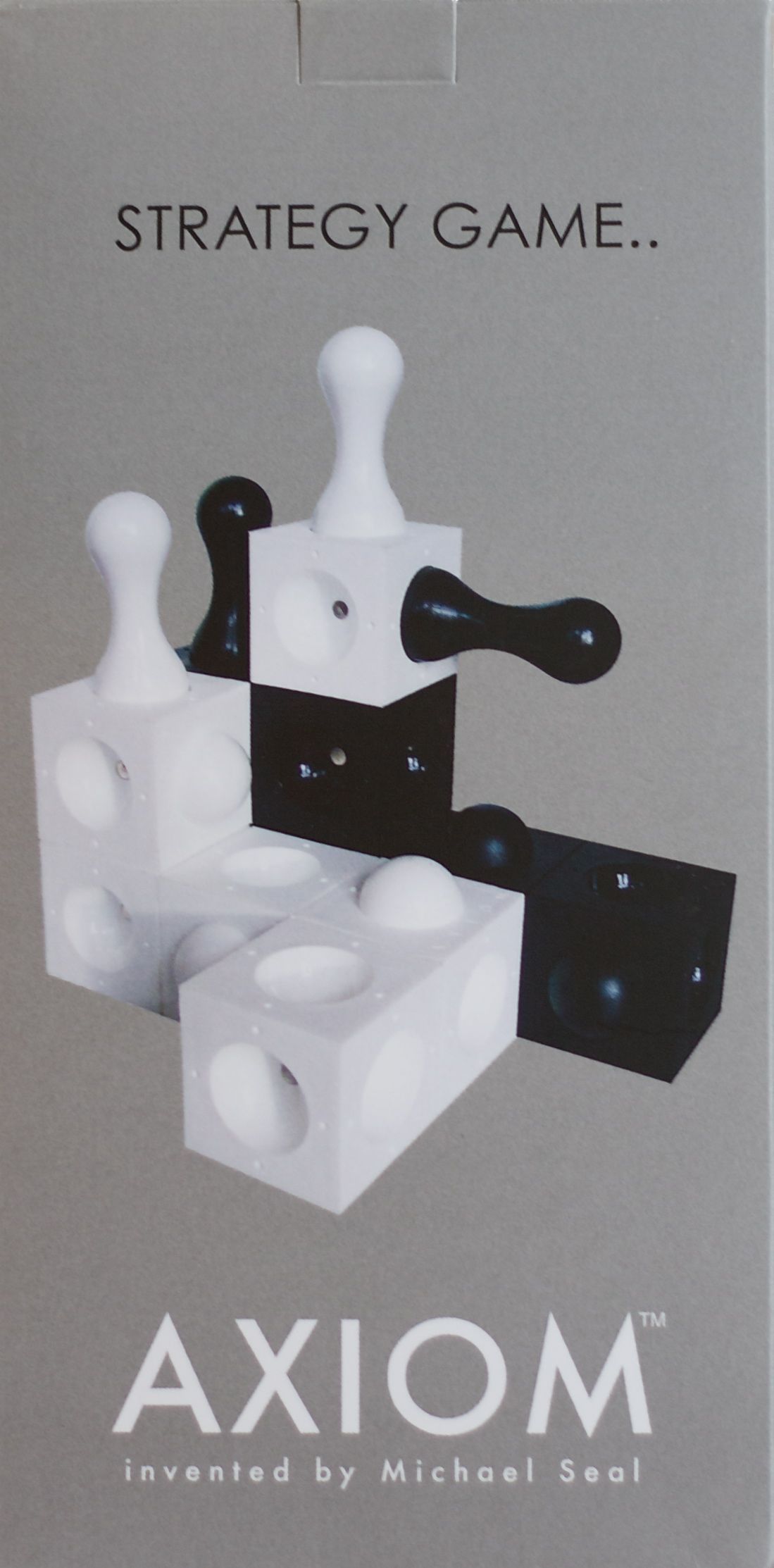
Axiom is a two player strategy game that is played in three dimensions. The board is made up of twelve cubes, six of each color. Each player has two pawns which snap into the indentations on the cubes. The object is to capture one of the other player's pawns. On a turn, a player can move one of their pawns over the surfaces of the cubes, or move one of their cubes to change the playing surface. At Essen 2008, a new version was released with a new physical design: smooth curved pawns, held into the indentations by magnets.

Qué sensaciones ofrece

Modular Board Abstract Strategy

Inteligencia del juego

Aprende el juego

100% de cobertura de conocimiento

Preparación

1. Print the Axiom Game Mat (A3 size): full size for Axiom 3000 (cube & sphere version) or 95% for Axiom 2000 (angular version). The mat is a 6×7 cube grid with coordinates A–G (columns) and 1–6 (rows).\n\n2. Place pieces at their starting coordinates as follows:\n\nBLACK PIECES:\n- Double-dome cubes: C3wu1, D3ws1, E3wu1\n- Single-dome cubes: C3e2, D3d2, E3e2\n- Sceptres: C3u2, E3u2\n\nWHITE PIECES:\n- Double-dome cubes: E4eu1, D4en1, C4eu1\n- Single-dome cubes: E4w2, D4d2, C4w2\n- Sceptres: E4u2, C4u2\n\n3. For the grey & orange Axiom set, substitute Black → Grey and White → Orange throughout.\n\n4. Black moves first.

Flujo del turno

Players alternate turns, one move per turn. On their turn, a player moves either one Cube or one Sceptre. Movement is recorded using the coordinate system: the mat location (e.g. D3), an optional dome/sceptre direction letter (e.g. 'd' for down, 'n' for north), and a level number within the stack (e.g. 2 for level 2). Pieces can move to adjacent squares or onto stacks, changing level. A move may result in attacking an opponent's piece (sceptre or cube) or blocking the opponent's options. The turn ends after a single piece is moved.

Puntuación y victoria

The game is won outright (no point scoring). A player wins when they achieve an undefendable dominant position, most likely by eliminating the opponent's last sceptre or manoeuvring a sceptre into a decisive winning position the opponent cannot counter. Puntuación objetivo: Win condition: eliminate opponent's sceptres or achieve an undefendable position Fuentes de puntuación: Winning by eliminating opponent sceptres, Winning by achieving an undefendable dominant sceptre position

Fuente: Rulebook

Reglas que debes conocer

Las reglas más útiles para jugar bien la primera partida.

Setup

The game is played on a 6×7 grid mat with coordinates A–G and 1–6.

The Axiom Game Mat is a 6×7 cube grid. Columns are labelled A through G and rows are labelled 1 through 6, creating a coordinate system for identifying mat locations. The coordinate system is a practical limit of the printed mat and is NOT a restriction on cube movement — pieces may move beyond the mat boundary in physical play if space allows. The mat is available in two print sizes: full size (Axiom 3000, cube & sphere version) or 95% size (Axiom 2000, angular version), printed on A3 paper.

General

Coordinates encode mat location, dome/sceptre direction, and stack level.

A full coordinate consists of up to four elements: 1. 1st letter (capital) + 1st number = Mat grid location (e.g. D3 = column D, row 3). 2. 2nd letter (lower case) = direction the dome or sceptre is pointing. Possible directions: n (north), s (south), e (east), w (west), u (up), d (down). 3. 2nd number = level of the cube or sceptre within a cube stack (e.g. level 1 = bottom, level 2 = one above, etc.). A cube carrying two domes will have two direction letters in its coordinate. Example: 'D3d2' = mat location D3, dome pointing down, at stack level 2. Reduced coordinates may be used when moves are unambiguous (e.g. 'E3 to D4' instead of 'E3u2 to D4u2').

Setup

Each player has two types of pieces: Cubes (with domes) and Sceptres.

Each player controls two types of playing pieces: - Cubes: three-dimensional block pieces, each topped with one or two directional domes. The dome's direction is tracked in coordinates. Cubes can be stacked on top of each other, forming multi-level stacks. - Sceptres: rod-like pieces that can be placed on top of cube stacks or on the mat. Sceptres also have a direction (level and orientation) tracked in coordinates. For the grey & orange set: Grey = Black, Orange = White throughout all rules and notation.

Setup

Black and White each start with three double/single-dome cubes and two sceptres at defined coordinates.

The game begins with pieces placed at the following coordinates: BLACK: - Double-dome cubes: C3wu1, D3ws1, E3wu1 - Single-dome cubes: C3e2, D3d2, E3e2 - Sceptres: C3u2, E3u2 WHITE: - Double-dome cubes: E4eu1, D4en1, C4eu1 - Single-dome cubes: E4w2, D4d2, C4w2 - Sceptres: E4u2, C4u2 Black's pieces occupy row 3; White's pieces occupy row 4. The two sides face each other across adjacent rows at the start of the game.

Turn structure

Players alternate turns; each turn consists of moving exactly one piece (cube or sceptre).

Axiom is a strictly alternating turn game. On each turn, the active player moves exactly one of their pieces — either a Cube or a Sceptre. Black moves first. After a move is completed, the turn passes to the opponent. A move is recorded using the coordinate notation system (full or reduced). No passing or skipping turns is described in the rules.

Movement

Cubes move across the mat and can be placed onto or within stacks, changing level.

A cube may be moved to a new mat location. Movement can include changing the stack level — for example, moving a cube from level 2 at one location to level 3 at another indicates it has been placed on top of another cube. The dome direction of the cube may also change as a result of the move and is updated in the coordinate record. The mat coordinate boundary (A–G, 1–6) is a practical notation limit and does not formally restrict cube movement.

Movement

Sceptres move across the mat, including diagonally, and can be placed onto cube stacks.

Sceptres can move to adjacent mat locations including diagonally (as demonstrated in the example game, move 9: 'C3 to D4 – diagonal move wins game'). A sceptre can be placed on top of a cube stack, taking the next available level. The sceptre's direction and level are tracked in coordinates. Sceptres are key attacking and winning pieces.

Movement

Sceptres can move diagonally, as evidenced by the winning move in the example game.

Diagonal movement is legal for sceptres. In the example game, move 9 is explicitly described as 'Black S: C3 to D4 – diagonal move wins game,' confirming that moving one square diagonally (e.g. from C3 to D4) is a valid sceptre move. This diagonal capability is significant for attacking and winning positions.

Informe estratégico

Sceptre Aggression

Sceptres are the primary attacking and winning pieces. Moving a sceptre onto an opponent's cube stack can eliminate their pieces and threaten a decisive win. Prioritise sceptre development and aggression, since the example game's winning move is a sceptre diagonal to the opponent's key position.

Diagonal Attack Lines

Sceptres can move diagonally, which creates attack angles that are harder for the opponent to block with orthogonally-focused defences. The game's decisive final move (C3 to D4) is a diagonal — always consider diagonal sceptre threats when planning attacks.

Cube Blocking

Cubes can be repositioned to block the opponent's pieces and limit their movement or attack options. However, blocking only delays the inevitable if the opponent has multiple threats. Blocking is most valuable when it cuts off all of the opponent's winning lines simultaneously.

Stack Height and Level Control

Building higher stacks (reaching level 3 or above) can be strategically powerful, as a sceptre placed at a high level dominates the surrounding board. Controlling stack height limits the opponent's ability to place pieces on top of yours.

Exploiting Mat Boundary Freedom

The mat boundary (A–G, 1–6) is not a movement restriction. In physical play, manoeuvring pieces beyond the mat boundary can open unexpected attack angles that the opponent may not anticipate, especially if they are thinking within the printed grid.

Preguntas frecuentes y casos límite

Can a sceptre move onto a stack that already has cubes on it?

Yes. A sceptre can be placed on top of a cube stack, taking the next available level. This is demonstrated in the example game (move 1: sceptre moves 'onto a white cube') and move 5 (sceptre moves to level 3, eliminating a white cube). The resulting level is encoded in the coordinate's level number.

Can sceptres move diagonally, and can that win the game?

Yes. Sceptres can move diagonally. The example game ends on move 9 with 'Black S: C3 to D4 – diagonal move wins game,' explicitly confirming diagonal movement is legal and can be the decisive winning move.

Is a piece restricted to the printed A–G, 1–6 mat grid?

No. The rulebook explicitly states the A–G / 1–6 boundary is 'a practical limit for the purposes of the Mat, and is not meant as a restriction on cube movement.' Pieces may move beyond the printed mat boundary in physical play.

Can a sceptre block another sceptre's attack? What if there is no valid block?

Yes, a sceptre can be moved to block an attacking sceptre (example game move 8: 'White S: D3 to D4n2 – blocking this attack'). However, a block is not always a sufficient defense — the rulebook notes that at move 8, 'white had no possible defense,' meaning the opponent may still have an alternative winning line that the block cannot stop.

How are double-dome cubes recorded in coordinate notation?

A cube with two domes will have two lowercase direction letters in its coordinate, one for each dome. For example, 'C3wu1' means mat location C3, first dome pointing west (w), second dome pointing up (u), at stack level 1. 'D3ws1' means location D3, domes pointing west and south, level 1.

When can reduced coordinates be used instead of full coordinates?

Reduced coordinates (omitting direction letters and/or level numbers) may be used when the move is unambiguous — i.e., when there is only one possible piece at that location or only one valid destination. For example, 'E3 to D4' is acceptable when only one piece is at E3. Direction letters are noted as 'useful for separating the level number,' so they aid clarity even in reduced form.

Pregunta Sobre Este Juego

Juegos similares