Setup
The game is played on a 6×7 grid mat with coordinates A–G and 1–6.
The Axiom Game Mat is a 6×7 cube grid. Columns are labelled A through G and rows are labelled 1 through 6, creating a coordinate system for identifying mat locations. The coordinate system is a practical limit of the printed mat and is NOT a restriction on cube movement — pieces may move beyond the mat boundary in physical play if space allows. The mat is available in two print sizes: full size (Axiom 3000, cube & sphere version) or 95% size (Axiom 2000, angular version), printed on A3 paper.
General
Coordinates encode mat location, dome/sceptre direction, and stack level.
A full coordinate consists of up to four elements:
1. 1st letter (capital) + 1st number = Mat grid location (e.g. D3 = column D, row 3).
2. 2nd letter (lower case) = direction the dome or sceptre is pointing. Possible directions: n (north), s (south), e (east), w (west), u (up), d (down).
3. 2nd number = level of the cube or sceptre within a cube stack (e.g. level 1 = bottom, level 2 = one above, etc.).
A cube carrying two domes will have two direction letters in its coordinate. Example: 'D3d2' = mat location D3, dome pointing down, at stack level 2. Reduced coordinates may be used when moves are unambiguous (e.g. 'E3 to D4' instead of 'E3u2 to D4u2').
Setup
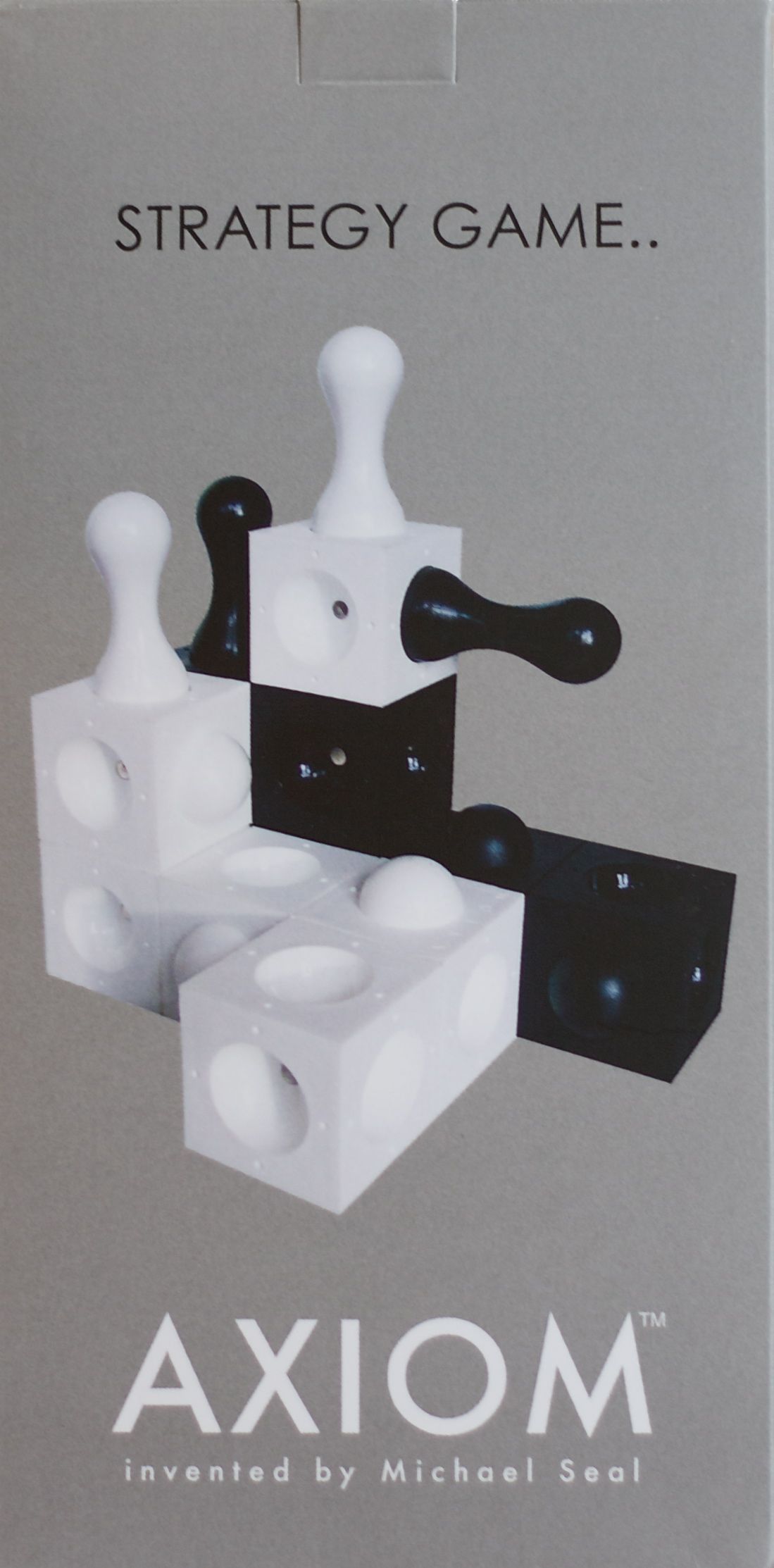
Each player has two types of pieces: Cubes (with domes) and Sceptres.
Each player controls two types of playing pieces:
- Cubes: three-dimensional block pieces, each topped with one or two directional domes. The dome's direction is tracked in coordinates. Cubes can be stacked on top of each other, forming multi-level stacks.
- Sceptres: rod-like pieces that can be placed on top of cube stacks or on the mat. Sceptres also have a direction (level and orientation) tracked in coordinates.
For the grey & orange set: Grey = Black, Orange = White throughout all rules and notation.
Setup
Black and White each start with three double/single-dome cubes and two sceptres at defined coordinates.
The game begins with pieces placed at the following coordinates:
BLACK:
- Double-dome cubes: C3wu1, D3ws1, E3wu1
- Single-dome cubes: C3e2, D3d2, E3e2
- Sceptres: C3u2, E3u2
WHITE:
- Double-dome cubes: E4eu1, D4en1, C4eu1
- Single-dome cubes: E4w2, D4d2, C4w2
- Sceptres: E4u2, C4u2
Black's pieces occupy row 3; White's pieces occupy row 4. The two sides face each other across adjacent rows at the start of the game.
Turn structure
Players alternate turns; each turn consists of moving exactly one piece (cube or sceptre).
Axiom is a strictly alternating turn game. On each turn, the active player moves exactly one of their pieces — either a Cube or a Sceptre. Black moves first. After a move is completed, the turn passes to the opponent. A move is recorded using the coordinate notation system (full or reduced). No passing or skipping turns is described in the rules.
Movement
Cubes move across the mat and can be placed onto or within stacks, changing level.
A cube may be moved to a new mat location. Movement can include changing the stack level — for example, moving a cube from level 2 at one location to level 3 at another indicates it has been placed on top of another cube. The dome direction of the cube may also change as a result of the move and is updated in the coordinate record. The mat coordinate boundary (A–G, 1–6) is a practical notation limit and does not formally restrict cube movement.
Movement
Sceptres move across the mat, including diagonally, and can be placed onto cube stacks.
Sceptres can move to adjacent mat locations including diagonally (as demonstrated in the example game, move 9: 'C3 to D4 – diagonal move wins game'). A sceptre can be placed on top of a cube stack, taking the next available level. The sceptre's direction and level are tracked in coordinates. Sceptres are key attacking and winning pieces.
Movement
Sceptres can move diagonally, as evidenced by the winning move in the example game.
Diagonal movement is legal for sceptres. In the example game, move 9 is explicitly described as 'Black S: C3 to D4 – diagonal move wins game,' confirming that moving one square diagonally (e.g. from C3 to D4) is a valid sceptre move. This diagonal capability is significant for attacking and winning positions.