Setup
Each player takes one color's five animals and places them at their designated starting positions.
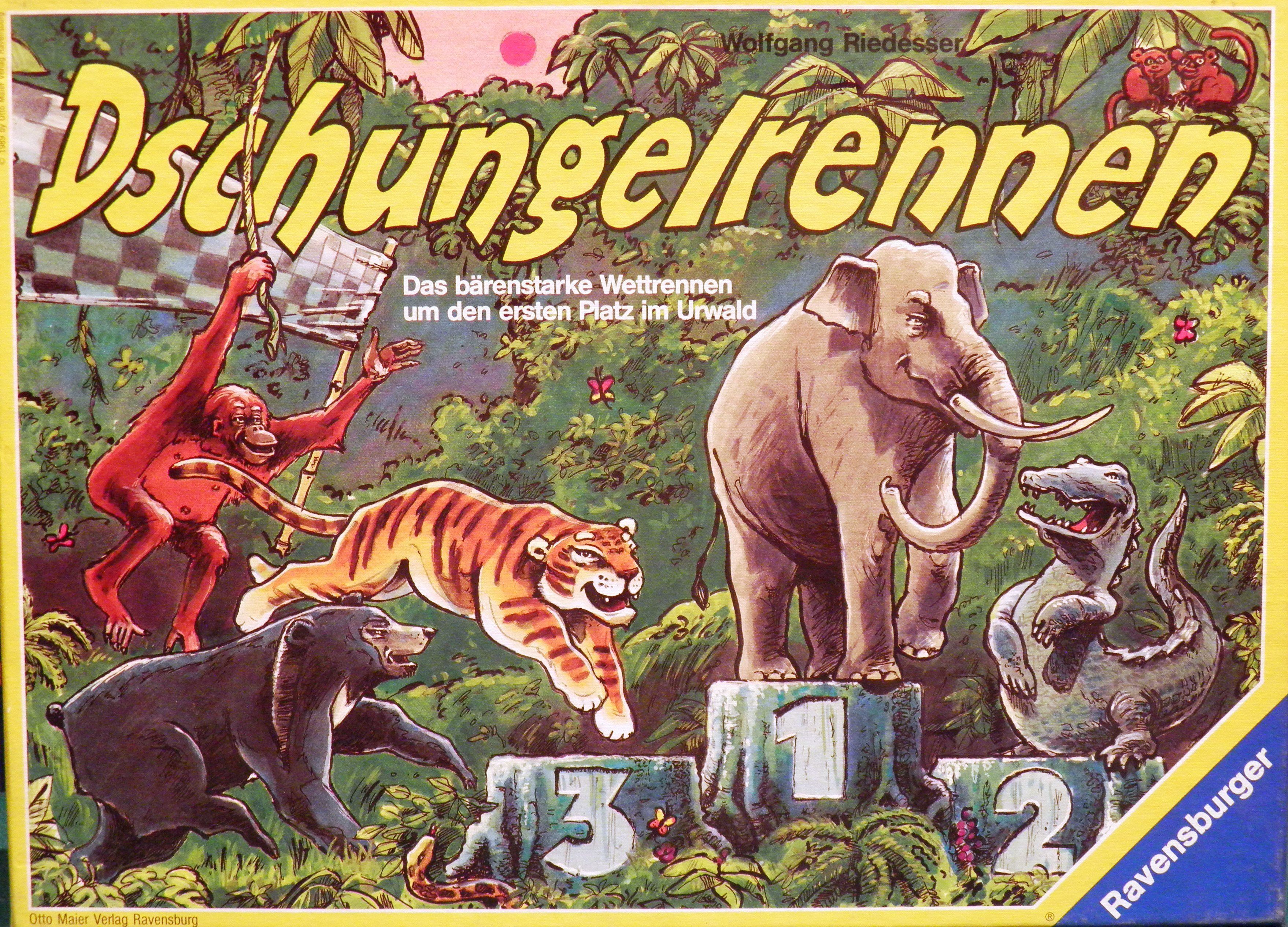
Before the game begins, each player selects one color and receives all five animals of that color (tiger, bear, monkey, elephant, crocodile). Each animal is placed at the starting position on the board where its picture is depicted. All animals begin at rest at the start before any movement occurs.
Setup
The youngest player goes first; play proceeds clockwise.
The youngest player takes the first turn. After that, players take turns in clockwise order for the remainder of the game.
Turn structure
At the start of a turn, the active player rolls the special die to determine which animal(s) to move and how many steps.
On each turn, the active player rolls the special die. The die face shows either a specific animal type (e.g. tiger) or an animal combination (e.g. bear/monkey or elephant/crocodile), along with a number of steps (1 or 2), or a joker symbol with '3'. The result dictates exactly which animal(s) must be moved and how many total steps must be taken that turn.
Movement
One step means moving to the next FREE space; occupied spaces are jumped over and not counted.
When an animal moves one step forward, it advances to the very next space in the direction of the finish line that is not currently occupied by another animal. Any spaces that are occupied by other animals are skipped entirely and do not count as a step. Animals always move forward toward the finish line and never backward.
Restriction
Animals can only move forwards, never backwards.
All animal movement is strictly in the forward direction toward the finish line. No rule or die result ever causes an animal to move backward. There is no mechanism to move an animal in reverse.
Restriction
Only one animal may occupy any given space at a time; animals cannot land on each other or eliminate each other.
Each space on the track can hold at most one animal at any given time. Animals cannot land on a space already occupied by another animal and cannot knock other animals out of the race. When moving, occupied spaces are simply jumped over (see movement_one_step_definition).
Turn structure
A die face showing one animal and a number requires moving exactly that animal the specified number of steps.
When the die shows a single animal type (e.g. tiger with '2'), the active player must move her tiger exactly two steps forward. There is no choice of animal in this case — the specific animal shown must be moved.
Turn structure
A die face showing an animal combination with '1' requires moving one of the two animals one step forward.
When the die shows a combination of two animals (e.g. bear/monkey or elephant/crocodile) with the number '1', the active player must move either one of those two animals exactly one step forward. The player chooses which of the two animals to move.