1989 BGG rank #20249

Dschungelrennen

2–5 players 30 min Ages 10+ 1.3/5 complexity 5.5/10 rating

About this game

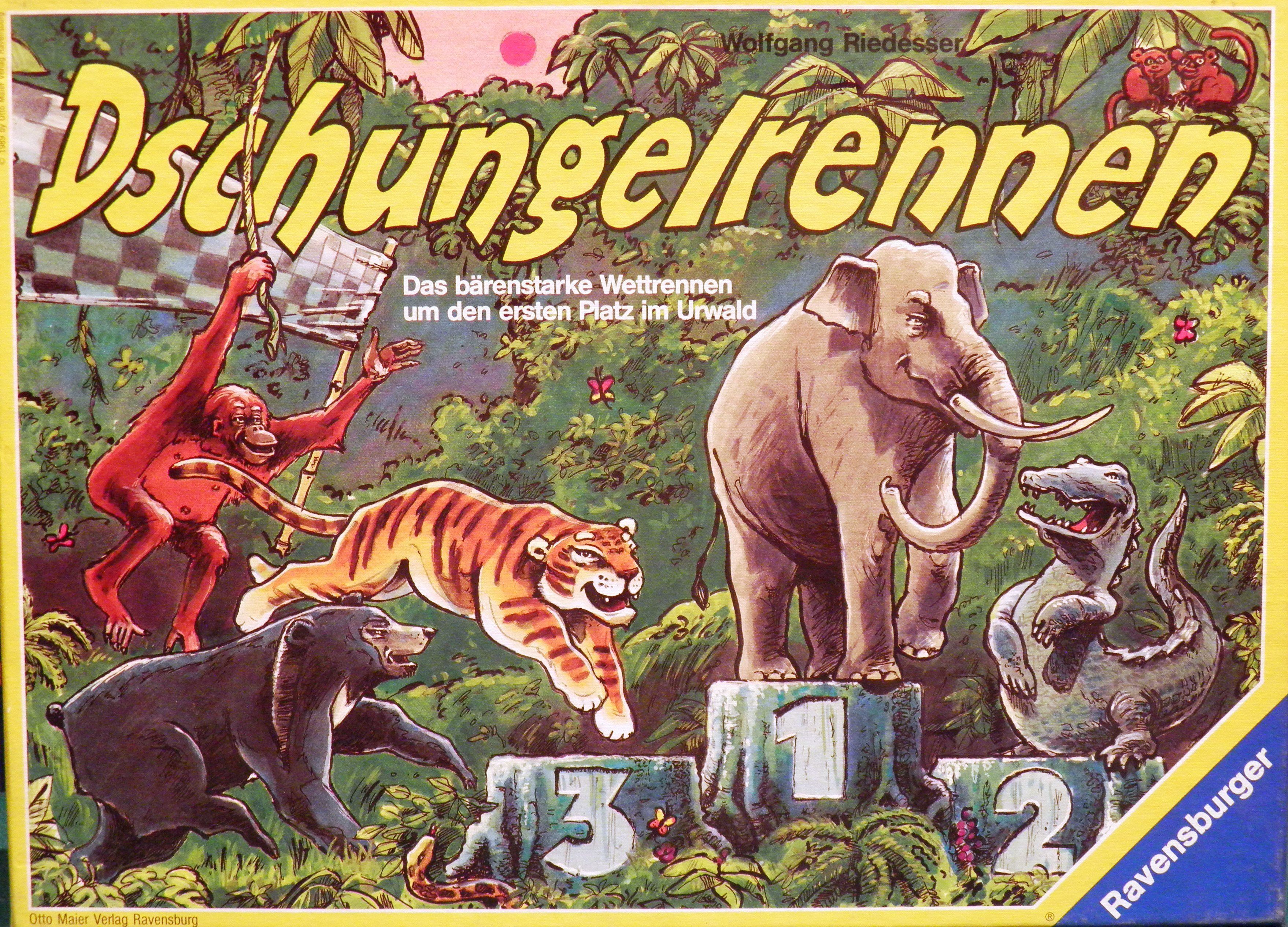
Each player has a group of 5 animals in one color: crocodile, monkey, bear, tiger, elephant. They all race to gain the best places on the podiums. There is a podium for each type of animal, with points for first, second and third arrivals. Once all the first positions of each podium has been taken the game is over. The player the most points, which is not necessarily the player with the most podiums, is the winner. Movement is by dice which shows either one animal, two animals, or a joker. These reduce the thinking time a lot, as you have only a few choices to make, but still some choices to give the impressions that players are actually playing. In addition to that, certain spaces on the board allow for extra movement. Sometimes you may move an animal in the very back in order to gain some extra movements for the others. Is a conga-line-style race, because only one animal can occupy one space, and the taken spaces don't count when you move your animal, which results in amazing jumps over other animals.

What it feels like

Racing Children's Game

Game intelligence

Learn the game

100% knowledge coverage

Setup

1. Each player chooses one color and takes the five animals of that color (tiger, bear, monkey, elephant, crocodile). 2. Each animal is placed at its designated starting position on the board, where its picture is shown. 3. Determine the youngest player — they will go first. 4. Play proceeds clockwise from the first player.

Turn flow

On their turn, the active player rolls the special die. The die result specifies which animal (or animal combination) must be moved and how many total steps (1, 2, or 3). The player moves the indicated animal(s) forward the required steps, jumping over any occupied spaces. If a single animal combination is rolled showing "2", the player may split the steps between the two animals (one step each) or move one animal both steps. If a joker (3) is rolled, the player may distribute the 3 steps freely among any of their animals. Only one new animal may be brought into the race per turn. If a rolled animal has already finished, the player must instead advance their animal that is furthest behind. After completing the normal move, if any animal ended its move on a joker space, the player immediately takes bonus steps equal to the number printed on that joker space, distributing them freely. A joker space may only be used once per turn. The turn then passes clockwise.

Scoring and victory

The player with the most total points scored by their animal team wins. Points are determined by each animal's finishing position on its type's victory stand. In multi-round play, points from all rounds are summed. Scoring sources: Tiger finishing 1st place on victory stand, Tiger finishing 2nd place on victory stand, Tiger finishing 3rd place on victory stand, Elephant/Crocodile finishing 1st place (8 pts each), Elephant/Crocodile finishing 2nd place on victory stand, Elephant/Crocodile finishing 3rd place on victory stand, Monkey/Bear finishing 1st place (6 pts each), Monkey/Bear finishing 2nd place on victory stand, Monkey/Bear finishing 3rd place on victory stand

Source: Rulebook

Rules to know

The most useful rules for getting a first game right.

Setup

Each player takes one color's five animals and places them at their designated starting positions.

Before the game begins, each player selects one color and receives all five animals of that color (tiger, bear, monkey, elephant, crocodile). Each animal is placed at the starting position on the board where its picture is depicted. All animals begin at rest at the start before any movement occurs.

Setup

The youngest player goes first; play proceeds clockwise.

The youngest player takes the first turn. After that, players take turns in clockwise order for the remainder of the game.

Turn structure

At the start of a turn, the active player rolls the special die to determine which animal(s) to move and how many steps.

On each turn, the active player rolls the special die. The die face shows either a specific animal type (e.g. tiger) or an animal combination (e.g. bear/monkey or elephant/crocodile), along with a number of steps (1 or 2), or a joker symbol with '3'. The result dictates exactly which animal(s) must be moved and how many total steps must be taken that turn.

Movement

One step means moving to the next FREE space; occupied spaces are jumped over and not counted.

When an animal moves one step forward, it advances to the very next space in the direction of the finish line that is not currently occupied by another animal. Any spaces that are occupied by other animals are skipped entirely and do not count as a step. Animals always move forward toward the finish line and never backward.

Restriction

Animals can only move forwards, never backwards.

All animal movement is strictly in the forward direction toward the finish line. No rule or die result ever causes an animal to move backward. There is no mechanism to move an animal in reverse.

Restriction

Only one animal may occupy any given space at a time; animals cannot land on each other or eliminate each other.

Each space on the track can hold at most one animal at any given time. Animals cannot land on a space already occupied by another animal and cannot knock other animals out of the race. When moving, occupied spaces are simply jumped over (see movement_one_step_definition).

Turn structure

A die face showing one animal and a number requires moving exactly that animal the specified number of steps.

When the die shows a single animal type (e.g. tiger with '2'), the active player must move her tiger exactly two steps forward. There is no choice of animal in this case — the specific animal shown must be moved.

Turn structure

A die face showing an animal combination with '1' requires moving one of the two animals one step forward.

When the die shows a combination of two animals (e.g. bear/monkey or elephant/crocodile) with the number '1', the active player must move either one of those two animals exactly one step forward. The player chooses which of the two animals to move.

Strategy briefing

Prioritize the tiger

The tiger scores 10 points for 1st place — significantly more than any other animal (8 for elephant/crocodile, 6 for bear/monkey). When rolling a joker (3 free steps), always consider whether advancing the tiger yields more expected points than spreading steps among lower-value animals.

Chain formation for long jumps

Because occupied spaces are skipped and do not count as steps, positioning your animals in a tight chain with no gaps allows a single step to effectively cover large board distances. Arrange animals close together to maximize the physical distance covered per die step.

Step ordering in split moves

When splitting a combo-2 roll, the order in which you move each animal matters greatly. Move the trailing animal first to close a gap in your chain, then use the leading animal's step to make a long jump over the newly tightened group.

Maximize joker space triggers

Landing on a joker space grants bonus free steps equal to the printed number. Because the bonus is only triggered by ending your normal move on the space (not passing through), plan your step counts precisely to land on joker spaces rather than overshoot them.

Avoid wasting the one-new-animal-per-turn rule

Only one animal may enter the race per turn. If two animals of a combo are still at the start and you roll that combo with '2', you are forced to use both steps on one animal instead of splitting. Try to stagger when you introduce animals so you always have options for splitting combo rolls.

Race toward 1st-place stumps

The game ends as soon as every animal type's 1st place stump is filled. Animals still on the track score nothing. Focus on getting at least one representative of each animal type across the finish line to secure points, rather than trying to fill all three stumps of a single type.

Common questions and edge cases

The die shows an animal combination with '2' (e.g. elephant/crocodile), but both animals are still at the starting position. Can the player split the move?

No. Because only one new animal may be brought into the race per turn, the player must choose one of the two animals and move it two steps. The move cannot be split between two animals that are both still at the starting position.

A joker is rolled. Can the player use the 3 steps to bring two different animals off the starting position?

No. The rule that only one new animal may be brought into the race per turn also applies to joker rolls. Only one animal may be introduced from the starting position; the remaining steps must be used on animals already in play.

A player rolls 'tiger 2', moves their tiger onto a joker space, then takes the bonus steps and moves their elephant onto the same joker space. Does the joker trigger again?

No. A joker space can only be used once per turn. Even if a second animal ends up on the joker space (e.g. because the tiger vacated it and the elephant moved there), the joker does not grant a second bonus in the same turn.

An animal needs to move two steps. The first step would land it on a joker space, but its second step takes it off and past the joker space. Does the player get the bonus?

No. The joker space bonus is only triggered when an animal ends its total movement on a joker space. Passing through (or stepping onto and then off) a joker space mid-move treats it as a normal free space with no bonus.

A player rolls 'bear/monkey 2' and splits the move: the first animal lands on a joker space, then the second animal is moved. When is the joker bonus taken?

The joker bonus is only taken after the entire original move (both animals' steps) is fully completed. It does not matter whether the first or last animal in a split move ends up on the joker space — the bonus is always resolved last.

The die shows an animal (e.g. tiger) that has already crossed the finish line. What happens?

The player cannot move the tiger further. Instead, she must use the movement (same number of steps) to advance whichever of her animals is currently furthest behind in the race.

Three animals of a given type have already placed 1st, 2nd, and 3rd on the victory stand, and a fourth animal of that type now crosses the finish line. Where does it go and what does it score?

The fourth (and any subsequent) animal of that type is placed on the 3rd place stump alongside any animals already there. All animals sharing the 3rd place stump score the 3rd place point value.

The game ends when each victory stand's 1st place is filled. Do players with animals still on the track score anything?

No. Animals that have not crossed the finish line score zero points, regardless of how far along the track they are. Only animals with a position on a victory stand contribute to their owner's score.

Ask About This Game

Similar games