Turn structure
Each turn, the active player places one stone of every color in play onto free board spaces.
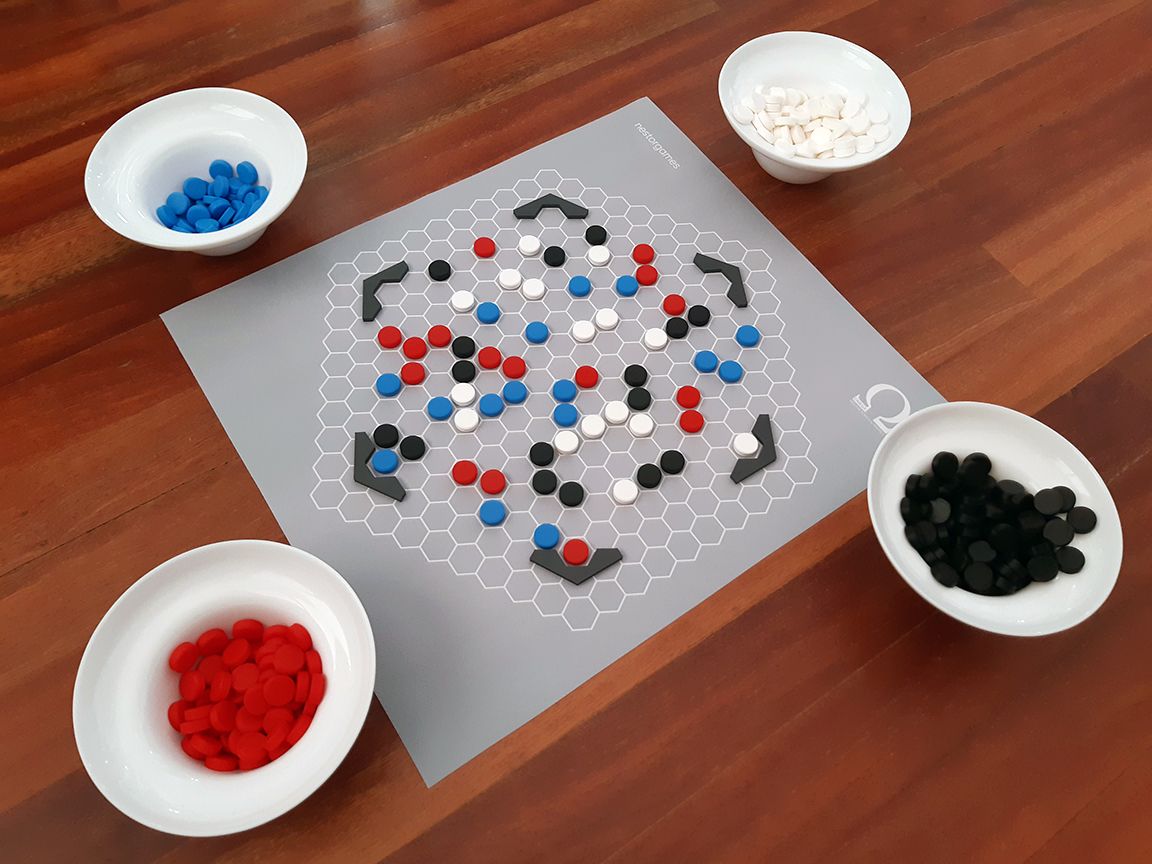
On their turn, the active player must place exactly one stone of each color currently in play (all colors, not just their own) onto any free spaces on the board. In a 2-player game, the active player places 1 white stone and 1 black stone. In a 3-player game, 1 white, 1 black, and 1 red stone. In a 4-player game, 1 white, 1 black, 1 red, and 1 blue stone. The player freely chooses the placement location for each stone. All placements are mandatory — the player cannot skip placing any color.
Turn structure
Players take turns in color order: White first, then Black, Red, Blue.
The first turn is taken by the White player. Subsequent turns follow color order: White → Black → Red → Blue, then back to White. Colors not in play (e.g., Red and Blue in a 2-player game) are skipped in the rotation.
Turn structure
Stones may only be placed on free (unoccupied) hex spaces.
When placing stones during a turn, each stone must be placed on a hex space that is currently unoccupied. No two stones may occupy the same space. The active player may place the stones of different colors wherever they choose among the available free spaces.
Setup
The color marker stone chosen at setup is kept in front of the player and never placed on the board.
At the start of the game, each player picks one stone of their assigned color and places it in front of them as a 'color marker' to indicate which color they own. This stone is removed from the playable pool and is never placed on the board during the game.
General
A group is a set of connected stones of the same color on the hexagonal grid.
A group consists of one or more stones of the same color that are connected to each other through direct adjacency on the hexagonal grid. On a hex grid, each hex has up to 6 neighbors. Stones of the same color that share a hex edge are part of the same group. Isolated single stones each form their own group of size 1. Groups of different colors are always separate.
Scoring
The value of a group equals the number of stones in that group.
At the end of the game, each contiguous group of same-colored stones has a 'value' equal to its size — i.e., the total number of stones belonging to that group. A lone stone has a value of 1.
Scoring
A player's final score is the product (multiplication) of the values of all their groups.
At the end of the game, identify all groups for each player's color. Each group's value equals its size (number of stones). Multiply all group values together to get the player's final score. For example, if White has groups of sizes 1, 2, 2, 4, and 3, White's score is 1×2×2×4×3 = 48. A player with only a single group of size N scores N. Single-stone groups (value 1) do not increase the product.
Endgame
The player with the highest score wins. Ties are broken in favor of the later player in turn order.
After scores are calculated, the player with the highest score wins. In the case of a tie, the last of the tied players (in turn order) wins. For example, if White and Black tie, Black wins the tiebreak.