2010 BGG rank #18690

OMEGA

2–4 players 30 min Ages 8+ 3.5/5 complexity 5.5/10 rating

About this game

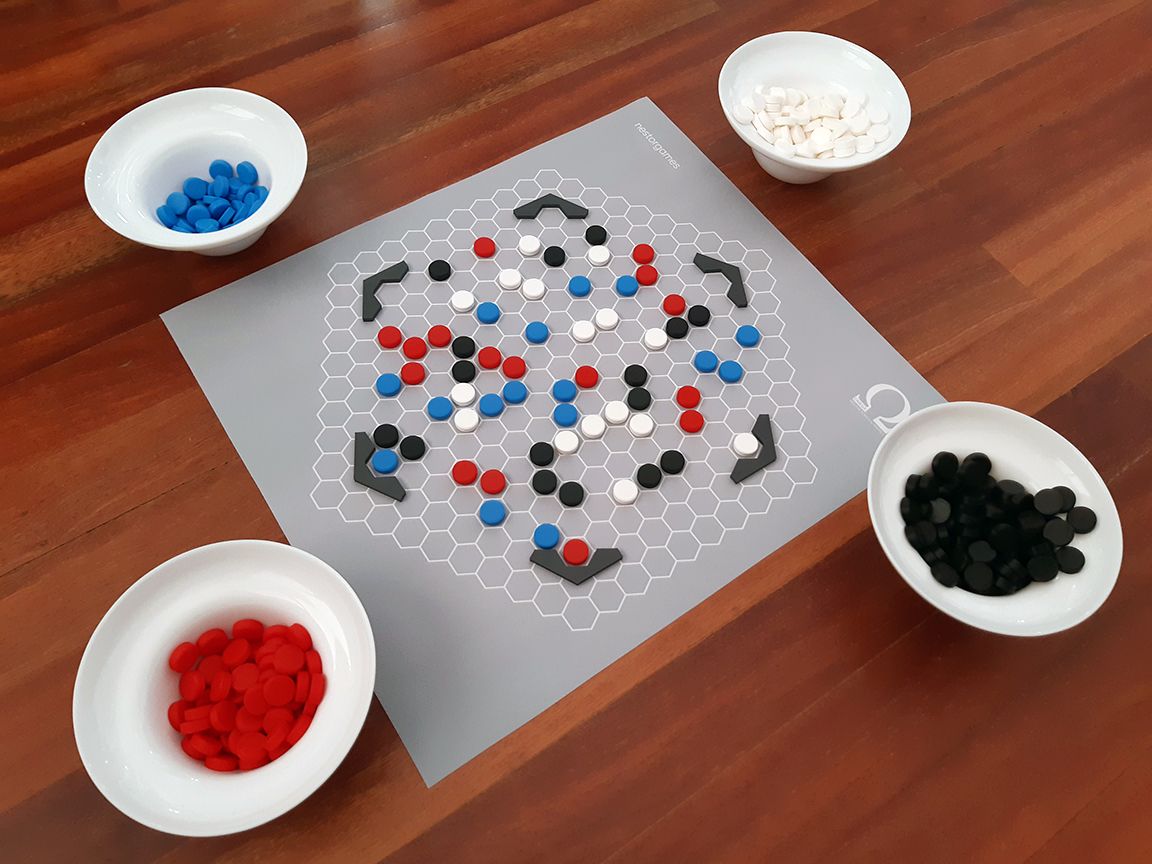
OMEGA was born as an experiment on complexity and intuitive arithmetic. Both concepts teamed up to create this little monster. It feels like a cross between Hex and Go. In OMEGA, players try to create groups of their colors by placing stones in a hexagonal grid, in order to score the most points. But each player places stones of all colors in play. The final score for each color is calculated by multiplying the sizes of the different groups of that color. Thanks to the 6 acrylic 'corners' included in the game, it can be played on various board sizes. From 5-hexes side to 10-hexes side. Other board shapes can be configured, too. You will soon realize that you don´t need to calculate your score during play (multiplying your group values). Use an intuitive strategy instead. How? You must figure it out by yourself. 2-player games of size beyond 8 are only recommended for experienced players and scores are often gigantic. OMEGA was initially designed for 2 players. The designer then added the 3 and 4 player option, but the gameplay is completely different.

What it feels like

Tile Placement Abstract Strategy

Explore these mechanics in Cardboard

Start an original prototype from reusable design patterns—not this game's content.

Open mechanics workbench

Game intelligence

Learn the game

100% knowledge coverage

Setup

1. Agree on the number of players (2–4) and the board grid size (5-hex side up to 10-hex side, standard is 10-hex side).\n2. Place the 6 'corner' pieces on the board to define the chosen grid size and shape.\n3. Separate stone pools by color: White (136), Black (136), Red (91), Blue (68).\n4. Each player selects a color and places one stone of that color in front of them as a 'color marker' — this stone is NOT used during the game.\n5. Color assignment: 2 players use White and Black; a 3rd player uses Red; a 4th player uses Blue.\n6. White takes the first turn. Turn order proceeds: White → Black → Red → Blue.

Turn flow

Play proceeds clockwise in color order: White, Black, Red, Blue (skipping colors not in play). On their turn, the active player MUST place exactly one stone of EACH color currently in play onto any free (unoccupied) spaces on the board. For a 2-player game this means placing 2 stones (one white, one black); for 3 players, 3 stones (white, black, red); for 4 players, 4 stones (white, black, red, blue). The active player chooses freely where to place each stone, including their own and all opponents' colors. There are no passes or skips — placement of all colors is mandatory each turn.

Scoring and victory

Each player multiplies the sizes of all their color groups together. The player with the highest product wins. Ties are broken in favor of the last tied player in turn order. Scoring sources: Group sizes (number of stones in each contiguous same-color group) multiplied together

Source: Rulebook

Rules to know

The most useful rules for getting a first game right.

Turn structure

Each turn, the active player places one stone of every color in play onto free board spaces.

On their turn, the active player must place exactly one stone of each color currently in play (all colors, not just their own) onto any free spaces on the board. In a 2-player game, the active player places 1 white stone and 1 black stone. In a 3-player game, 1 white, 1 black, and 1 red stone. In a 4-player game, 1 white, 1 black, 1 red, and 1 blue stone. The player freely chooses the placement location for each stone. All placements are mandatory — the player cannot skip placing any color.

Turn structure

Players take turns in color order: White first, then Black, Red, Blue.

The first turn is taken by the White player. Subsequent turns follow color order: White → Black → Red → Blue, then back to White. Colors not in play (e.g., Red and Blue in a 2-player game) are skipped in the rotation.

Turn structure

Stones may only be placed on free (unoccupied) hex spaces.

When placing stones during a turn, each stone must be placed on a hex space that is currently unoccupied. No two stones may occupy the same space. The active player may place the stones of different colors wherever they choose among the available free spaces.

Setup

The color marker stone chosen at setup is kept in front of the player and never placed on the board.

At the start of the game, each player picks one stone of their assigned color and places it in front of them as a 'color marker' to indicate which color they own. This stone is removed from the playable pool and is never placed on the board during the game.

General

A group is a set of connected stones of the same color on the hexagonal grid.

A group consists of one or more stones of the same color that are connected to each other through direct adjacency on the hexagonal grid. On a hex grid, each hex has up to 6 neighbors. Stones of the same color that share a hex edge are part of the same group. Isolated single stones each form their own group of size 1. Groups of different colors are always separate.

Scoring

The value of a group equals the number of stones in that group.

At the end of the game, each contiguous group of same-colored stones has a 'value' equal to its size — i.e., the total number of stones belonging to that group. A lone stone has a value of 1.

Scoring

A player's final score is the product (multiplication) of the values of all their groups.

At the end of the game, identify all groups for each player's color. Each group's value equals its size (number of stones). Multiply all group values together to get the player's final score. For example, if White has groups of sizes 1, 2, 2, 4, and 3, White's score is 1×2×2×4×3 = 48. A player with only a single group of size N scores N. Single-stone groups (value 1) do not increase the product.

Endgame

The player with the highest score wins. Ties are broken in favor of the later player in turn order.

After scores are calculated, the player with the highest score wins. In the case of a tie, the last of the tied players (in turn order) wins. For example, if White and Black tie, Black wins the tiebreak.

Strategy briefing

Maximize the product, not the largest group

Because the score is a product of group sizes, several medium-sized groups outperform one large group and many size-1 groups. For example, groups of 4, 4, 4 score 64, while one group of 10 and two of 1 score only 10. Aim for multiple balanced groups rather than one dominant cluster.

Avoid single-stone groups

A group of size 1 multiplies your score by 1 — contributing nothing. Every isolated stone of your color is a wasted multiplicand. Use your turns (and your opponents' turns) to ensure your stones stay connected or grow into groups of at least size 2.

Control empty spaces strategically

The game always ends with some empty spaces. These gaps can permanently sever what would have been a large group into two smaller ones (reducing the product) or protect a separation you want. Placing opponents' stones to create strategic gaps — or your own stones to bridge gaps before the game ends — is a key skill.

Weaponize your turn: place opponents' stones disadvantageously

Since you place one stone of every color per turn, you can place opponents' stones in isolated spots (creating unhelpful size-1 groups for them) or split their large forming groups by filling bridge hexes with their color in a disconnected way. Conversely, opponents will try to do the same to you.

Pie rule timing in 2-player games

In 2-player games with the pie rule, White's first move reveals strategic intent. If White creates a highly favorable position, Black should swap colors. White should therefore make a balanced, non-committal first move to discourage the swap.

Tournament play: consistency across both colors matters

In tournaments, you must play both White and Black, and scores are summed. A strategy that wins by a large margin as White but loses badly as Black may lose the tournament. Develop a flexible approach that works from both color positions.

Common questions and edge cases

Can the active player place an opponent's color stone anywhere they want, even to block or help that opponent?

Yes. The active player places one stone of EVERY color in play on any free spaces they choose. There is no restriction on where any color's stone is placed. This means the active player has full control over where all colors go that turn, including deliberately splitting or merging opponents' groups.

Does a single isolated stone (group of size 1) hurt a player's score?

Yes. A single stone forms a group with value 1, and multiplying by 1 does not increase the product. Having multiple isolated stones multiplies by 1 repeatedly, leaving the score unchanged from larger groups. Players should avoid or minimize single-stone groups as they contribute nothing to the score.

What happens if the free spaces run out mid-round, not exactly at the start of White's turn?

The game end check happens only just before White's turn. If during a round the spaces become too few to finish it, play continues until White's next turn, at which point the check is made. The current round is always completed before checking for game end. Any remaining spaces at that point remain empty.

Two players tie in score. Who wins?

The last of the tied players in turn order wins. For example, in a 4-player game, if White and Red tie, Red wins because Red comes after White in the turn order (White → Black → Red → Blue).

Can the pie rule be used in a tournament game?

No. The pie rule is explicitly prohibited in 2-player tournament play. Tournament games are always played without the pie rule.

Is the color marker stone subtracted from the available stones for play?

Yes. Each player removes one stone of their color at the start to serve as the color marker, which is never placed on the board. This reduces the available pool by 1 stone per color in play.

Do empty spaces at the end of the game affect scoring?

Empty spaces are never part of any group; only stones count. However, empty spaces can separate two clusters of same-colored stones that might otherwise have been connected, effectively keeping them as two separate groups with a lower combined product than one merged group. Controlling which spaces remain empty is therefore an important strategic element.

Ask About This Game

Similar games