1999 Puesto n.º 16114 en BGG

Pacal

2 jugadores 20–30 min A partir de 12 años 1.7/5 de complejidad 5.5/10 de valoración

Acerca de este juego

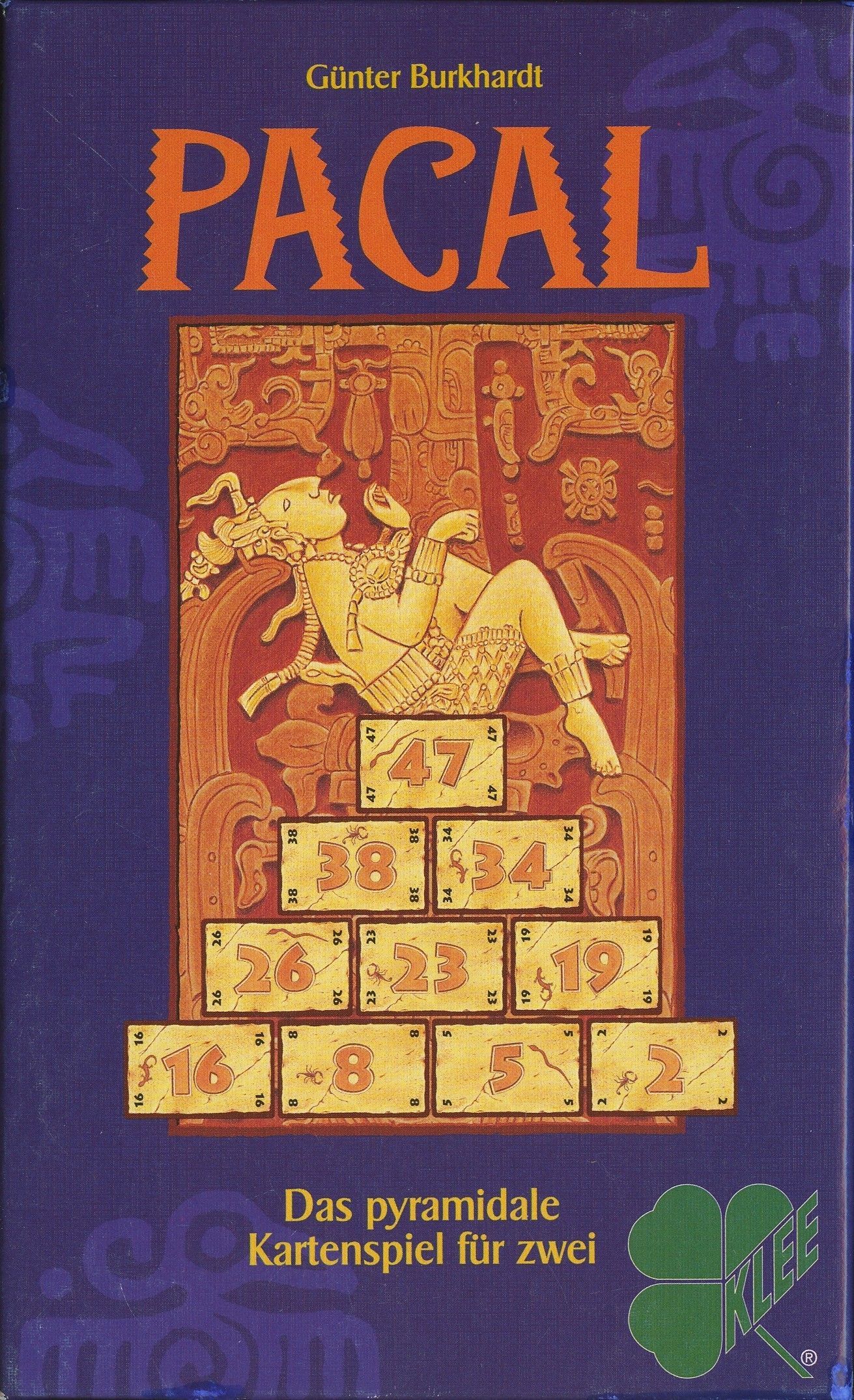
King Maya Pacal was born on March 26th 603 A.D. from Mrs. Zuc Kuk. Nobody knows Pacal’s real name. He was called Pacal in many writings in order to show everybody that he was a person because his armor was found after a war and in the Mayan language armor is called Pacal. This king had a throne and he was in charge for over 68 years. Now there has to be a successor, and the players have to build their pyramid. The greatest value has to be upside and the lowest has to be on the base ascendant sorted from left to right. Who’s going to build his pyramid first and will be the new king?

Qué sensaciones ofrece

Hand Management Card Game

Explora estas mecánicas en Cardboard

Crea un prototipo original con patrones de diseño reutilizables, no con el contenido de este juego.

Abrir el taller de mecánicas

Inteligencia del juego

Aprende el juego

100% de cobertura de conocimiento

Preparación

1. Place the game board between the two players. 2. Each player chooses a player marker and places it on the largest/outermost spot on their side of the board. 3. Shuffle all 50 cards. 4. Deal 10 cards face down to each player; each player arranges these 10 cards into a face-down pyramid in front of them. These cards are NOT in play — they serve only as the physical base structure on which live cards will be placed face up. 5. From the remaining 30 cards, each player takes 15 cards as their hand. 6. To determine the starting player, each player reveals the top card of their pyramid and then places it back. The player who showed the higher value goes first.

Flujo del turno

The game is played in rounds, with players alternating turns within each round. On your turn (as the active/start player): 1. OFFER: Choose 2 cards from your hand and place them face up on the table. 2. PICK: Your opponent selects 1 of the 2 cards and returns the other to you. 3. PLACE: Each player must immediately place the card they received (you place the returned card; your opponent places the card they chose) onto one of the 10 fields in their own pyramid, following all building rules. 4. The turn then passes to the other player, who now becomes the active player and offers 2 cards from their hand. This alternating offer-pick-place cycle continues until a round ends. Special case — Last card: After each player has played 14 cards (and thus has 1 card remaining in hand), that final card may be placed directly into the player's own pyramid if it legally fits, without going through the offer phase. Solo mode: On each turn, draw the top card from the drawpile and immediately attempt to place it in the pyramid following all building rules.

Puntuación y victoria

The player who first wins three rounds by being the first to complete their pyramid (or winning a tiebreaker) wins the game. Each round win advances the player's marker one step toward the center of the board; reaching the center (3 wins) ends the game. Puntuación objetivo: 3 round wins Fuentes de puntuación: Completing all 10 pyramid fields before your opponent (round win), Tiebreaker: smaller difference between highest and lowest card value when both players finish simultaneously (round win)

Fuente: Rulebook

Reglas que debes conocer

Las reglas más útiles para jugar bien la primera partida.

Setup

The pyramid has 10 fields arranged in a triangular structure with a single top field.

Each player's pyramid consists of 10 fields arranged in a triangular (pyramidal) shape. The physical base is formed by 10 face-down cards dealt at the start of each round — these are not in play and simply provide the scaffolding. The 10 playable fields are where cards are placed face up during the game.

Building

The highest-value card must be placed at the top of the pyramid; values must decrease toward the base.

The pyramid must be built so that the highest card value occupies the single top field (apex). Moving downward through the pyramid's rows, card values must be lower than the card(s) in the row above. This means the apex always holds the greatest value in the completed pyramid.

Building

Within each row of the pyramid, cards must be ordered left to right in descending value; the rightmost card in the base row must be the lowest.

Within any horizontal row of the pyramid, the card values must decrease from left to right. As a consequence, the card on the far right of the bottom (base) row must be the lowest-value card in the entire pyramid. All placements must respect this left-to-right descending ordering within their row and the top-to-bottom descending ordering across rows.

Restriction

Once a card is placed on the pyramid, it cannot be moved.

Cards placed on any field of the pyramid are permanent. A player may not reposition, swap, or remove a card once it has been placed, regardless of future placements.

Building

Each card value (field) may be covered by exactly one additional card; a card that is already covering another card cannot itself be covered again.

In the pyramid structure, upper-row cards physically overlap (cover) lower-row cards. Each field/card may be covered by a card from the row above exactly once. If a field already has a card covering it (i.e., a card from a higher row has already been placed on top of it), it cannot be covered a second time. This limits where new cards can legally be placed as the pyramid fills.

Restriction

A card may only be placed on an uncovered field where it satisfies all ordering rules (vertical and horizontal).

When placing a card, the player must choose an uncovered field such that: (1) the card's value is lower than any card that will sit above it (or it is the top field), (2) the card's value is higher than any card to its right in the same row, and (3) the card's value is lower than any card to its left in the same row. If no such valid field exists, the player immediately loses the round (see: instant_loss_rule).

Turn structure

The active player selects 2 cards from their hand, places them face up, and the opponent picks one; the other is returned.

On each turn, the active player chooses any 2 cards from their hand and places them face up on the table. The opponent then selects exactly 1 of the 2 cards to keep for their own pyramid. The remaining card is returned to the active player. Both players must then immediately place their received card into their own pyramid.

Special

After 14 cards each have been played, the final card in hand may be placed directly into the player's own pyramid.

Once each player has placed 14 cards through the normal offer-pick cycle, each player will have exactly 1 card remaining in hand. This final card bypasses the offer phase: the player may place it directly into their own pyramid if it legally fits according to all building rules. There is no obligation to offer this card to the opponent.

Informe estratégico

Controlling what your opponent receives

Since you choose which 2 cards to offer, you can present your opponent with two bad options for their pyramid while reclaiming the one that fits yours. However, your opponent will always take the card more useful to them, so offering one card you genuinely want back alongside a low-value trap card is more reliable than offering two cards you want.

Protecting uncovered fields

Because each field can only be covered once, and once covered cannot receive a new card, you must plan your placement order carefully. Filling lower fields too early can block future placements of mid-range values, potentially triggering the instant loss condition if no legal field remains.

Avoiding the instant loss

The instant loss rule is triggered whenever you hold a card with no legal placement. This is most likely when your pyramid is nearly full with covered fields and a card value falls outside any remaining valid slot. Keep mental track of your open fields' valid value ranges to avoid being trapped.

Tiebreaker awareness

If you think both players will finish their pyramids simultaneously, try to minimize the spread between your lowest and highest card. This means favoring mid-range cards and avoiding extreme values (very high or very low) when possible.

Last card flexibility

Since the 15th (last) card can be placed directly into your own pyramid if it fits — without going through the offer phase — you get a guaranteed uncontested placement at the end. Plan your hand so your last card is one you need. Conversely, if your opponent's pyramid is nearly full, you can accelerate your own completion by ensuring your 15th card fits.

Solo mode efficiency

In solo mode, the goal is to complete the pyramid using as few drawpile cards as possible, with 10 being perfect. Since you draw sequentially with no choice, the pyramid's ordering constraints mean that many draws will not fit — accept early losses and try again to learn which pyramid layouts give the most placement flexibility.

Preguntas frecuentes y casos límite

A player receives the returned card from an offer but that card cannot legally be placed anywhere on their pyramid. Do they lose?

Yes. The instant loss rule applies regardless of how the card was received. If the card returned to the active player cannot be placed on any field of their pyramid according to all building rules, that player immediately loses the round.

A player wants to place a high-value card but all fields that could accommodate it are already covered. What happens?

If no valid uncovered field exists where the card can be legally placed (satisfying ordering rules), the player immediately loses the round per the instant loss rule. The covering rule is therefore a critical strategic constraint — once a field is covered, it is permanently unavailable.

A player's final (15th) card does not legally fit anywhere on their pyramid. Do they lose?

No — the rule states the last card 'may be built into the pyramid if possible.' The word 'if possible' means it is optional. If the final card cannot be placed, the player simply does not place it; they do not lose. However, if the opponent completes their pyramid first, the player with an incomplete pyramid loses the round regardless.

Both players place their 10th pyramid card on the same turn. Who wins the round?

Neither player automatically wins. Calculate each player's card value spread (highest card minus lowest card in their completed pyramid). The player with the smaller spread wins the round. If the spreads are somehow equal, the rulebook does not specify a further tiebreaker — the game is silent on this edge case.

Can the active player deliberately offer two cards they want returned (i.e., cards that are bad for the opponent)?

Yes. The active player freely chooses which 2 cards to offer. The opponent picks 1, and the other is returned to the active player. This means the offering player can strategically offer one card they want back and one less useful card, accepting that the opponent will likely take the better card for themselves. Both the offer and the pick are fully open information (cards are face up).

The top card of the face-down pyramid is revealed to determine first player. Is that card now 'seen' and does it affect strategy?

The card is revealed and then placed back face down. It remains part of the face-down base pyramid and is NOT in play — it cannot be placed on the active pyramid. The reveal only determines starting player. Both players now know one value hidden in each other's base pyramid.

Pregunta Sobre Este Juego

Juegos similares