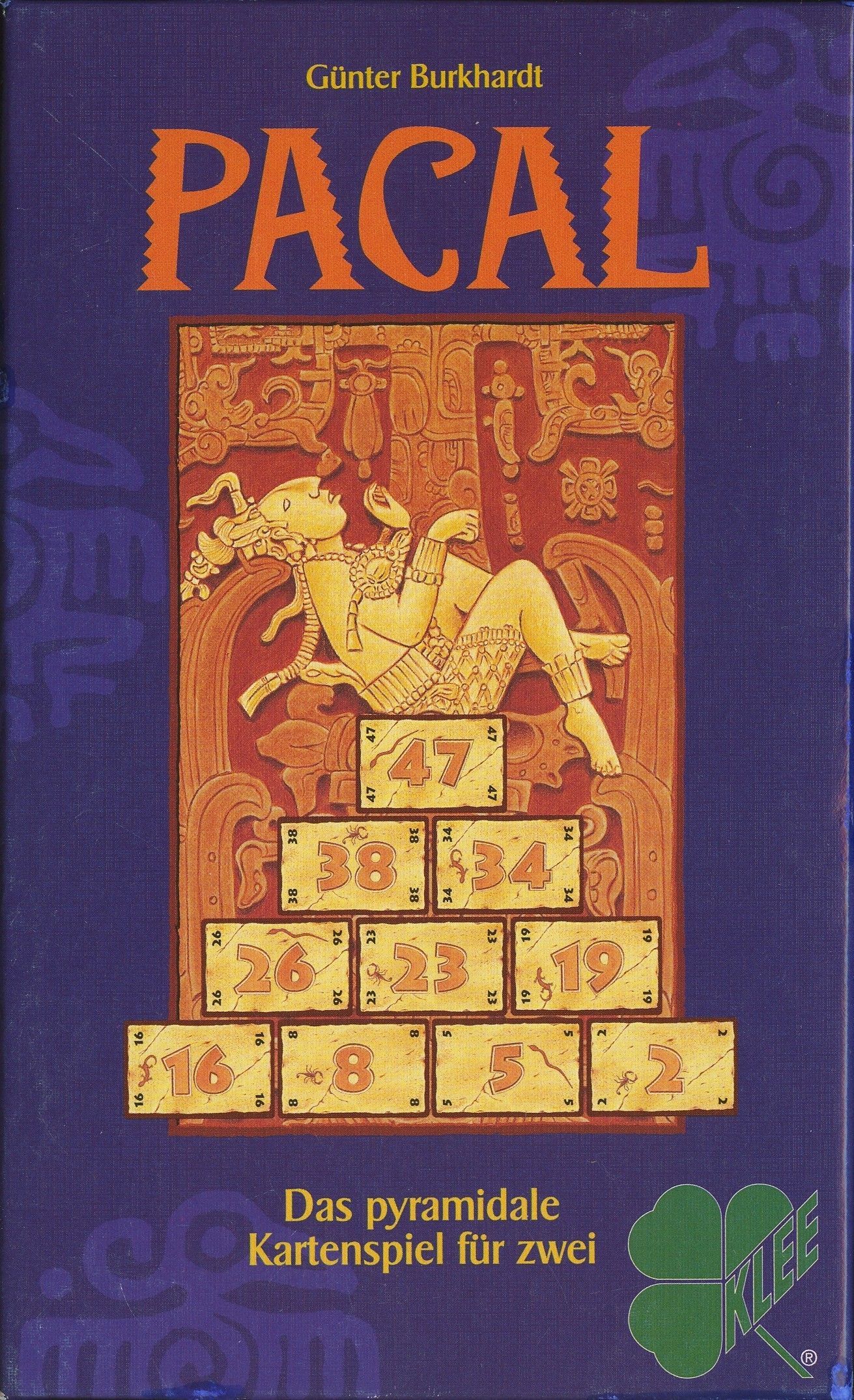
Setup
The pyramid has 10 fields arranged in a triangular structure with a single top field.
Each player's pyramid consists of 10 fields arranged in a triangular (pyramidal) shape. The physical base is formed by 10 face-down cards dealt at the start of each round — these are not in play and simply provide the scaffolding. The 10 playable fields are where cards are placed face up during the game.
Building
The highest-value card must be placed at the top of the pyramid; values must decrease toward the base.
The pyramid must be built so that the highest card value occupies the single top field (apex). Moving downward through the pyramid's rows, card values must be lower than the card(s) in the row above. This means the apex always holds the greatest value in the completed pyramid.
Building
Within each row of the pyramid, cards must be ordered left to right in descending value; the rightmost card in the base row must be the lowest.
Within any horizontal row of the pyramid, the card values must decrease from left to right. As a consequence, the card on the far right of the bottom (base) row must be the lowest-value card in the entire pyramid. All placements must respect this left-to-right descending ordering within their row and the top-to-bottom descending ordering across rows.
Restriction
Once a card is placed on the pyramid, it cannot be moved.
Cards placed on any field of the pyramid are permanent. A player may not reposition, swap, or remove a card once it has been placed, regardless of future placements.
Building
Each card value (field) may be covered by exactly one additional card; a card that is already covering another card cannot itself be covered again.
In the pyramid structure, upper-row cards physically overlap (cover) lower-row cards. Each field/card may be covered by a card from the row above exactly once. If a field already has a card covering it (i.e., a card from a higher row has already been placed on top of it), it cannot be covered a second time. This limits where new cards can legally be placed as the pyramid fills.
Restriction
A card may only be placed on an uncovered field where it satisfies all ordering rules (vertical and horizontal).
When placing a card, the player must choose an uncovered field such that: (1) the card's value is lower than any card that will sit above it (or it is the top field), (2) the card's value is higher than any card to its right in the same row, and (3) the card's value is lower than any card to its left in the same row. If no such valid field exists, the player immediately loses the round (see: instant_loss_rule).
Turn structure
The active player selects 2 cards from their hand, places them face up, and the opponent picks one; the other is returned.
On each turn, the active player chooses any 2 cards from their hand and places them face up on the table. The opponent then selects exactly 1 of the 2 cards to keep for their own pyramid. The remaining card is returned to the active player. Both players must then immediately place their received card into their own pyramid.
Special
After 14 cards each have been played, the final card in hand may be placed directly into the player's own pyramid.
Once each player has placed 14 cards through the normal offer-pick cycle, each player will have exactly 1 card remaining in hand. This final card bypasses the offer phase: the player may place it directly into their own pyramid if it legally fits according to all building rules. There is no obligation to offer this card to the opponent.