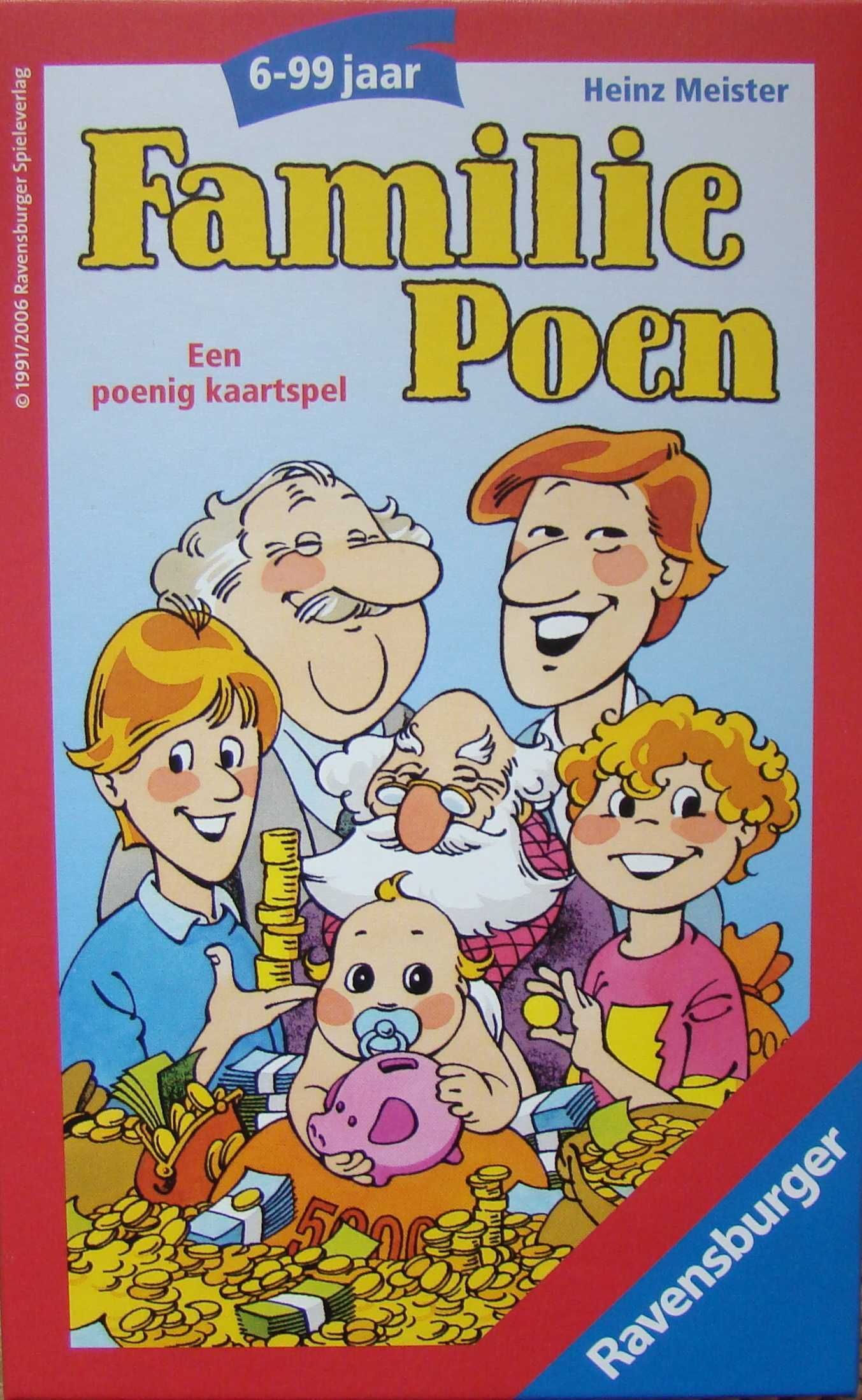
General
Each Family Poen character card has a fixed numeric value.
There are six card values, each represented by a different family member: Baby = 1, Boy = 2, Older Brother = 5, Dad Poen = 10, Grandpa Poen = 20, Great-Grandpa = 50. These values are fixed and never change. Each value exists in six different colours: red, blue, yellow, green, grey, and purple, giving 36 cards in total.
Setup
Each player begins with a fixed set of coins totalling 104.
At the start of the game each player receives the following coins: 1×50, 1×20, 2×10 (=20), 2×5 (=10), 4×2 (=8), and 4×1 (=4), for a total of 112 coins. These coins serve as both the currency for paying round winners and the measure of victory at game end.
Setup
Shuffle the deck and deal 5 cards face-down to each player; flip the top remaining card to start the discard pile.
The full deck is shuffled. Each player is dealt 5 cards face-down and holds them so opponents cannot see them. The remaining cards form the draw pile, placed face-down in the centre of the table. The top card of the draw pile is flipped face-up and placed beside the draw pile to form the discard pile. This face-up card sets the initial matching requirement for the first player.
Setup
The youngest player goes first in the opening round.
In the very first round, the youngest player takes the first turn. In all subsequent rounds, the player who paid the most coins to the previous round's winner becomes the starting player. In the event of a tie for most paid, the rules do not specify a tiebreaker — players may decide amongst themselves (e.g., youngest among those tied).
Card play
On your turn, play a card matching either the value or colour of the top discard card.
When it is your turn, you must play one card from your hand onto the discard pile. The card you play must match the current top card in one of two ways: (a) it has the same numeric value as the top card, regardless of colour, or (b) it has the same colour as the top card, regardless of value. Example: if the top card is a Blue 50, you may play any other 50-value card (of any colour) or any other blue card (of any value). After playing, your turn ends and the next player must match your newly played card.
Card play
If you cannot match the top card, draw one card from the draw pile; play it immediately if it matches, otherwise your turn ends.
If you have no card in hand that matches the top discard card (by value or colour), you must draw the top card from the draw pile. If this drawn card matches the top discard card, you may play it immediately on the same turn. If the drawn card does not match, your turn ends and the card stays in your hand. You may only draw one card per turn in this situation.
Special
When playing your second-to-last card, you must announce 'Zahlemann'.
When you play the card that leaves you with exactly one card in hand (i.e., your second-to-last card), you must announce 'Zahlemann' at the time of playing it. If you forget to announce 'Zahlemann' and another player notices before the next player takes their turn, you must draw the top card from the draw pile as a penalty. This penalty card cannot be played immediately even if it would match the top discard card.
Special
Playing your last card ends the round; announce 'Zahlemann und Söhne'.
When you play your final card from your hand, you announce 'Zahlemann und Söhne'. This immediately ends the current round. You are the winner of the round. All other players must now pay you coins equal to the total value of the cards remaining in their hands.