2021 BGG rank #970

A Gentle Rain

1 player 15 min Ages 8+ 1.1/5 complexity 6.7/10 rating

About this game

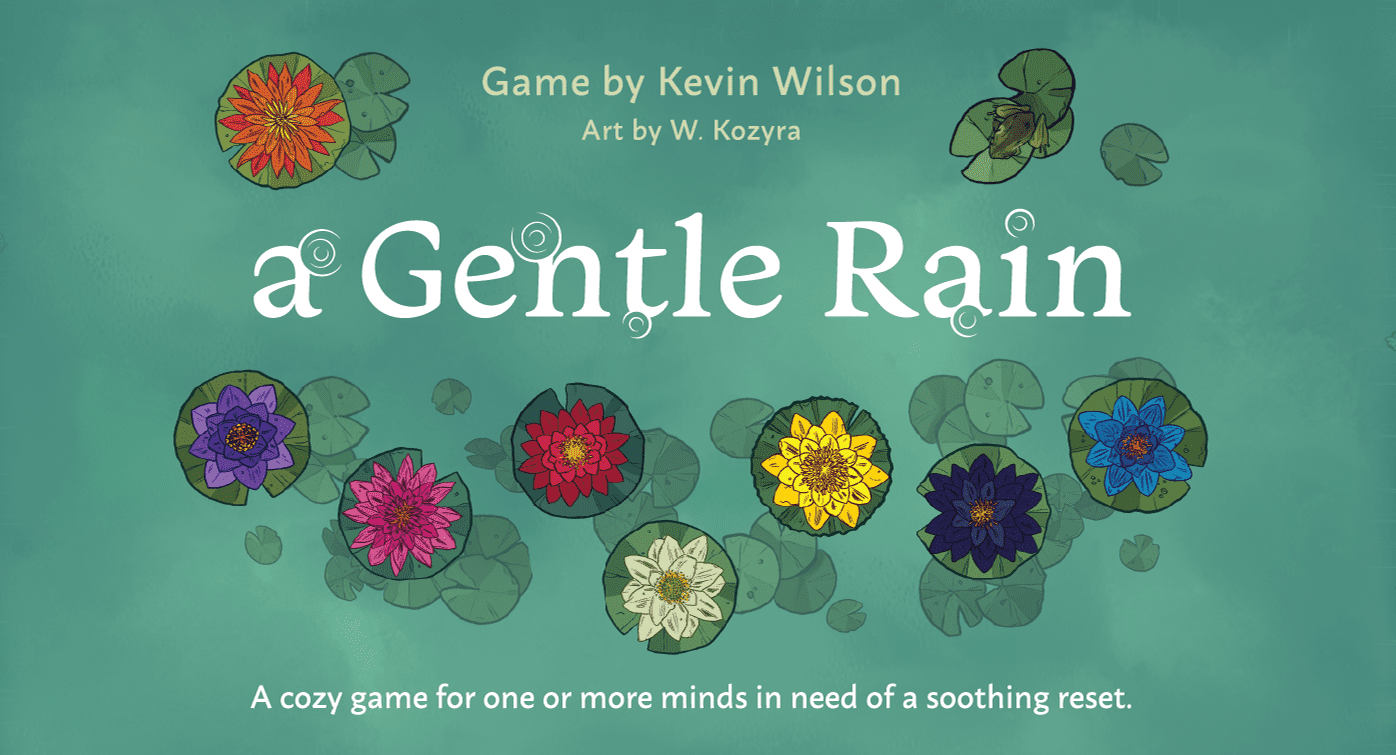
TAKE A DEEP BREATH, AND RELAX... You have come to the lake hoping to see a rare and beautiful sight. The lilies of the lake only open their blossoms in the rain, and only rarely do all eight kinds of lily bloom at once. The goal of A Gentle Rain is to place the lake tiles in such a way to cause all eight types of lilies to bloom before you run out of tiles and the rain ends. Place each new tile you draw next to a tile already in play, making sure to match the colors of all the tile edges touching the tile you are placing. Each time you manage to complete a square of four touching tiles, a blossom opens between them. Keep Score, or don’t. —description from the publisher

What it feels like

Tile Placement Solo / Solitaire Game Pattern Building Puzzle Flowers Coziness / Relaxation / Self-Care / Well-being

Explore these mechanics in Cardboard

Start an original prototype from reusable design patterns—not this game's content.

Open mechanics workbench

Game intelligence

Learn the game

100% knowledge coverage

Setup

1. Shuffle all 28 tiles and place them in a facedown stack within reach of the play area.\n2. Place all 8 blossom tokens nearby within reach.\n3. Flip a single tile from the top of the stack faceup and place it in the center of your play area. This is the starting tile and begins the game.

Turn flow

Each turn has two steps:\n1. DRAW: Draw the top tile from the facedown stack.\n2. PLACE or DISCARD: Attempt to place the drawn tile adjacent to any existing tile in the play area, following the matching rule (all touching edges must show matching flower types/colors). If no valid placement exists, discard the tile and draw the next one.\nADDITIONALLY: Whenever four placed tiles form a 2×2 square, immediately place a blossom token in the empty center space of that square, provided you have a blossom token that matches one of the surrounding flower types/colors. If no matching token is available, no blossom is placed and play continues.

Scoring and victory

Additive score calculated at game end. Higher is better. A perfect score is 29. Target score: 29 Scoring sources: Blossom tokens successfully placed during the game (1 point each, max 8), Unplayed tiles remaining in the facedown stack at game end (1 point each, max 21 counted)

Source: Rulebook

Rules to know

The most useful rules for getting a first game right.

Setup

Shuffle all 28 tiles into a facedown stack.

Before the game begins, shuffle all 28 flower tiles together and place them in a single facedown stack within easy reach of the play area.

Setup

Place all 8 blossom tokens within reach.

All 8 blossom tokens are placed in a pool near the play area before the game starts. They are available for use throughout the game.

Setup

Flip one tile faceup and place it in the center of the play area to start.

After shuffling, flip the top tile of the stack faceup and place it in the center of your play area. This tile is the seed of the garden and does not need to match anything. The remaining tiles stay in the facedown stack.

Turn structure

Each turn, draw the top tile from the facedown stack.

On your turn, take the top tile from the facedown stack and attempt to place it in the play area. If the tile cannot be placed anywhere legally, it is discarded (removed from the game). Either way, your turn then ends and you draw again on the next turn.

Tile placement

A tile may only be placed so that every touching edge matches the flower type/color of the adjacent tile's edge.

When placing a drawn tile, it must be placed orthogonally adjacent to at least one existing tile. Every edge of the newly placed tile that touches an edge of an already-placed tile must show the same flower type and color as that neighboring edge. A tile that would cause any mismatch on any touching edge cannot be placed in that position. 'Adjacent' means sharing a full edge (not diagonal).

Restriction

If a drawn tile has no valid placement, it is discarded; continue drawing.

If the drawn tile cannot legally be placed in any open position adjacent to existing tiles (because no position satisfies the edge-matching rule), the tile is discarded from the game. Play continues by drawing the next tile on your following turn. Discarded tiles do not count as 'unplayed tiles' for scoring.

Special

When four tiles form a 2×2 square, place a blossom token in the center.

Whenever the placement of a tile completes a 2×2 square of four tiles (i.e., four tiles occupy the four corners of a square grid space, leaving an empty center), a blossom token must be placed in the empty center space of that square — provided a matching token is available (see blossom_token_matching rule). This is triggered immediately upon completing the square.

Restriction

The blossom token placed in a square's center must match the flower type/color of at least one of the surrounding flowers.

When a 2×2 square of tiles is completed and a blossom token is to be placed in the center, the token placed must match the flower type/color of at least one of the flowers on the inner edges surrounding that center space. If you have no remaining blossom token that matches any of the surrounding flower types/colors, no blossom token is placed and play simply continues.

Strategy briefing

Maximizing Unplayed Tiles

Because unplayed tiles (up to 21) contribute directly to your score, completing the game quickly by placing all 8 blossom tokens early is highly rewarding. Focus on building 2×2 squares efficiently so you exhaust your blossom supply while many tiles remain in the stack.

Tile Placement and Edge Matching

Plan tile placement to open multiple valid positions for future tiles. Since a tile that cannot be placed anywhere is discarded (and discarded tiles score nothing), maintaining flexible open edges reduces waste and keeps your options open.

Blossom Token Management

There are only 8 blossom tokens, one per flower type. When completing a 2×2 square, the token placed must match a surrounding flower. Spending a rare-colored token early may make it impossible to claim a later square surrounded by that same color. Prioritize squares that allow you to use tokens whose colors appear abundantly in your growing garden.

Engineering 2×2 Squares

The placement rule requires all touching edges to match. Deliberately placing tiles to form L-shapes and U-shapes around open center spaces sets up future 2×2 square completions. Keep track of which flower colors border your open spaces to ensure you'll have a matching blossom token available when the square closes.

Scoring Cap Awareness

The unplayed tile bonus is capped at 21. Since one tile seeds the board at setup and 7 tiles could theoretically be placed (one per blossom, with very efficient play), you need at least 7 placed tiles plus the starting tile — meaning 21 remaining is achievable but requires placing blossoms with minimal tile use. Be aware the cap rewards speed but not recklessness.

Common questions and edge cases

Does a tile that is discarded because it cannot be placed count as an 'unplayed tile' for scoring?

No. Discarded tiles have been drawn from the stack and removed from the game; they are neither placed nor 'unplayed.' Only tiles that are still in the facedown stack and were never drawn count as unplayed tiles for scoring (capped at 21).

If placing a single tile completes more than one 2×2 square simultaneously, do you place a blossom in each?

The rulebook describes the trigger as completing 'a square of tiles,' implying each completed square earns a blossom opportunity. If a single tile completes multiple 2×2 squares, a blossom token should be placed (if a matching token is available) for each completed square, one at a time, checking the matching rule for each center space independently.

If all 8 blossom tokens are already placed and a new 2×2 square is completed, does the game end?

No — the game ends when you place your LAST blossom token. If all 8 are already placed and another square is completed, there are no tokens to place, but the game does not re-trigger an end condition from this. The game would have already ended the moment the 8th token was placed.

If the game ends with more than 21 tiles still in the stack, how many points do you score for them?

Only a maximum of 21 unplayed tiles are counted for scoring, regardless of how many remain. For example, if 25 tiles remain, you still only score 21 points from unplayed tiles. The cap is explicitly stated in the scoring formula.

What happens if placing the last blossom token also exhausts the tile stack on the same turn?

The game ends as soon as the last blossom token is placed — that is the primary end trigger. The tile stack being empty is a secondary end condition. Either condition independently ends the game; whichever occurs first applies.

Ask About This Game

Similar games