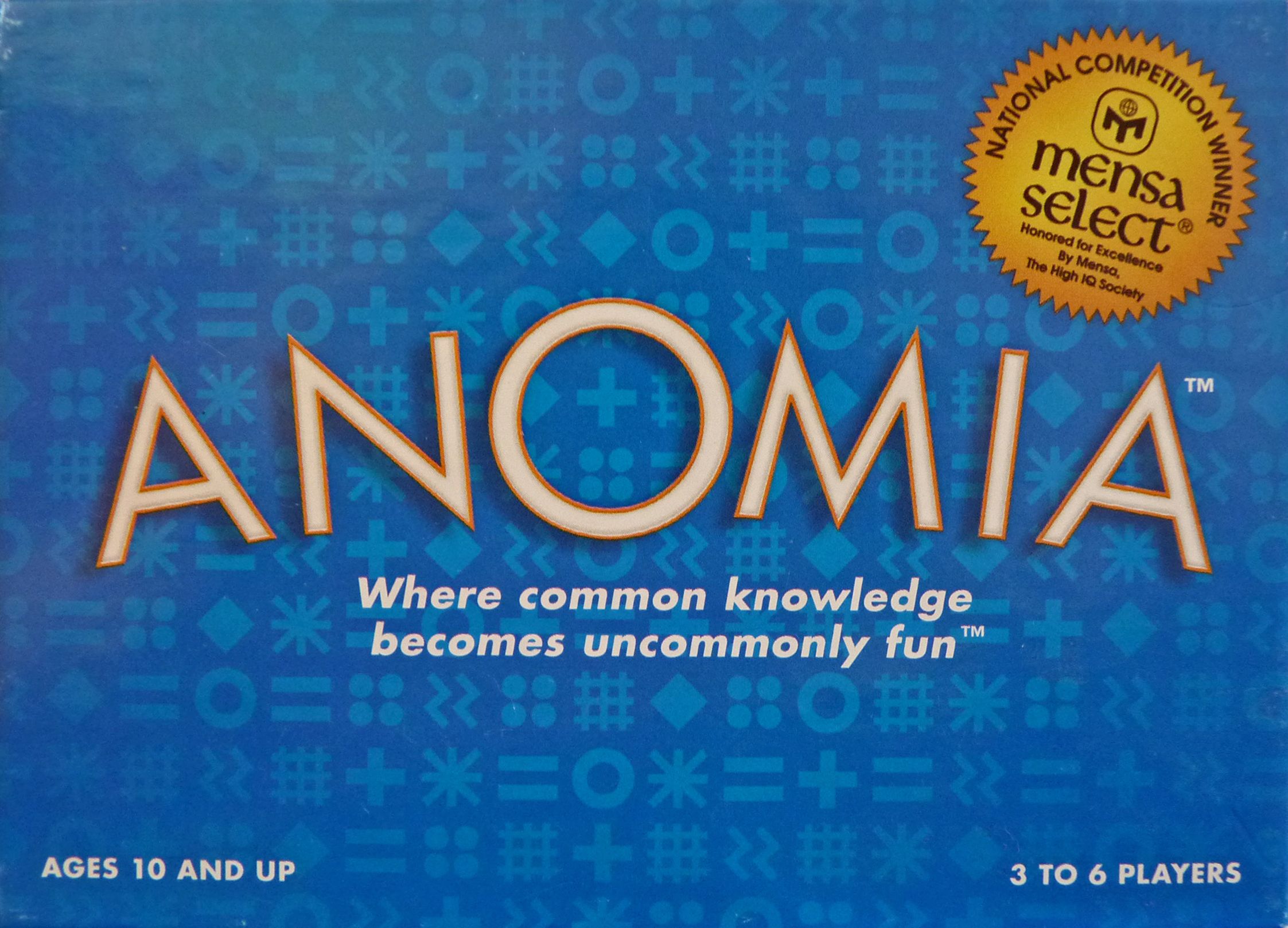
2010 BGG rank #1892

Anomia

3–6 players 30 min Ages 10+ 1.1/5 complexity 6.3/10 rating

About this game

Anomia plays off the fact that our minds are positively brimming with all sorts of random information: things to eat, pop songs, websites, etc... Sure, under normal circumstances, it's easy to give an example of a frozen food or a dog breed, but you'll find that your brain works a little differently under pressure! To play, draw and reveal a card from the center pile. Does the symbol on your card match one on another player's card? If so, you must quickly face-off with the other player by giving an example of the person, place, or thing on their card before they can do the same for yours. If you blurt out a correct answer first, you win their card and the drawing continues. Sounds simple, right? Wrong! Wild cards allow non-matching symbols to match, increasing the number of things to which you must pay attention. Cascading face-offs can occur when you hand over a lost card, thereby revealing a new top card on your play pile.

What it feels like

Pattern Recognition Speed Matching Trivia Real-time Word Game Party Game

Game intelligence

Learn the game

100% knowledge coverage

Setup

1. Choose which deck(s) to play with (Deck 1, Deck 2, or both shuffled together for a combined game).\n2. Shuffle the chosen deck thoroughly.\n3. Deal all cards face-down as evenly as possible to all players.\n4. Each player places their cards face-down in a personal draw pile in front of them.\n5. Each player also designates a space for their face-up pile (played cards) and a separate winnings pile (captured cards).\n6. Determine the starting player (e.g., youngest goes first) and begin play clockwise.

Turn flow

Play proceeds clockwise. On your turn, flip the top card of your face-down draw pile face-up onto your personal face-up pile, so all players can see it. Immediately, all players check if the new card's symbol matches the symbol on any other player's top face-up card. If a match is found, those two players instantly face off — racing to shout a correct example of their OPPONENT's card category. The winner takes the loser's card into their winnings pile. If the loser's newly exposed top card matches anyone else's card, a cascading face-off begins immediately. All cascades resolve before drawing continues. If a Wild card is flipped, the two players flanking the flipper face off instead. Once all face-offs are resolved, the next player clockwise takes their turn and flips a card.

Scoring and victory

Most cards in winnings pile wins Scoring sources: Winning face-off challenges to capture opponent's top face-up card, Winning face-offs triggered by Wild cards

Source: Rulebook

Rules to know

The most useful rules for getting a first game right.

Setup

Shuffle the deck and deal the cards face-down evenly among all players.

Before play begins, select one of the available decks (the original game includes two decks: Deck 1 and Deck 2, which can be played separately or combined). Shuffle the chosen deck thoroughly and distribute all cards face-down, as evenly as possible, to all players. Each player holds their stack face-down in front of them — this is their personal draw pile.

Turn structure

On your turn, flip the top card of your pile face-up onto your personal discard pile.

Play proceeds clockwise. On your turn, take the top card of your face-down draw pile and flip it face-up, placing it on top of your personal face-up pile (visible to all players). The newly revealed card's symbol and category are now active and can trigger a face-off.

Special

When two players' top face-up cards share the same symbol, those players immediately face off.

After any card is flipped face-up, all players check whether the symbol on the newly revealed card matches the symbol on any other player's current top face-up card. If a match is found between two players, those two players immediately enter a face-off. Normal turn order is suspended until the face-off is resolved.

Special

In a face-off, matching players race to name an example of their opponent's card category.

When two players have matching symbols on their top face-up cards, they face off. Each player must race to be the first to shout out a correct example of the category printed on their OPPONENT's card (not their own card). The player who gives a correct answer first wins the face-off.

Special

The face-off winner takes the loser's top face-up card and adds it to their winnings pile.

The player who first gives a correct example of their opponent's category wins that opponent's top face-up card. The winning player places the captured card face-down in their personal 'winnings pile' (kept separate from their draw pile). The captured card counts toward the winner's final score.

Special

Losing a card in a face-off may expose a new top card that triggers another face-off.

When a player loses their top face-up card in a face-off, their next face-up card is now exposed as their new top card. If that newly exposed card's symbol matches any other player's current top face-up card, a new face-off immediately begins between those two players — even before normal drawing resumes. These cascading face-offs continue until no two players' top face-up cards share a symbol.

Special

Wild cards link the two players on either side of the person who flipped it, forcing them to face off.

Some cards in the deck are Wild cards. When a Wild card is flipped face-up, it creates a temporary link between the players sitting immediately to the left and right of the player who flipped the Wild card. Those two neighboring players must immediately face off: they race to give an example of the category on their opponent's card. The Wild card itself has no category and does not participate in future symbol matching — only the two flanking players are affected.

Special

Winning or losing a face-off triggered by a Wild card can also cause cascading face-offs.

When a face-off triggered by a Wild card concludes, the loser's new top face-up card is checked against all other players' top face-up cards for symbol matches, potentially triggering cascading face-offs just as a regular face-off loss would.

Strategy briefing

Focus on your opponent's category, not your own

The most common mistake is trying to answer your own card's category instead of your opponent's. Actively train yourself to read the opponent's card the moment a match occurs, since the face-off rule requires you to name an example of their category.

Stay alert at all times — it is never truly 'not your turn'

Because face-offs trigger instantly whenever any card is flipped and cascades can involve any player, you must watch all face-up piles constantly, not just during your own flip. A cascade triggered by someone else's loss can suddenly make your card match another player's.

Know your neighbors when Wild cards are in play

Wild cards only affect the two players sitting immediately to the left and right of the flipper. Sitting next to an active/high-volume flipper increases your Wild card exposure. Being aware of your seating position relative to other players can inform how much you mentally prepare for Wild card face-offs.

Speed over precision — wrong answers have no penalty

Since incorrect answers carry no penalty, it can be advantageous to blurt out any plausible answer quickly rather than carefully deliberating. This puts psychological pressure on your opponent and buys you time if they hesitate.

Winning cards creates cascade risk for your opponent

When you win a card from an opponent, their new top card is immediately exposed and checked for matches. Winning streaks can chain into multiple consecutive face-offs against different players, so maintaining mental stamina and awareness of the board state is critical.

Common questions and edge cases

A Wild card is flipped, triggering a face-off between the two flanking players. The loser loses their top card — does this trigger another face-off?

Yes. After the Wild card face-off resolves, the loser's new top face-up card is immediately checked against all other players' top cards for symbol matches. If a match is found, a new face-off begins (a cascade), just as it would after any regular face-off.

A player has run out of draw cards but still has a face-up pile. Can their top face-up card still be involved in a face-off?

Yes. A player with an empty draw pile still has their current top face-up card active. That card can still match another player's card and trigger a face-off. The player simply skips flipping on their own turn.

During a face-off, which category must each player name an example of — their own card or their opponent's?

Each player must name an example of their OPPONENT's category, not their own. This is a core source of confusion and mental pressure in the game.

A flipped card's symbol matches two different players' top cards at the same time. What happens?

Only one face-off can occur at a time. Resolve the first face-off (typically with the closest player clockwise). After that face-off and any cascades are resolved, check again for any remaining matches before continuing normal play.

Both players in a face-off keep giving wrong answers. Does play continue?

Yes. There is no penalty for wrong answers and the face-off does not time out. Players continue shouting attempts until one player gives a correct, valid example of the opponent's category. The face-off cannot end in a draw.

Ask About This Game

Similar games