2024 BGG rank #8476

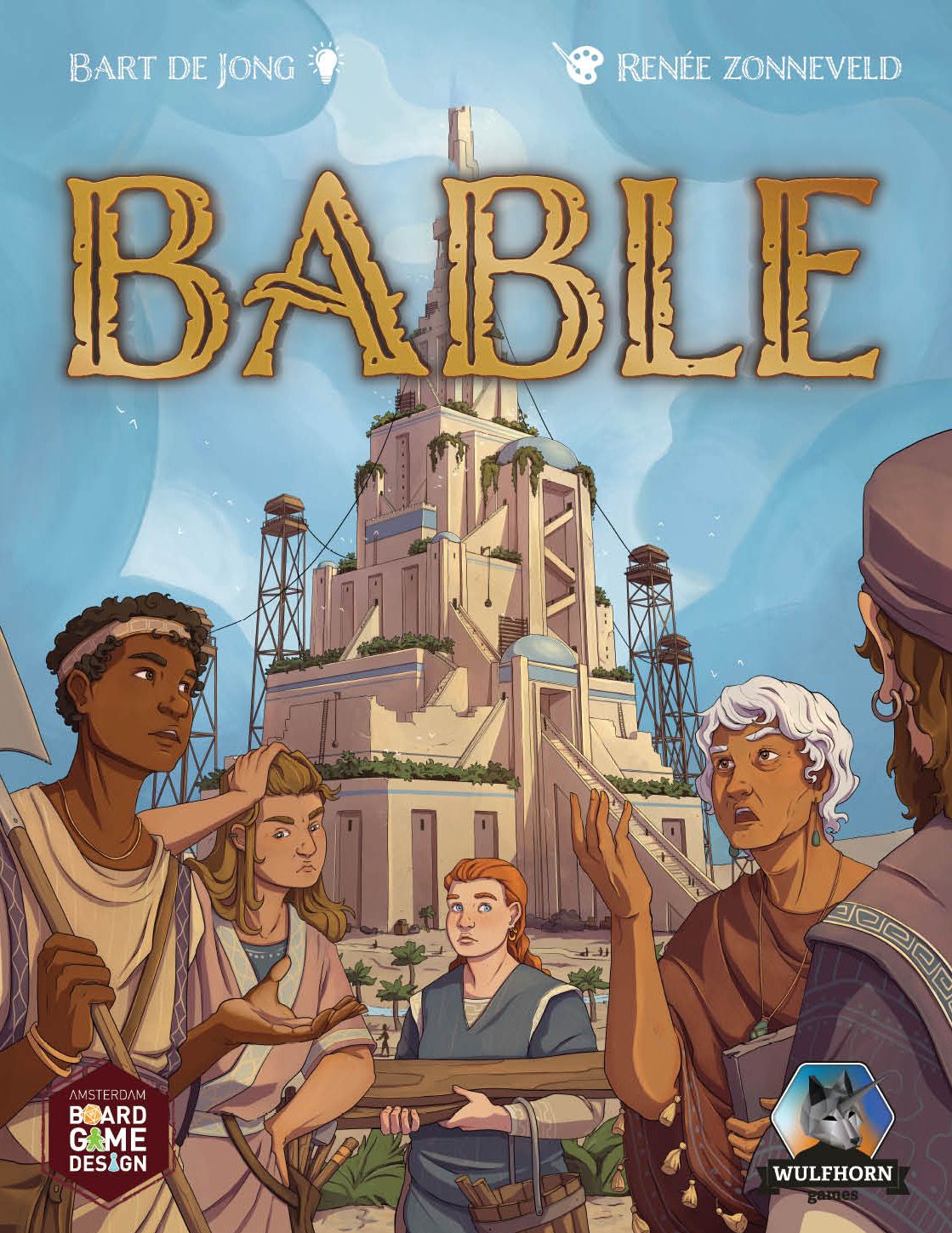
Bable

2–5 players 20–45 min Ages 10+ 2.1/5 complexity 5.6/10 rating

About this game

Bable is a challenging cooperative card game where no one speaks your language. You build the mythical Tower of Babel together with your fellow players. However, you may not perform any actions during your turn; instead you have to give orders to other players. Meanwhile, your languages are slowly changing, making it increasingly difficult to understand each other. Players work together by giving each other commands. While building, their languages slowly change, making it increasingly harder to understand each others commands. Do the players manage to construct the tower before the chaos is complete? The goal in Bable is to complete building the tower before they run out of actions. Players construct the tower in 4 distinct Layers, containing (from bottom to top) 4, 3, 2 and 1 Building cards. Players must complete each Layer before its corresponding Idea deck runs out. Players always have 4 actions in hand (build, draw, give and reveal) that help construct the tower. The actions are referred to by their symbols, as the words associated to the actions will change during the game. Players are not allowed to perform actions on their own turn. Instead, on their turn they give assignments to other players to perform actions. An important actions is the build action, which allows a player to place a Building card in the tower if they pay the associated cost in Materials. —description from the designer

What it feels like

Cooperative Game Communication Limits Hand Management Card Game Civilization

Explore these mechanics in Cardboard

Start an original prototype from reusable design patterns—not this game's content.

Open mechanics workbench

Game intelligence

Learn the game

80% knowledge coverage

Setup

1. Shuffle the Resource cards and deal 3 to each player, placed face-up in front of them as their personal Supply. Shuffle the remaining Resource cards into a face-down deck.\n2. Give each player a set of 4 Starting Word cards in their player color; players take these into their hand.\n3. Shuffle the Word cards and deal 1 to each player. Each player takes their new Word card into their hand, then discards (face-down) the Starting Word card that shares the same command symbol as the drawn Word card.\n4. Shuffle the Building cards and deal 1 to each player. Players place it face-down in their Supply.\n5. Create four Idea decks using the following composition:\n - Deck 4: 2 Word cards\n - Deck 3: 3 Word cards, 1 Building card\n - Deck 2: 5 Word cards, 2 Building cards\n - Deck 1 (at 2/3/4/5 players): 6/7/8/9 Word cards and 7/6/5/5 Building cards\n6. Shuffle each Idea deck and place all four in a column to the left of the play area.\n7. (Advanced only) Shuffle the 9 Confusion cards and place them in a deck next to the play area.\n8. The player who most recently spoke a non-native language goes first; play continues clockwise.

Turn flow

On your turn, you are the "overseer." You take exactly two actions (in any order, and you may repeat actions or target the same player twice), then draw one Idea card.\n\n**Two Actions (choose from):**\n a. Give a command to another player — speak a word you think matches one of their Word cards. If correct, they reveal the card and perform the command, then return it to hand. If incorrect, they shake their head and nothing happens.\n b. Reveal a card to all other players — either a Word card from your hand (show it, then return it) or a Building card from your supply (flip it face-up permanently).\n\n**Draw Phase:**\nDraw 1 Idea card from the lowest available (non-empty) Idea deck. If that deck is empty, draw from the next deck above it. If the card drawn is the last card from a deck whose corresponding tower layer is incomplete, the game immediately ends in a loss.

Scoring and victory

Cooperative win/loss — all players win together or lose together. There is no point scoring; the outcome is binary. Target score: Complete the 4-layer tower (placing all 10 Building cards: 4+3+2+1) before any Idea deck runs out with its corresponding layer unfinished. Scoring sources: Completing all 4 tower layers before the corresponding Idea decks run out results in a victory., Failing to complete any layer before its Idea deck runs out results in a loss.

Source: Rulebook

Rules to know

The most useful rules for getting a first game right.

Setup

Deal 3 Resource cards face-up to each player as their starting Supply; shuffle the rest into a face-down deck.

Shuffle all Resource cards. Deal 3 to each player; players place these face-up in front of them — this is their personal Supply. Shuffle the remaining Resource cards into a face-down deck placed in the play area.

Setup

Each player receives 4 Starting Word cards (one per command symbol) in their player color into their hand.

Give each player a set of 4 Starting Word cards in their player color. Players take all 4 into their hand. Each Starting Word card corresponds to one of the four command symbols.

Setup

Deal 1 Word card to each player; they add it to their hand and discard the Starting Word card with the same command symbol.

Shuffle the Word cards and deal 1 to each player. Each player takes their new Word card into their hand. They then find the Starting Word card in their hand that shares the same command symbol as the newly drawn Word card, and place that Starting Word card face-down into a discard pile. This ensures each player always has exactly 1 Word card per command symbol.

Setup

Deal 1 Building card face-down to each player's Supply.

Shuffle the Building cards. Deal 1 Building card face-down to each player. Players place it face-down in their Supply. Players may look at their own face-down Building cards at any time.

Setup

Create four Idea decks of Word and Building cards, then shuffle and place them in a column.

Assemble four separate Idea decks as follows: - Deck 4: 2 Word cards - Deck 3: 3 Word cards + 1 Building card - Deck 2: 5 Word cards + 2 Building cards - Deck 1: At 2 players: 6 Word + 7 Building; at 3 players: 7 Word + 6 Building; at 4 players: 8 Word + 5 Building; at 5 players: 9 Word + 5 Building. Shuffle each deck separately and place all four in a column to the left of the play area, with Deck 1 at the bottom.

Setup

The player who most recently spoke a non-native language goes first; play is clockwise.

The player who most recently spoke a language that is not their native tongue takes the first turn. Play then continues in clockwise order.

Turn structure

Each turn: take 2 actions (give commands or reveal cards), then draw 1 Idea card.

On your turn you are the overseer. You must take exactly 2 actions, then draw 1 Idea card. For your 2 actions, each may independently be either: (a) give a command to another player, or (b) reveal a card to all other players. You may give two commands to the same player, two commands to different players, the same command twice, or two different commands. You may also choose both actions to be reveals.

Card play

Speak a word to another player; if they have a matching Word card, they perform the command.

Choose another player and speak a word you believe corresponds to one of their Word cards. If the player has a Word card in their hand with that exact word, they must reveal it, perform the associated command, then take the Word card back into their hand. If they do not have a Word card with that word, they shake their head and no command is performed. If a player has two or more Word cards with the same word, they may choose which command to perform when that word is spoken to them.

Common questions and edge cases

A player has two Word cards in their hand with the same word on them. Another player speaks that word as a command — what happens?

The commanded player may choose which of those two commands to perform. They reveal the chosen card, perform that command, and return it to their hand.

Can a player build with a Building card that is still face-down in their Supply, without revealing it first?

Yes. The Build command allows a player to pay the cost of any Building card in their Supply, face-up or face-down, and place it in the tower. The player may look at their own face-down cards at any time to know the cost.

Deck 1 (the lowest deck) has run out of cards. Which deck does the active player draw from?

The player draws from the next available deck above the empty one — in this case, Deck 2. If Deck 2 is also empty, they draw from Deck 3, and so on.

A player draws the last card from Deck 2. Layer 2 is complete, but Layer 1 is not. Does the game end?

No. The loss condition checks whether the layer corresponding to *that specific deck* is complete. Deck 2 corresponds to Layer 2. Since Layer 2 is complete, the game does not end. Play continues drawing from Deck 3.

What is the difference between using the Reveal command (from a command word) and revealing a card as a turn action?

Both are valid ways to share information. The Reveal command (performed when commanded by another player) lets the commanded player reveal up to 2 cards from their hand or Supply. The turn action reveal (taken on your own turn) lets the active overseer reveal 1 card from their own hand or Supply. The Reveal command can show Word or Building cards; so can the action reveal.

A player's Word cards are placed face-down due to a Confusion card penalty. Can they still perform commands if they receive one?

No. While a player's Word cards are face-down on the table (until the start of their next turn), other players may not give that player any commands at all.

A Confusion card forces a player to give all their Resources to the player on their right, pushing that player over the 7-card limit. What happens?

The receiving player accepts all the cards, then immediately discards down to 7 Resource cards.

A player discards a Word card due to the 'discard a Word card' Confusion penalty. Can other players still give them commands for the discarded command symbol?

There is no Word card for that symbol in the player's hand, so any word spoken for that command will result in the player correctly shaking their head (in the basic game) or triggering another Confusion card (in the advanced game). The player will only recover that command slot when they draw a Word card with the matching command symbol via a normal Idea card draw.

Can a player place a Building card into Layer 3 if Layer 1 or Layer 2 is not yet complete?

No. The Build command specifies that Building cards are always placed into the lowest unfinished layer. Players cannot skip layers.

A player performs the Draw Resources command but the Resource deck is empty. What happens?

The Resource discard pile is reshuffled to form a new deck, and the player then draws 2 cards from it.

Ask About This Game

Similar games