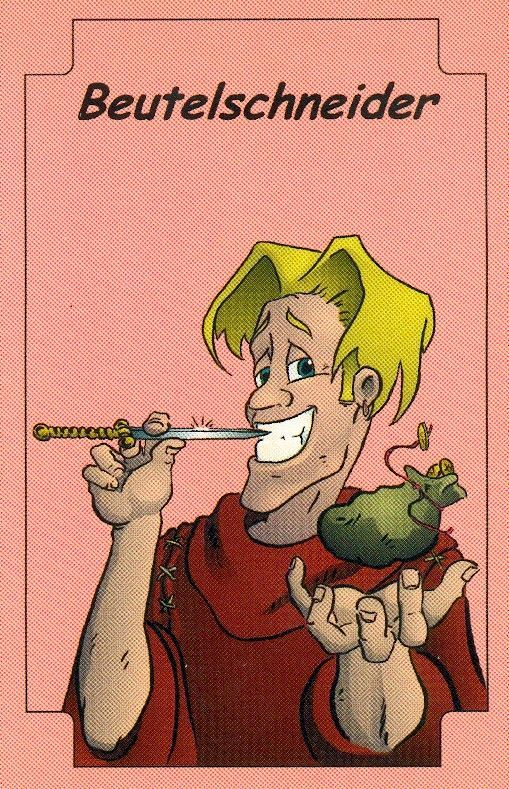
1997 BGG rank #24176

Beutelschneider

3–4 players 30 min Ages 0+ 1.3/5 complexity 5.5/10 rating

About this game

Translated as Cutpurse, this is a fairly unique entry in the trick-taking genre. Three of the suits are relatively normal, however, the cards that are worth points, in the form of gold coins, have the least value. The special thing about this game is the trump suit, which could have the Assassin killing the King or the Adventurer seducing the Countess; the character interaction is very interesting aspect.

What it feels like

Trick-taking Card Game

Game intelligence

Learn the game

100% knowledge coverage

Setup

1. Separate the 32-card deck by suit if desired, then shuffle all cards together. 2. If playing with 3 players: remove the top two cards from the shuffled deck and place them face-down aside (out of the game for that hand). Do not look at them. 3. Deal all remaining cards equally to each player: 8 cards each for 4 players, ~10 cards each for 3 players. 4. Agree on a target score before the first hand (e.g. 100 or 200 points). The blue suit is always trump — no bidding or trump selection is needed.

Turn flow

Players play a series of tricks. The leader of each trick plays a card face-up; all other players in clockwise order each play one card face-up. Normal trick-taking rules apply: players must follow the led suit if able; if unable, they may play any card including trump. Trumps (blue suit) beat all non-trump cards. Among cards of the same suit, the higher-ranked card wins. The winner of a trick leads the next trick. Special card powers (Guard, Assassin, Adventurer/Countess, Beutelschneider) are resolved at the end of each trick before scoring. After all cards are played, players score their captured tricks. Hands continue until one player reaches or exceeds the agreed target score.

Scoring and victory

Cumulative scoring across multiple hands. After each hand, players add their scores (positive and negative) to their running totals. The first player to reach or exceed the agreed target score at the end of a hand wins. Target score: Pre-agreed (e.g. 100 or 200 points) Scoring sources: Numbered cards (1–4, 10) score their face value each when captured in a trick, Beutelschneider card: –20 points to the player who captures it, Guard (G) win bonus: +10 if G cancels the Beutelschneider penalty AND wins that trick, Guard (G) last trick bonus: +10 if G wins the last trick of the hand, Assassin (M) kill bonus: +10 if M kills the Sovereign (F) and wins the trick, Adventurer/Countess seduction bonus: +10 if the seducing card (played second) wins the trick

Source: Rulebook

Rules to know

The most useful rules for getting a first game right.

General

There are four suits: green, yellow (non-trump), red (non-trump, with Beutelschneider as highest), and blue (always trump).

The deck contains four suits of cards. Green and yellow each have 9 cards ranked in ascending order: 1, 2, 3, 4, B (Beggar), S (Barmaid), W (Landlord), 10, K (Merchant/Kaufman). Red also has 9 cards in the same ascending order, except the highest card is NOT the K but the Beutelschneider — the only card in the deck without an identifier in its corners. Blue is the permanent trump suit and contains 5 cards in ascending order: G (Guard), M (Assassin), A (Adventurer), C (Countess), F (Sovereign).

General

The blue suit is always and permanently the trump suit; no bidding or selection is needed.

The blue suit (Guard, Assassin, Adventurer, Countess, Sovereign) is always the trump suit for every hand. It is fixed and never changes. Trump cards beat all non-trump (green, yellow, red) cards regardless of rank.

Setup

With 4 players, deal all 32 cards — 8 each.

When playing with 4 players, shuffle all 32 cards and deal 8 cards to each player. No cards are set aside.

Setup

With 3 players, remove the top 2 cards face-down before dealing.

When playing with 3 players, after shuffling, take the top two cards from the deck and place them aside face-down. These cards are out of play for the hand and are not revealed. Deal the remaining 30 cards to the three players (10 each).

Turn structure

Players must follow the led suit if they have a card of that suit in hand.

On your turn within a trick, you must play a card of the same suit as the card that led the trick, if you have one or more such cards in hand. If you have no cards of the led suit, you may play any card from your hand, including a trump card or any other suit.

Turn structure

Trumps beat non-trumps; within the same suit, higher rank wins.

The winner of a trick is determined as follows: (1) If any blue (trump) cards were played, the highest-ranked trump wins. (2) If no trump was played, the highest-ranked card of the led suit wins. Cards of non-led, non-trump suits never win a trick. The winner of a trick collects all cards played into it and leads the next trick. Special card powers are applied before or during this determination where relevant (see Assassin, Adventurer/Countess seduction rules).

Scoring

Each numbered card (1–4 and 10) captured scores its face value in points.

After a hand concludes, each player counts the numbered cards (1, 2, 3, 4, and 10) among the tricks they captured. Each such card scores points equal to its printed number. Letter cards (B, S, W, K) and blue suit cards score 0 points on their own (unless bonuses apply). Note: the red-suit 10 also scores 10 points if captured.

Scoring

Capturing the Beutelschneider costs the capturing player 20 points (score may go negative).

If a player wins a trick that contains the Beutelschneider (the highest card of the red suit), that player loses 20 points. This penalty is applied after checking whether the Guard (G) cancels it. A player's score may go below zero as a result of this penalty.

Strategy briefing

Avoiding the Beutelschneider

The Beutelschneider is the highest red card, so it will win any trick led in red (unless a trump is played). Never lead red if you have the Beutelschneider — and be very wary of being forced to follow suit into a trick where you must play it. Holding the Guard (G) as a 'safety valve' to cancel the –20 can be extremely valuable.

Timing the Guard (G)

G is the weakest trump but has high strategic value. Playing it after the Beutelschneider cancels –20 even without winning. If you can also win the trick with G (unlikely given its low rank) AND it is the last trick, you earn +20 in bonuses. Save G strategically rather than spending it early as a low trump.

Baiting the Sovereign (F) with the Assassin (M)

The Assassin (M) only kills the Sovereign (F) if played AFTER F. Therefore, inducing an opponent to play F early in a trick (e.g., by leading a suit they must trump) and then following with M can neutralize the game's most powerful trump and score a +10 bonus. Never play M before you expect F to appear in the same trick.

Adventurer/Countess Seduction Timing

Since the second of A or C played in a trick always outranks the first, holding the higher-ranked Countess (C) back and playing it after an opponent leads with Adventurer (A) is the normal winning play. But if you hold Adventurer (A), you can 'steal' a trick from the Countess by playing A after C — a powerful reversal worth a +10 bonus.

Point Card Concentration

Numbered cards (1–4 and 10) are the primary positive scoring source. The 10s and 4s are most valuable. Since you must follow suit, controlling trump allows you to dictate when high-value point tricks are won. Avoid winning tricks that contain only low-value or letter cards if it means exposing yourself to the Beutelschneider later.

3-Player Unknown Cards

In a 3-player game, two cards are removed face-down before dealing. This means any card — including the Beutelschneider, Guard, Sovereign, or high-point cards — may simply be absent from the hand. Do not over-rely on or fear specific cards until you have evidence they are in play.

Common questions and edge cases

The Beutelschneider is played, then the Guard (G) is played later in the same trick, but a higher trump wins the trick — does the –20 still get cancelled?

Yes. The Guard cancels the –20 penalty simply by being played after the Beutelschneider in the same trick, regardless of whether G wins the trick. The player who wins the trick does NOT suffer the –20. However, since G did not win the trick, the +10 win bonus is not awarded.

The Guard (G) plays after the Beutelschneider in the last trick and wins it — how many bonus points does G's controller earn?

G's controller earns +20 in bonuses: +10 for winning the trick in which G cancelled the Beutelschneider, and +10 for winning the last trick. Both bonuses apply simultaneously.

The Guard (G) is played first (or before the Beutelschneider) in a trick, and the Beutelschneider is played afterward — does G still cancel the –20?

No. The cancellation only occurs if G is played AFTER the Beutelschneider in trick order. If G is played before the Beutelschneider, the –20 penalty is not cancelled and applies to whoever wins the trick.

The Assassin (M) is played first, then the Sovereign (F) is played afterward in the same trick — does M still kill F?

No. M only kills F if M is played AFTER F in trick order. If M is played before F, the kill does not occur and F retains its status as the highest trump, winning the trick normally.

The Countess (C) is played first, then the Adventurer (A) is played second in the same trick — who wins?

The Adventurer (A) seduces the Countess and outranks her for this trick, so A wins (assuming no other higher trump is present). A's controller also earns a +10 bonus for winning with the seducing card.

Can a player's score go below zero?

Yes. The –20 penalty from capturing the Beutelschneider can push a player's score into negative territory. There is no floor on scores.

Is the Beutelschneider affected by normal trick-winning rules (follow suit, trump beats non-trump)?

Yes, normal rules apply. The Beutelschneider is the highest card in the red suit. It beats all other red cards but is still beaten by any blue (trump) card. If red is led, players must follow with a red card if able. Winning a trick containing the Beutelschneider with a trump card still saddles the trump player with the –20 penalty (unless G was played after the Beutelschneider in that trick).

In a 3-player game, what happens to the two cards removed at the start?

They are placed face-down and set aside. They are not revealed during or after the hand and play no part in that hand. Their identity is unknown to all players.

Ask About This Game

Similar games