2004 BGG rank #2999

Boomtown

3–5 players 30 min Ages 10+ 1.7/5 complexity 6.0/10 rating

About this game

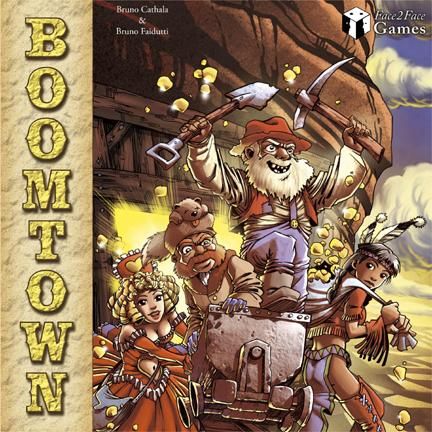
There's gold in them thar hills! In Boomtown — a game with auctions, dice, and fun/nasty action cards to play on opponents — you start as a gold digger and try to end as a tycoon. To do this, you must first buy the best mining concessions, hoping to find gold veins. You can also try to become the Mayor of Whiskey River or San Narciso, in order to get a small cut on concessions sales, or build a saloon where lucky prospectors will spend their nuggets in moonshine whiskey. If business is really bad, you can still rely on bank or stagecoach hold-ups to reestablish you. A well placed stick of dynamite can also solve some minor problems. Piraci features the same gameplay as Boomtown, but with the players now sailing the waters instead of panning them.

What it feels like

Set Collection Turn Order: Auction Auction / Bidding Dice Rolling Take That American West Card Game

Explore these mechanics in Cardboard

Start an original prototype from reusable design patterns—not this game's content.

Open mechanics workbench

Game intelligence

Learn the game

100% knowledge coverage

Setup

1. Each player receives 10 gold in poker chips (white = 1 gold, red = 5 gold, blue = 10 gold). 2. Shuffle all cards and place them face down as the draw deck. In a 3-player game, optionally remove 15 random cards (without looking at them) from the deck. 3. Place the 2 dice, bank poker chips, town tokens, and mayor pawns near the draw deck. 4. Randomly determine the first player. In subsequent turns, the winner of the last auction becomes the first player. 5. On the very first turn, all drawn cards must be mining concession cards — if any other card type is drawn, return it to the deck and replace it with the first mine drawn, then reshuffle.

Turn flow

Each turn proceeds in three phases: (1) DRAW — Draw cards equal to the number of players from the deck and place them face up in a row. (2) AUCTION & CARD SELECTION — Starting with the first player and going clockwise, players bid gold for the right to choose first. The highest bidder pays their bid (distributed to opponents via the payment chain rule), then chooses one card. The remaining cards are chosen by each other player in clockwise order from the highest bidder's left. When a player takes a mine in a town where another player is mayor, they must pay the mayor a fee equal to the mayor's number of mines in that town. (3) PRODUCTION — The first player rolls 2 dice. Each mine whose production die value matches either rolled die produces gold equal to its production value, paid to the mine's owner. Dangerous mines that match a roll of 2 or 12 collapse and are removed. The turn then ends and the next turn begins with the auction winner as the new first player.

Scoring and victory

Highest total gold score wins. In case of a tie, the rulebook does not specify a tiebreaker. Scoring sources: Gold in poker chips accumulated during play, Production value of all owned mines (sum of production value numbers on owned mine cards, +3 per New Vein card attached), 5 gold bonus per mayor pawn held at game end

Source: Rulebook

Rules to know

The most useful rules for getting a first game right.

Setup

Each player begins the game with 10 gold in poker chips.

At game start, each player receives 10 gold worth of poker chips. Chip denominations: white = 1 gold, red = 5 gold, blue = 10 gold. The remaining chips form the bank.

Setup

First player is chosen randomly; thereafter the auction winner becomes first player.

The first player for the very first turn is chosen randomly. From the second turn onward, the player who won the previous turn's auction (the highest bidder) becomes the new first player.

Turn structure

At the start of each turn, draw cards equal to the number of players.

At the beginning of each turn, draw a number of cards from the draw deck equal to the number of players and place them face up in a row. On the first turn only, all drawn cards must be mining concession cards. If any non-mine card is drawn on the first turn, return it to the deck, replace it with the first mine drawn, and reshuffle the deck.

Turn structure

Players bid gold starting with the first player; highest bidder wins the right to choose first.

Bidding starts with the first player and proceeds clockwise. The first player may either pass or bid 1 or more gold. Each subsequent player may bid higher than the current highest bid or pass. A player who passes is eliminated from the auction and cannot re-enter. Bidding continues until all but one player has passed. A player may never bid more gold than they currently have. Special case: if ALL players pass, the first player (who was the first to pass) is considered the highest bidder at a bid of 0.

Trading

With 4–5 players, the highest bidder pays their bid to the player on their right, who keeps half (rounded up) and passes the rest rightward.

With 4 or 5 players: the highest bidder pays the full bid amount to the player on their right. That player keeps half (rounded up) and passes the remainder to the next player on their right. This continues around until the money runs out. The highest bidder may never receive any of the money they paid — if the bidder's left neighbor (the last player in the chain before it would return to the bidder) receives 2 or more gold, that player keeps all of it.

Trading

With 3 players, payment works the same as 4–5 players except the 3rd player gives the remainder to the bank.

With 3 players: the highest bidder pays the full bid to the player on their right. That player keeps half (rounded up) and passes the remainder to the next player on their right. That second player keeps half (rounded up) and gives the rest to the bank (not back to the highest bidder or any other player).

Turn structure

After the auction, the highest bidder picks a card first, then players pick leftward in order.

After the auction concludes and the bid is paid, the highest bidder chooses 1 of the face-up cards. Then the player to the highest bidder's left chooses 1 of the remaining cards. Card selection continues passing leftward until every player has chosen exactly 1 card.

Building

A taken mine card is placed face up in front of the player, grouped by town color.

When a player takes a mining concession card, they place it face up in front of them. For convenience, mines should be grouped by town (border color): Cactus Junction = green, Cold Mountain = purple, Coyote City = red, Dry Gulch = yellow, San Narciso = blue.

Strategy briefing

Bid Aggressively for Mine Selection Order

Winning the auction secures not just first pick of cards, but also makes you the next first player. Losing the auction means others choose cards before you, potentially taking the mine you wanted. However, the bid payment chain means your opponents directly profit from your high bids, so overbidding enriches your competition.

Race to Become Mayor

Becoming mayor of a town generates a passive income stream: every subsequent mine taken in your town costs opponents gold paid directly to you. The Governor event card can double this fee. Prioritize getting a second mine in a promising town early.

Diversify Mine Production Dice

Mines produce only when their production die matches a rolled die. Owning mines with a spread of production die numbers maximizes the chance that at least one mine produces each turn. The Telegraph card can compensate for unlucky rolls.

Target Dangerous Mines Carefully

Dangerous mines can collapse on a roll of 2 or 12. These are the least likely dice results (one combination each), making dangerous mines relatively safe statistically. However, placing a New Vein on a dangerous mine risks losing both if it collapses.

Use Saloon Cards for Passive Income

A Saloon placed on a high-production town creates income every time any mine in that town produces, regardless of who owns those mines. Combining a Saloon with Saloon Girls doubles this income. Saloons scale with the number of mines in the chosen town, so selecting a town with many active mines maximizes value.

End-Game Mine Value Matters as Much as Cash

At game end, both gold chips and the production value of owned mines count equally toward score. A high-value mine is worth acquiring even at a steep bid cost, as its production value contributes directly to the final score independent of dice luck.

Mayor Pawns Are Worth 5 Gold Each

Each mayor pawn held at game end is worth 5 gold in scoring. Holding multiple mayorships can swing the final score significantly. Protect your mayorships from Expropriation plays that could flip town control.

Common questions and edge cases

A player takes a mine that gives them more mines than the current mayor in that town. Do they pay the fee AND take the pawn?

Yes. The player must first pay the fee to the current mayor (equal to the mayor's current mine count in that town), and only after paying does the player take the mayor pawn and become the new mayor.

The current mayor has a Governor card active. If a player takes a mine in that town and then becomes mayor, how much do they pay?

The player pays double the normal fee (due to Governor) to the current mayor first, then takes the mayor pawn. Once the new player becomes mayor, the Governor card is discarded because the original mayor lost control of the pawn.

Can a player use Expropriation to steal a mine in a town where the victim is the mayor?

Yes. The expropriating player must still pay the mayor fee (equal to the mayor's current mine count in that town) when stealing the mine. If the theft causes the expropriating player to have more mines than the mayor, they then take the mayor pawn — but only after paying the fee.

What happens to a New Vein card placed on a dangerous mine if that mine collapses?

The New Vein card is discarded when the dangerous mine collapses on a roll of 2 or 12. It does not transfer to another mine.

Does the +3 from New Vein count toward the production value score at game end?

Yes. The final score includes the production value of all owned mines. Since New Vein permanently increases a mine's production value by 3, that +3 is included in the end-game scoring total.

A player's mine produces gold but they owe saloon fees they cannot fully pay. What happens?

The mine owner must pay all the gold they currently have to the saloon owner. The saloon owner receives no compensation for the shortfall. The mine owner is not removed from the game but may be left with 0 gold and thus unable to bid.

Can the Telegraph card be used to change a die after the production roll to trigger more of your own mines?

Yes. The Telegraph card can be played after any production roll to change one die to any value of the player's choosing. This can cause additional mines to produce gold on that turn. However, it also means dangerous mines matching the new value (if 2 or 12) would collapse.

What happens if every player passes in the auction?

If all players pass, the first player (who was the first to pass) is considered the highest bidder at a bid of 0 gold. They pay nothing but still get to choose their card first.

If a Saloon card is Dynamited, what happens to the Saloon Girls card attached to it?

If a Saloon is Dynamited and removed from the game, any Saloon Girls card attached to that Saloon is also immediately discarded.

A player holds a Governor card but isn't a mayor yet. When do they get to use it?

The player keeps the Governor card in front of them with no effect. As soon as they become a mayor (by acquiring a 2nd mine in any town), they may immediately place one of their mayor pawns on the Governor card to activate its effect.

Ask About This Game

Similar games