1998 BGG rank #8570

Bucket Brigade

3–5 players 30 min Ages 7+ 1.3/5 complexity 5.6/10 rating

About this game

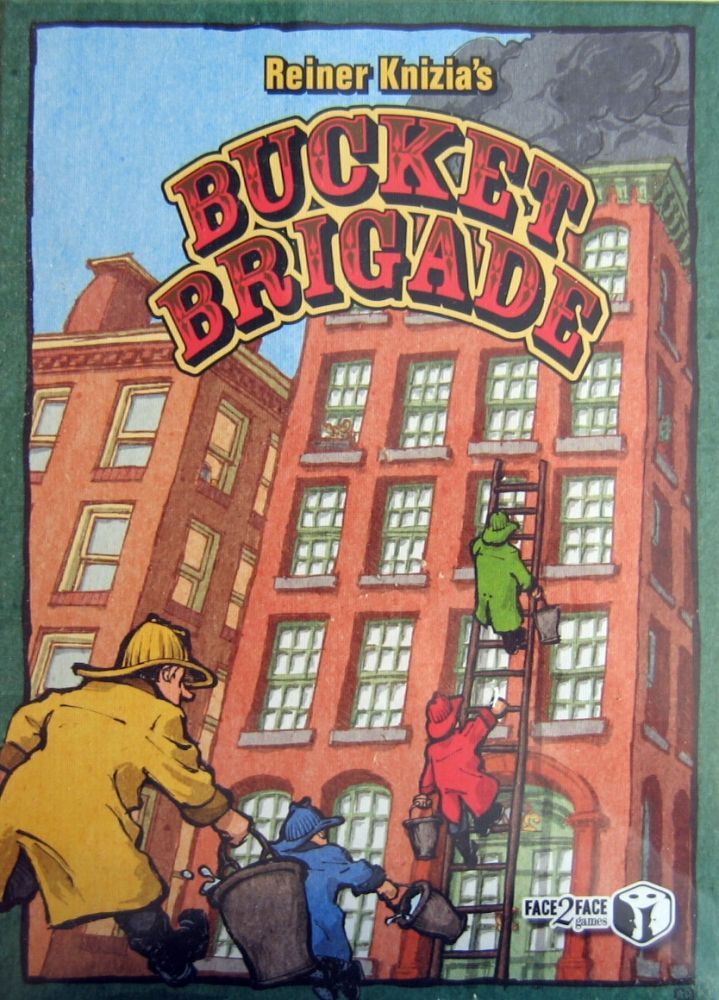
Bucket Brigade is a card game with a racing track by Reiner Knizia. Players use colored cards (numbered 1 or 2) to move four colored tokens along a track. The color that wins the race makes cards in that color worth +3 at the end of the round. The other three, depending on how far they advanced, are worth anywhere from +2 to -1. If a color moved farther, its color are worth more points -- but you probably spent more of that color to move it there, giving you fewer points! Irony. The new Bucket Brigade edition by Face 2 Face Games uses the exact same rules, score levels on the racetrack, and card distribution as the original, but instead of Honeybears, the racing tokens are firemen ascending a ladder.

What it feels like

Hand Management Animals Children's Game Card Game

Explore these mechanics in Cardboard

Start an original prototype from reusable design patterns—not this game's content.

Open mechanics workbench

Game intelligence

Learn the game

100% knowledge coverage

Setup

1. Place the board in the center of the table. 2. Place all 4 hedgehog figures on the Start field. 3. Shuffle the 55 cards. Remove cards before dealing if fewer than 5 players: remove cards so each player receives 10 cards in a 3-player game, or 3 cards in a 4-player game. In a 5-player game, deal all cards equally. Hold cards so opponents cannot see them. 4. Place the point tokens next to the board. 5. The player who last ate an apple (or the youngest player) begins the first round.

Turn flow

On your turn, select one card from your hand and place it face-up on the common discard pile. Then move the hedgehog matching the card's color forward by the number of spaces indicated on the card (1 space for one plus sign, 2 spaces for two plus signs). If you played a rainbow joker card, you choose any color hedgehog to move. After playing the card and moving the hedgehog, your turn ends and play passes clockwise.

Scoring and victory

Most total point tokens accumulated across all rounds wins. Ties broken by highest score in the most recent round. Scoring sources: Cards remaining in hand (each worth the space value of the matching-color hedgehog), Bonus points for ending the round (3 points in base game, 6 in advanced variant), Advanced: pairs of same-color single-plus cards score 5× space value, Advanced: single-plus cards (unpaired) score 1× space value, Advanced: double-plus cards score 2× space value

Source: Rulebook

Rules to know

The most useful rules for getting a first game right.

Setup

Deal the correct number of cards per player count, removing excess cards first.

Before dealing, remove cards from the deck based on player count so that each player receives an equal hand: in a 3-player game each player gets 10 cards; in a 4-player game each player gets 3 cards. In a 5-player game, all 55 cards are dealt equally (11 cards each). Removed cards are placed back in the box and play no role in that round.

Setup

All hedgehog figures start on the Start field at the beginning of every round.

At the start of each round, all 4 hedgehog figures are placed on the Start field of the board. This happens at the beginning of every round, not just the first.

Turn structure

On your turn, play one card face-up to the common pile and move the corresponding hedgehog.

On your turn you must select exactly one card from your hand and place it face-up onto the single common discard pile shared by all players. You then move the hedgehog of the color shown on the card forward by the number of spaces indicated: one plus sign means 1 space forward, two plus signs means 2 spaces forward. After moving the hedgehog, your turn is over.

Special

The rainbow hedgehog card is a joker — the player may move any color hedgehog.

The card depicting a rainbow hedgehog is a joker. When played, the active player may choose any one hedgehog color and move it forward by the number of spaces shown on the joker card (1 or 2 spaces). The joker is placed on the common discard pile like any other card.

Turn structure

Play proceeds clockwise. The starting player changes each round.

Within a round, turns proceed clockwise. The player who last ate an apple (or the youngest player if this cannot be determined) starts the first round. At the start of each subsequent round, the player to the left of the previous round's starting player begins.

Endgame

A round ends immediately when any hedgehog enters the last space (numbered 3).

The round ends immediately as soon as any hedgehog is moved onto the final space of the track (the space marked with the value 3). This is triggered by the player who played the card that moved the hedgehog there. Scoring then takes place before the next round is set up.

Scoring

Each card remaining in hand scores points equal to the space value of the matching-color hedgehog.

At the end of a round, every player scores points for the cards still in their hand (cards not yet played). Each card is worth a number of points equal to the value of the space the hedgehog of that card's color is currently standing on. For example, if the green hedgehog is on space 2, each green card in hand is worth 2 points. Cards of a color whose hedgehog is on the Start field (value 0) or a negative-value space score accordingly.

Scoring

Joker (rainbow) cards are worth 0 points during scoring.

Joker cards remaining in a player's hand at the end of a round score 0 points, regardless of where any hedgehog is positioned on the board.

Strategy briefing

Holding high-value cards vs. advancing hedgehogs

Cards score based on the hedgehog's position at round end, so holding many cards of a color whose hedgehog is far advanced is very lucrative — but advancing that hedgehog also risks another player ending the round before you can score. Balance advancing hedgehogs you hold few cards for while keeping the track position high for colors you hold many cards of.

Timing the round-ending move

Ending the round grants 3 bonus points (6 in advanced). Trigger the end when your hand cards score well at current hedgehog positions, and opponents are likely holding cards of low-value colors.

Joker card usage

Jokers score 0 points in hand, so they have no end-of-round value. Use them to advance a hedgehog of a color you hold many cards of (boosting their scoring value) or to trigger the round end on your terms.

Avoiding negative scores

Cards of colors with hedgehogs on low or negative spaces are scoring liabilities. Since negative totals are floored at 0, you can sometimes afford to hold a few bad cards — but playing them early to advance those hedgehogs converts them from dead weight into a board asset.

Advanced variant: pairing single-plus cards

In the advanced variant, pairs of same-color single-plus cards score 5× the space value instead of 1× each (2× total), a massive multiplier. Prioritize keeping pairs of the same color in hand and advancing that color's hedgehog as far as possible before the round ends.

Card count asymmetry in 4-player games

In a 4-player game each player receives only 3 cards. Rounds will be very short, so the round-ending bonus is proportionally more impactful and there is less opportunity to build a large hand score. Prioritize positioning for the bonus.

Common questions and edge cases

A player has joker cards remaining in hand at end-of-round scoring. How much do they score?

Joker cards always score 0 points, regardless of any hedgehog positions. They provide flexibility during play but no scoring value.

A player holds cards whose hedgehog color is on a negative-value space. Do they lose points?

If a player's total calculated score for the round is negative, they receive 0 points for that round and do not lose any previously accumulated tokens.

Does the player who ends the round score both card points AND the round-ending bonus?

Yes. The player who ends the round scores points for all cards remaining in their hand (based on hedgehog positions) AND receives the 3-point bonus (6 in advanced). Both are combined into their round total.

A hedgehog never moved from the Start field. What are cards of that color worth at scoring?

Cards score points equal to the space value the hedgehog occupies. If the hedgehog is on the Start field (value 0), those cards score 0 points each.

In the advanced variant, when does a pair of same-color single-plus cards trigger the 5× bonus?

Exactly two cards of the same color each showing one plus sign form a pair and together score 5× the space value. Any remaining unpaired single-plus cards of the same color score 1× the space value each.

Two players are tied on total points at the end of the game. Who wins?

The tied player who scored more points specifically in the final (most recent) round is the winner.

Ask About This Game

Similar games