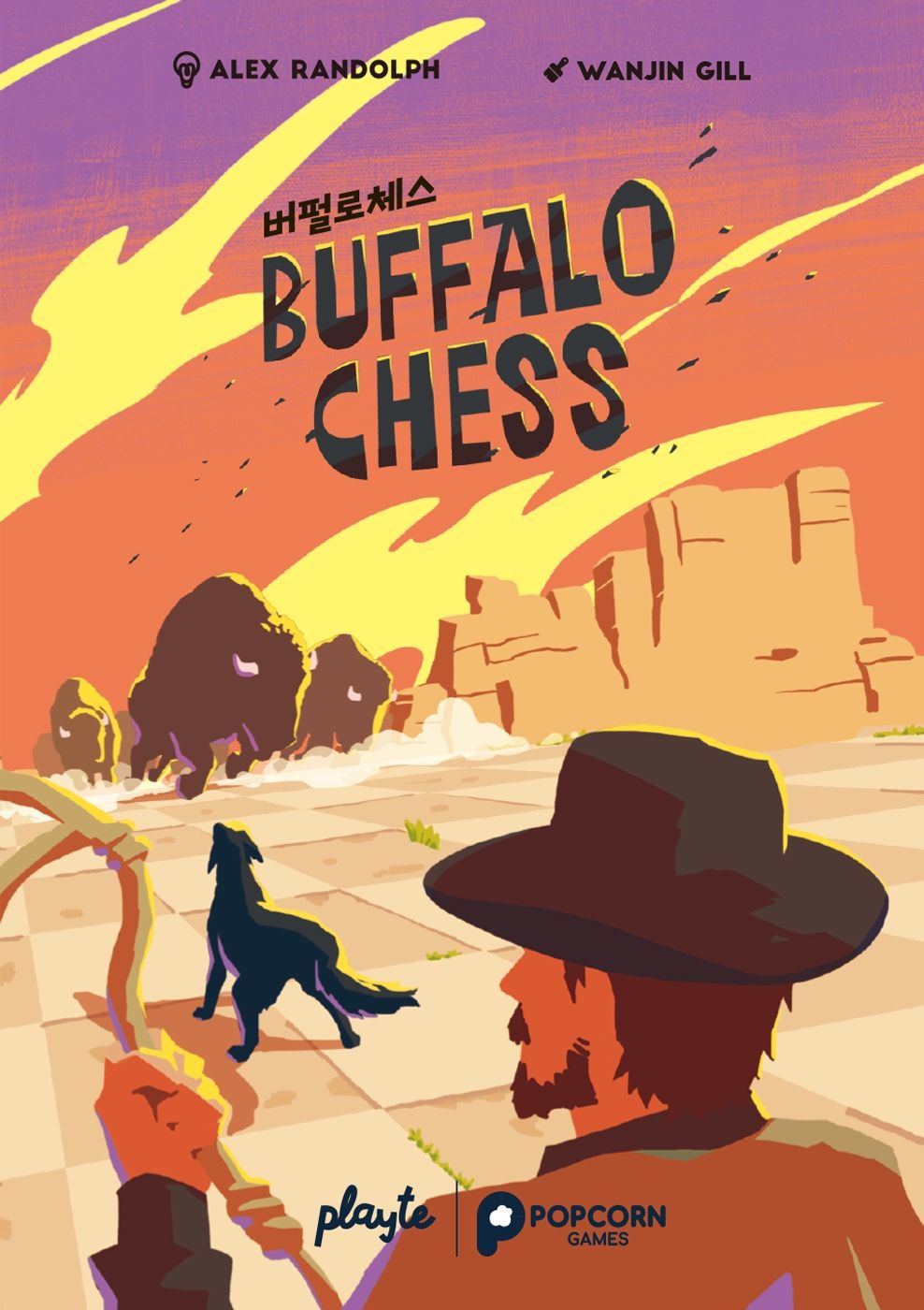
1975 BGG rank #10521

Buffalo Chess

2 players 30 min Ages 8+ 1.5/5 complexity 5.6/10 rating

About this game

In Buffalo Chess, a.k.a. Bison, one player represents Indians who are trying to keep the village from being overrun by buffalo. This player moves the Indian chief and his dogs while the other player takes charge of the herd of rampaging buffalo, all of which are represented by wooden pieces. Each side has its own style of play as the pieces move differently.

What it feels like

Variable Player Powers Grid Movement Abstract Strategy Children's Game American West Native Americans / First Peoples

Game intelligence

Learn the game

100% knowledge coverage

Setup

1. Lay the game board flat on the table. 2. Place all 11 Zombie pieces in a single row on the cemetery side of the board (the row just within or at the cemetery boundary). 3. Place the Partisan on the center square of the far side, just in front of the city boundary. 4. Place 2 Dogs immediately to the left of the Partisan and 2 Dogs immediately to the right of the Partisan, forming a line of 5 pieces (Dog, Dog, Partisan, Dog, Dog). 5. The Zombie player takes the first turn.

Turn flow

Players alternate turns. On each turn, a player moves exactly one of their pieces according to its movement rules. The Zombie player always goes first in a round. Only one piece may occupy any square at a time (exception: the Partisan capturing a Zombie by moving onto its square). There are no other actions — each turn consists solely of moving one piece.

Scoring and victory

Round-based: each round has a winner determined by win conditions. The overall match winner is the player who wins one round as the Zombie player and one round as the Defensive player across two rounds. Target score: Win one round as each role (Zombie and Defensive) across the two-round match. Scoring sources: Zombie player wins a round by moving any Zombie into the City zone., Defensive player wins a round by capturing all Zombies with the Partisan, or by blocking all remaining Zombies so none can advance.

Source: Rulebook

Rules to know

The most useful rules for getting a first game right.

Turn structure

Players alternate turns, each moving exactly one piece per turn.

On each turn, the active player must move exactly one of their own pieces. Players alternate turns throughout the game. No player may move an opponent's piece. No passing is described; a player must move a piece on their turn.

Turn structure

The Zombie player always goes first in a round.

At the start of each round, the Zombie player takes the first turn. Exception for beginners (see beginner_balance rule): by mutual agreement, the Defensive player may go first when a beginner controls the Defensive side.

Restriction

Only one piece may occupy any square at a time.

At no point may two pieces share the same square, with the sole exception being the moment the Partisan captures a Zombie by moving onto that Zombie's square (after which the Zombie is immediately removed). Zombies cannot move onto squares occupied by any other piece, Dogs cannot move through or onto occupied squares, and the Partisan cannot move onto a square occupied by a Dog or another Partisan (there is only one Partisan).

Movement

Zombies move one square forward per turn.

Each Zombie moves exactly one square forward (toward the city) per turn. Zombies cannot move sideways, diagonally, or backward. Zombies may enter the City zone. Zombies cannot move onto a square occupied by any other piece — they are blocked by Dogs, the Partisan, or other Zombies. Zombies cannot attack, capture, or remove Dogs or the Partisan under any circumstances.

Movement

Dogs move like a chess queen — any number of squares in a straight line (8 directions) — but cannot capture and must stay in the middle section.

A Dog may move any number of unoccupied squares in a straight line in any one direction: horizontally, vertically, or diagonally (all 8 directions). A Dog cannot jump over or pass through a square occupied by any piece (friendly or enemy). Dogs cannot capture Zombies or any other piece. Dogs cannot enter the Cemetery zone or the City zone; they must remain within the middle section of the board at all times. Dogs block Zombies by occupying squares in the Zombies' forward path.

Movement

The Partisan moves one square in any direction (8 directions) and can capture Zombies; must stay in the middle section.

The Partisan moves exactly one square per turn in any of the 8 directions: horizontally, vertically, or diagonally. The Partisan can capture a Zombie by moving onto the square occupied by that Zombie; the Zombie is immediately removed from the board. The Partisan cannot enter the Cemetery zone or the City zone; it must remain within the middle section of the board at all times. The Partisan cannot capture or remove Dogs (there are no friendly-fire rules stated, and Dogs are on the same side).

General

The board is divided into three zones: Cemetery, middle section, and City.

The board has three distinct zones: (1) The Cemetery — the starting zone on one side where Zombies begin; Zombies start here and may leave it. Dogs and the Partisan may NOT enter the Cemetery. (2) The City — the goal zone on the opposite side; if a Zombie enters the City, the Zombie player wins. Dogs and the Partisan may NOT enter the City. (3) The Middle Section — the central area of the board where all gameplay for the Defensive pieces occurs. Dogs and the Partisan are restricted to this zone at all times.

Restriction

Zombies cannot attack, capture, or remove Dogs or the Partisan.

Zombies have no ability to capture or remove any Defensive piece (Dogs or Partisan). If a Zombie's forward square is occupied by a Dog or the Partisan, the Zombie is simply blocked and cannot move to that square. The Zombie player cannot use Zombies offensively against Defensive pieces.

Strategy briefing

Dog Placement for Blocking

Because Dogs move like chess queens (any distance, 8 directions, rule: dog_move) but cannot enter the City or Cemetery (rule: board_zones), position Dogs early to cover entire columns or diagonals in front of groups of Zombies. A single Dog can block an entire file of Zombies if placed directly ahead of them, since Zombies only move forward one square at a time (rule: zombie_move).

Partisan as the Only Eliminator

The Partisan is the only piece that can remove Zombies from the board (rule: partisan_move). Since the Defensive win condition requires either capturing ALL Zombies or blocking ALL remaining ones (rule: defensive_win_condition), the Partisan should be used aggressively to reduce the Zombie count, making the blocking task easier for the Dogs with fewer Zombies to cover.

Zombie Spreading Strategy

Because Dogs cannot enter the Cemetery or City (rule: board_zones) and move in straight lines that can be anticipated, the Zombie player should spread Zombies across multiple columns. This forces Dogs to split coverage. A Dog blocking one column cannot simultaneously block another without leaving gaps, and the Partisan can only be in one place (rule: partisan_move — 1 square per turn).

Dogs Cannot Jump — Use This Against Them

Dogs cannot pass through any occupied square (rule: dog_cannot_pass_through_pieces). The Zombie player can use Zombies as inadvertent blockers of Dog movement. A Zombie occupying a central square limits the directions a Dog can slide across the board, reducing the Defensive player's flexibility.

Beginner Defensive First-Turn Advantage

The publisher acknowledges the Defensive side is harder to play (rule: beginner_balance). Taking the first turn as the Defensive player allows Dogs to reposition before any Zombie has advanced, giving more time to establish a blocking formation. Beginners on the Defensive side should request this option.

Match Role Switching — Master Both Sides

Since the overall match requires winning one round as each role (rule: match_structure), players must be competent on both sides. Practicing the harder Defensive role is critical, as winning as the Zombie player alone is insufficient for overall match victory.

Common questions and edge cases

A Dog is standing directly in front of a Zombie. Can the Zombie capture or remove the Dog?

No. Zombies cannot attack, capture, or remove Dogs under any circumstances. The Zombie is simply blocked and cannot move forward to that square. The Zombie player must either wait or move a different Zombie.

A Dog wants to slide across the board in a straight line, but a Zombie is in its path. Can the Dog pass through or jump over the Zombie?

No. Dogs cannot move through or jump over any occupied square, including those occupied by Zombies. The Dog's movement stops at the square immediately before the Zombie. The Dog cannot land on the Zombie's square either, as Dogs cannot capture.

The Partisan moves onto a square occupied by a Zombie. What happens?

The Zombie is captured and immediately removed from the board. This is the only case where two pieces briefly share a square — the Zombie is removed as a result of the move. The Partisan now occupies that square.

Some Zombies have been captured, and the remaining Zombies all have their forward squares occupied. Does the Defensive player win immediately?

Yes. If all Zombies still on the board have their forward path blocked (the square directly in front of each remaining Zombie is occupied by a Dog, the Partisan, or another Zombie), and no Zombie can move forward, the Defensive player wins the round immediately.

Can a Dog move to block a Zombie that has almost reached the City, by entering the City zone?

No. Dogs are strictly restricted to the middle section of the board. They cannot enter the City zone or the Cemetery zone under any circumstances, even to block a Zombie on the verge of winning.

Can the Partisan chase a Zombie into the Cemetery or City to capture it?

No. The Partisan cannot enter the Cemetery or the City zone. It is restricted to the middle section of the board. If a Zombie reaches the City, it wins regardless of whether the Partisan could theoretically have captured it.

A Zombie's forward square is occupied by another Zombie. Can it move?

No. Zombies cannot move onto a square occupied by any other piece, including other Zombies. That Zombie is blocked until the square ahead is vacated or the game ends.

Each player wins the round in which they play their assigned role. Who wins the overall match?

The rulebook states the overall winner is the player who wins one round as both the Zombie player and the Defensive player. If each player wins exactly one round (each winning the round they play), the rulebook does not describe a tiebreak procedure — this edge case is unresolved in the rules as written.

Ask About This Game

Similar games