2005 BGG rank #5842

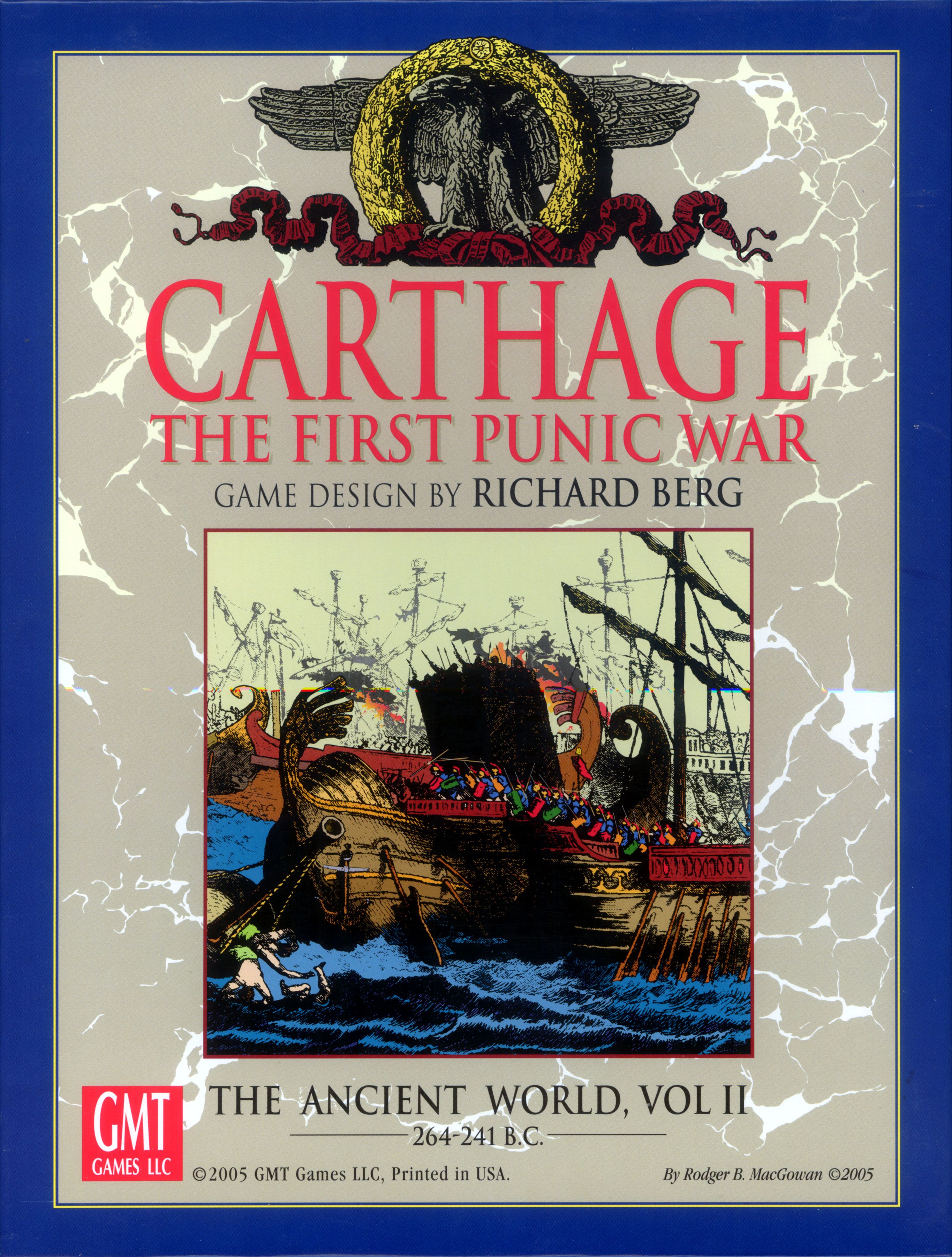
Carthage: The First Punic War – The Ancient World, Vol. II

1–2 players 1800 min Ages 12+ 4.0/5 complexity 5.7/10 rating

About this game

(from GMT website:) The Ancient World system moves to the Punic Wars, the greatest event in the ancient world and a true turning point in history. Carthage concentrates on Punic events that take place in Carthage/Africa as well as Sicily, with the main scenario being the massive First Punic War. Building on the popular mechanics and systems of Rise of the Roman Republic (Vol I), Carthage includes the full, advances naval system, with galley battles, fleet building expanding ports, and everything featured in the unusual, truly naval war that was the First Punic War. In addition, the detailed political systems for both powers, the soul of the game and a set of mechanics that truly puts the players in the heart of ongoing events, are expanded and clarified. With the addition of rules for the Reduction and Repair of city defenses, militia, and the ability of garrisons to Sally, sieges are now more than just sideshows. Carthage still uses The Ancient World's unique combat system, with its unusual Unpredictable Results, elephants, cavalry pursuit, and the dangers of fighting too many battles. Carthage's main scenario is, of course, the First Punic War, a twenty year affair that will take some time to play, but keep you entranced for years. The game also includes quick, one evening scenarios, including the playtester two-turn favorite Hiero; Hero or Gyro?, the twisty opening year of the First Punic War. We also have short scenarios for the first invasion of Carthage by Agathocles of Syracuse (311 BC) and the infamous Mercenary War that erupted in Carthage right after the First Punic War (241 BC). Carthage contains one full-sized map - the slightly redone Italy map (we've expanded rivers to a three-tiered system and corrected some tangential map errata) - plus a half-map for Carthage and Africa. The 1000+ full-color counters include every Roman magistrate of the era plus lots of Libyans, Numidians, Egyptians, Iberians, Celts ... if they were there, they're in this game. Also, part of the game package is a expanded group of play-aid charts, prompted by playtester insistence, to help keep track of the many details that campaigning can require. Carthage is the Punic War's game that ancients and gaming aficionados have been waiting for since the beginning of the wargame hobby. Detailed and demanding, it provides players with a highly playable leel of insight, decision-making, and just pure Fun. Game Features TIME SCALE 1 year per turn MAP SCALE 13 miles per hex UNIT SCALE Strength point = either 500 men; 300 cavalry; 10 elephants Designer: Richard Berg Developer: Alan Ray Art Director: Rodger B. MacGowan Map Art: Mark Simonitch Counters: Rodger B. MacGowan and Mark Simonitch

What it feels like

Hexagon Grid Dice Rolling Simulation Chit-Pull System Ancient Wargame

Explore these mechanics in Cardboard

Start an original prototype from reusable design patterns—not this game's content.

Open mechanics workbench

Game intelligence

Learn the game

100% knowledge coverage

Setup

Each game turn follows a strict seven-phase sequence. Players set up according to scenario-specific instructions before play begins. Rome controls legions and exercises imperium through elected leaders; Carthage manages army efficiency and political climate. All forces, leaders, and markers are placed as directed by the scenario setup before the first turn's Upgrade Phase begins.

Turn flow

Each game turn proceeds through seven phases in strict order: (A) Upgrade Phase — cities are rebuilt and Carthaginian army efficiency is updated; (B) Strategic Decision Phase — players make high-level command and political decisions including disbanding legions, prorogue of imperium, leader loss checks, Roman elections, Carthaginian political climate adjustment, force increase determination, and removal of raid markers; (C) Initiative Phase — the LAM pool is set and initiative is determined; (D) Operations Phase — the initiative-holding player activates a leader or resolves siege attrition; (E) Augury Phase — an augury event is resolved; (F) Devastation Phase — devastation is first recovered then attempted; (G) End-Turn Phase — inertia attrition is applied, port actions are resolved, legion and crew training occurs, recovery from battle is processed, and victory is determined.

Scoring and victory

Victory is determined at the end of each turn during Step G.5 of the End-Turn Phase. If a player meets the scenario victory conditions, they win immediately. Otherwise the game continues to the next turn. Scoring sources: Scenario-specific victory conditions evaluated during Victory Determination (G.5), Territory control and devastation, Military force strength and survival, Political objectives (Roman elections, Carthaginian political climate)

Source: Rulebook

Rules to know

The most useful rules for getting a first game right.

Turn structure

Upgrade Phase: City Rebuild and Carthaginian Army Efficiency are resolved at the start of each turn.

The Upgrade Phase is the first phase of every game turn and contains two steps resolved in order: (1) City Rebuild (see rule 9.86) — damaged or destroyed cities may be rebuilt according to the conditions specified in 9.86; (2) Carthaginian Army Efficiency (see CR 10.53) — the Carthaginian player adjusts their army efficiency rating per the conditions in CR 10.53. Both steps must be completed before advancing to the Strategic Decision Phase.

Building

Cities may be rebuilt during the Upgrade Phase per rule 9.86.

During Step A.1 of the Upgrade Phase, eligible damaged or destroyed cities may be rebuilt. The specific conditions, costs, and restrictions governing city rebuilding are defined in rule 9.86. City rebuild occurs before any Carthaginian Army Efficiency adjustment in the same phase.

Special

Carthaginian Army Efficiency is updated each turn during the Upgrade Phase per CR 10.53.

During Step A.2 of the Upgrade Phase, the Carthaginian player updates their army efficiency rating according to CR 10.53. This rating affects the combat and operational effectiveness of Carthaginian armies. It is resolved after City Rebuild and before the Strategic Decision Phase.

Turn structure

Strategic Decision Phase: Seven steps of high-level political and military decisions are resolved in strict order.

The Strategic Decision Phase (Phase B) is the second phase of each turn and contains seven steps resolved in strict sequence: (1) Disband Legions (CR 10.18); (2) Imperium Prorogue (CR 5.3); (3) Leader Loss Check (8.6); (4) Roman Elections (CR 5.2); (5) Carthaginian Political Climate (CR 5.71); (6) Force Increase Determination (CR 7.72); (7) Remove Raid Markers. All seven steps must be completed in order before proceeding to the Initiative Phase.

Resource management

Roman legions may be disbanded during the Strategic Decision Phase per CR 10.18.

Step B.1 of the Strategic Decision Phase allows the Roman player to disband legions per CR 10.18. Disbanding legions reduces Roman military strength but may free up resources or comply with political/game constraints. This step is resolved first among all Strategic Decision steps.

Special

Roman imperium may be prorogued during the Strategic Decision Phase per CR 5.3.

Step B.2 of the Strategic Decision Phase resolves Imperium Prorogue per CR 5.3. Imperium grants Roman leaders the authority to command forces; prorogue extends an existing leader's imperium beyond its normal term. This step occurs after Disband Legions and before the Leader Loss Check.

Special

A check is made for potential leader loss during the Strategic Decision Phase per rule 8.6.

Step B.3 of the Strategic Decision Phase performs the Leader Loss Check per rule 8.6. This check determines whether any leaders are lost due to attrition, political events, or other causes as specified in 8.6. It occurs after Imperium Prorogue and before Roman Elections.

Special

Roman leaders are elected during the Strategic Decision Phase per CR 5.2.

Step B.4 of the Strategic Decision Phase resolves Roman Elections per CR 5.2. New Roman leaders (consuls, praetors, etc.) are elected and receive imperium. This step occurs after the Leader Loss Check, ensuring that any lost leaders are accounted for before elections are held.

Strategy briefing

Timing Imperium and Elections

Because Imperium Prorogue (B.2) happens before Roman Elections (B.4), the Roman player should proactively prorogue valuable leaders before elections can replace them. Proroguing strong leaders preserves experienced command continuity, whereas allowing them to lapse forces reliance on potentially weaker elected successors.

Maximizing Carthaginian Force Increases

The Carthaginian Political Climate (B.5) directly precedes Force Increase Determination (B.6). Carthaginian players should invest in improving political climate in earlier turns so it is at its best value when force increases are calculated, maximizing available reinforcements.

Devastation Timing and Recovery

Since Devastation Recovery (F.1) occurs before Devastation Attempts (F.2) each phase, devastated territories are vulnerable to immediate re-devastation. The defending player should prioritize garrisoning recovering territories with forces capable of preventing new devastation attempts.

Avoiding Inertia Attrition

Forces that do not activate during the Operations Phase suffer inertia attrition (G.1) before receiving training benefits (G.3). Keeping forces active — even in limited operations — can preserve unit strength and improve training eligibility by avoiding attrition losses.

Initiative as the Strategic Lever

Winning Initiative Determination (C.2) grants control over the order of activations in the Operations Phase. Since the LAM pool is fixed before initiative is decided (C.1), the player who wins initiative can choose to activate their best leaders first, potentially completing decisive operations before the opponent can react.

Leveraging City Rebuild for Army Efficiency

Because City Rebuild (A.1) precedes Carthaginian Army Efficiency calculation (A.2), Carthaginian players should prioritize rebuilding cities that positively influence army efficiency per CR 10.53. Completing rebuilds early in a turn yields immediate efficiency benefits for the rest of that turn.

End-Turn Recovery and Victory Timing

Battle Recovery (G.4) is resolved before Victory Determination (G.5). A player on the verge of a victory condition should account for the opponent's recovery potential — units that appear spent after combat may partially recover and alter the victory calculus before the check is made.

Common questions and edge cases

Can a leader who is lost in the Leader Loss Check (B.3) be replaced in the same turn's Roman Elections (B.4)?

Yes. Because Leader Loss Check (B.3) occurs immediately before Roman Elections (B.4) within the same Strategic Decision Phase, any leader lost in B.3 is removed first, and new leaders are then elected in B.4 to fill vacancies.

Does Imperium Prorogue (B.2) apply to leaders who will be newly elected in the same turn's Roman Elections (B.4)?

No. Imperium Prorogue (B.2) is resolved before Roman Elections (B.4). Prorogue only extends imperium of leaders already in play. Newly elected leaders receive their imperium through the Roman Elections step (B.4), not through Prorogue.

Can a territory be devastated in the same phase that it recovers from devastation?

Yes, but recovery always happens first. The Devastation Recovery Segment (F.1) is fully resolved before the Devastation Attempt Segment (F.2). A territory that recovers in F.1 could be re-devastated in F.2 if eligible forces are present.

If forces recover losses in Step G.4 (Recovery from Battle), does that count toward Victory Determination in G.5?

Yes. Recovery from Battle (G.4) is resolved before Victory Determination (G.5). Forces that recover strength in G.4 are at their recovered strength when victory conditions are evaluated in G.5.

Do forces suffer inertia attrition (G.1) before or after they receive Legion/Crew Training (G.3)?

Inertia Attrition (G.1) is resolved before Legion/Crew Training (G.3) within the End-Turn Phase. Forces absorb attrition losses first, and then surviving forces may be eligible for training.

Does the Carthaginian Political Climate (B.5) affect the Force Increase Determination (B.6) in the same turn?

Yes. Carthaginian Political Climate (B.5) is resolved immediately before Force Increase Determination (B.6), meaning the updated political climate rating is in effect when Carthaginian force increases are calculated in B.6.

Does a city rebuilt in Step A.1 affect the Carthaginian Army Efficiency rating set in Step A.2?

Potentially yes. City Rebuild (A.1) is completed before Carthaginian Army Efficiency (A.2) is calculated. If the presence or status of a city is a factor in the army efficiency calculation per CR 10.53, a city rebuilt in A.1 would be counted in A.2.

Is the LAM pool established before or after initiative is determined?

The LAM Pool Segment (C.1) is resolved before the Initiative Determination Segment (C.2). The pool of available leaders is set first, and then initiative determines which player will begin activating leaders from that pool.

Must a player always activate a leader during the Operations Phase, or can they choose siege attrition instead?

A player may choose to resolve siege attrition instead of activating a leader during Phase D, per rule 5.5. The two options are mutually exclusive for a given action in Phase D — the player either activates a leader or resolves siege attrition.

Are raid markers from the previous turn removed before or after Force Increase Determination?

Raid markers are removed in Step B.7, after Force Increase Determination (B.6). If raid markers affect force increase calculations per CR 7.72, those effects are accounted for in B.6 before the markers are cleared in B.7.

Ask About This Game

Similar games