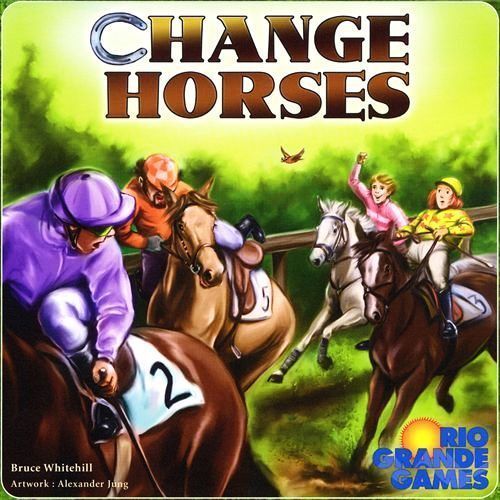
2008 BGG rank #29655

Change Horses

2–5 players 30 min Ages 8+ 1.6/5 complexity 5.5/10 rating

About this game

A racing game with a twist. Players secretly get a horse (of a particular color) assigned before the game starts. The player with the horse in last place at the end of the game wins. On your turn - sequence of play is decided by auction - you play a card that controls two different colored horese. When every player has put down cards, the horses move; but only horses with an odd number of cards on the table! If the number of open cards is even, the horse does not move. But, true to the spirit of horse racing, each player has a chance to play a "dirty trick", including Change Horses. This can affect the game dramatically. The best detailed description of the game is here. {This is one of the few multiplayer games that plays equally well with only two}

What it feels like

Auction / Bidding Hand Management Bluffing Racing Animals

Explore these mechanics in Cardboard

Start an original prototype from reusable design patterns—not this game's content.

Open mechanics workbench

Game intelligence

Learn the game

100% knowledge coverage

Setup

1. Place the board and line all 6 horses up in a random order, facing the direction of counter-clockwise travel around the track. All 6 horses are always used regardless of player count.\n2. Deal each player: 1 Racing Form card, 1 full set of 15 horse movement cards, 2 Wild Horse cards, and 1 Ownership Certificate (face down) showing the color of their horse. In a 2-player game each player receives 2 Ownership Certificates instead of 1.\n3. Advanced version only: deal each player a carrot bank equal to 11 × the number of players.

Turn flow

The game is played in repeating Double Rounds. Each Double Round consists of two half-rounds (plays 2–6 and plays 8–10 in the rulebook sequence).\n\nAt the start of a Double Round, each player selects 3 horse movement cards from their hand and places them face down. Turn order is determined (see turn_order_basic or turn_order_advanced), then players take turns playing one card face-up onto the tote board. After all players have played, horses are moved based on totals on the tote board. A second half-round follows: players each play a second card from their remaining 2, horses move again, then the tote board is cleared. Turn order is re-determined, each player draws 2 new cards to supplement their 1 remaining card, and the cycle repeats.

Scoring and victory

At game end, all Ownership Certificates are revealed. The player who owns the horse in last place wins. Remaining places are assigned by reverse finishing order (second-to-last = 2nd place, etc.). In the advanced version, leftover carrots break ties (photo finish). Target score: Own the last-place horse when the game ends Scoring sources: Horse finishing position (last place = win), Carrot tiebreaker in advanced version

Source: Rulebook

Rules to know

The most useful rules for getting a first game right.

General

Win by owning the horse that is last when the first horse crosses the finish line.

The goal of Change Horses is the opposite of a normal race. You want the horse you secretly own to be in LAST place at the moment the game ends. The last-place horse wins, the second-to-last horse finishes second, and so on. Ownership is hidden until the game ends.

Setup

Place the board; arrange all 6 horses in random order facing counter-clockwise.

Before play begins, place the race track board on the table. Line all 6 horses up at the starting positions in a random order, oriented for counter-clockwise movement around the track. All 6 horses participate in every game, regardless of the number of players.

Setup

Each player receives 1 Racing Form card, 15 horse movement cards, 2 Wild Horse cards, and 1 Ownership Certificate (2 in a 2-player game).

At setup, each player is dealt: one Racing Form card (used for turn-order determination), one complete set of 15 horse movement cards, two Wild Horse cards (jokers usable during the game), and one Ownership Certificate placed face down showing the color of that player's secret horse. In a 2-player game, each player receives 2 Ownership Certificates instead of 1.

Setup

Advanced version only: each player starts with 11 × (number of players) carrots.

This rule applies only in the advanced version of the game. At setup, each player receives a number of carrot tokens equal to 11 multiplied by the total number of players. Carrots are spent during turn-order auctions and cannot be earned back once spent.

Turn structure

At the start of each half-round, each player secretly selects 3 horse movement cards and places them face down.

To begin a Double Round, each player looks at their hand of horse movement cards and privately chooses exactly 3 cards. These 3 cards are placed face down in front of the player. No player may look at another player's face-down selection. Once all players have placed their 3 cards face down, they are all simultaneously revealed (turned over).

Turn structure

In turn order, each player plays 1 of their 3 revealed cards onto the tote board.

After the 3 selected cards are revealed, players take turns in the current turn order. On your turn, choose 1 of your 3 face-up cards and place it face-up on the tote board. Continue until every player has played exactly 1 card. This constitutes the first half-round. The 2 remaining cards in front of each player are kept for the second half-round.

Movement

After all players play a card, tally each horse color on the tote board: odd total = horse moves that many spaces; even total = horse does not move.

After every player has played a card in a half-round, resolve movement for all horses: (1) Count how many cards of each horse color are showing on the tote board. (2) If the count for a color is ODD, that horse moves forward (counter-clockwise) a number of spaces equal to that odd count. (3) If the count for a color is EVEN (including zero), that horse does NOT move this round. (4) Move each horse in sequence, starting with the horse on the innermost track. If two horses share the same track position, move the one that is further ahead (in front) first.

Turn structure

Each player plays a second card from their remaining 2 cards; horses are moved again using all cards now on the tote board.

After the first movement phase, each player still has 2 cards in front of them. In the same turn order, each player plays 1 of these 2 remaining cards onto the tote board (which still contains the cards from the first half-round). After all players have played, horses are moved again using the TOTAL of all cards currently on the tote board (both half-rounds combined).

Strategy briefing

Manipulating Horse Totals from Odd to Even

Since a horse only moves when its color appears an ODD number of times on the tote board, you can 'waste' a card by playing a duplicate of any color already showing an odd count, making it even and stopping that horse entirely. This is especially powerful in the second half-round when the first-half cards are already visible.

Turn Order Positioning

Playing last in a round is explicitly called out as an advantage. In the basic game, secure the #1 Racing Form card by having it from the previous round. In the advanced game, budget your carrots carefully across the whole game—since carrots cannot be earned back, overspending early to dominate turn order can bankrupt you, forcing the worst position permanently.

Saving Wild Cards for Critical Moments

You have only 2 Wild Horse cards for the entire game. The Stumble card can flip a key horse from odd to even (stopping it) or vice versa at a decisive moment. Save them for when a horse—especially yours—is near the finish line and needs to be slowed or when an opponent's card threatens to stall your horse.

Using Change Horses Defensively

If your horse is dangerously close to the front of the pack (risk of crossing the finish line last from your perspective—meaning it's close to winning in a normal race, which is bad for you), consider using Change Horses to swap to a horse that is further back. However, the new horse is unknown, so this is a calculated risk.

Carrot Tiebreaker Conservation

In the advanced version, unspent carrots break ties. If you are confident in your horse's trailing position late in the game, deliberately lose turn-order auctions cheaply to conserve carrots as a tiebreaker hedge—especially if two players may own similarly placed horses.

2-Player Certificate Awareness

In a 2-player game, each player owns 2 horses, making it harder to deduce which horse your opponent wants to trail. You should play more defensively across multiple horses rather than focusing on protecting a single color, and be wary of your opponent's Change Horses card shifting their allegiance.

Common questions and edge cases

A player plays a card that brings a horse color's total on the tote board from 1 (odd, would move) to 2 (even, would not move). Does the horse still move?

No. Only ODD totals cause movement. If the second half-round card brings any color's count to an even number, that horse does not move at all that phase—regardless of what happened in the first half-round.

A Stumble Wild Card covers one card on the tote board. Does the covered card count toward horse movement totals?

No. A covered card is completely ignored when counting color totals for movement. It does not contribute to any horse's count, potentially turning an odd count even (preventing movement) or simply reducing a total.

When resolving movement in the second half-round, do you only count the newly played cards, or ALL cards on the tote board?

ALL cards on the tote board are counted—both the cards played in the first half-round and the cards just played in the second half-round. The tote board is cumulative within a Double Round and only cleared after the second movement phase.

A player runs out of carrots mid-game in the advanced version. What happens?

The player surrenders all remaining carrots (if any) and permanently receives the lowest-numbered Racing Form card for every subsequent round. They can no longer participate in bidding.

In a 2-player game, a player uses the Change Horses Wild Card. What happens given they own 2 horses?

The player places their current (face-down) Ownership Certificate at the bottom of the pile and draws the top card. They now hold 1 new certificate plus still retain their other original certificate, keeping 2 certificates total. The newly drawn certificate may be the same color as one they already hold.

At the start of replenishing hands, one player has 0 cards left and another has 1. Does the game end?

The game ends when ALL players have only 1 card left. If any player has more than 1 card, the game continues. If a player has 0 cards, they effectively cannot participate further—the trigger is all players being reduced to 1 card.

The Fast Track Wild Card is played. Which horses are exempt from its effect?

Only horses that are currently BLOCKED do not move with Fast Track. All other horses in the last 2 rows move forward 2 lengths. The rulebook does not define 'blocked' beyond the Slippery Track sideways placement context; a blocked horse is one obstructed from forward movement by another horse's lateral position.

Why is holding the highest-numbered Racing Form card an advantage?

Per the rulebook, the player who plays their horse movement card LAST in a round has an advantage (they can see what others played before committing). The highest-numbered Racing Form card determines the last-to-play position. In the basic game this card is given to the previous round's #1 holder; in the advanced game it is auctioned.

Ask About This Game

Similar games