2000 BGG rank #3662

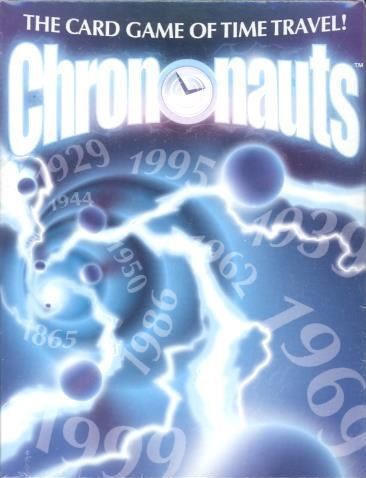
Chrononauts

1–6 players 30 min Ages 11+ 1.9/5 complexity 5.9/10 rating

About this game

In Chrononauts, each player becomes a time traveler, with a unique identity and a secret mission. During the game, players travel backwards and forwards through history, doing all those things people have always dreamed of using a time machine to do: Visiting the great moments of the past, peeking into the future, collecting up impossible artifacts and priceless works of art (at the moment just before history records their destruction), coming to grips with the paradoxes of time travel, and of course, changing pivotal events and altering the course of history itself. How would the timeline be different if Lincoln and JFK had not been assassinated? And is that the version of reality that you came from originally...the one you must return to in order to win? It's all packed into a fast and easy Fluxx-style card game that will take you to the beginning of time and back again.

What it feels like

Sudden Death Ending Tags Contracts Race Modular Board Solo / Solitaire Game Variable Set-up Hand Management Science Fiction Card Game Educational Political Alternate History Time Travel

Explore these mechanics in Cardboard

Start an original prototype from reusable design patterns—not this game's content.

Open mechanics workbench

Game intelligence

Learn the game

100% knowledge coverage

Setup

1. Lay out the Timeline cards in chronological order to form the timeline board. 2. Separate the Linchpin and Ripplepoint cards and place them face-up on their matching timeline spaces. 3. Shuffle the remaining deck (Action, Artifact, and Patch cards) and deal 3 cards to each player. 4. Each player draws an ID card (secret identity) and a Mission card. 5. Place the time traveler pawns on the timeline. 6. Place the draw deck face-down; leave space for a discard pile. 7. The player who most recently watched a time-travel movie goes first.

Turn flow

On each turn, a player must perform exactly one of the following actions: (1) Play a card from their hand — either an Action card (to affect the timeline or other players), a Patch card (to fix a paradox on a Linchpin), or an Artifact card (to place in their collection). (2) Use their time traveler's special ability (if applicable). (3) Draw the top card from the deck and add it to their hand (passing their turn). After performing their action, the player draws back up to their hand limit (if below it) and play passes clockwise. Players also check for win conditions at the end of every turn.

Scoring and victory

First player to achieve any one of the three win conditions immediately wins. There is no point scoring — victory is sudden-death. Target score: Any single win condition achieved first Scoring sources: Completing your Mission card by collecting all required Artifact cards, Matching the Timeline configuration specified on your ID card, Holding 10 or more cards in hand at the end of your turn

Source: Rulebook

Rules to know

The most useful rules for getting a first game right.

Setup

The Timeline is made up of ordered historical event cards spanning the 20th century.

The Timeline is a row of cards representing real historical events in chronological order. Each event space is either a Linchpin (a key event that, if changed, creates a Paradox and flips to a Ripplepoint) or a regular historical marker. The Timeline forms the central board of the game.

General

Linchpins are key timeline events; when altered they become Paradoxes and flip to Ripplepoints.

Each Linchpin card represents a pivotal historical event. When a player plays an Inverter card on a Linchpin, it is flipped to its Ripplepoint side, creating a Paradox at that location. The Ripplepoint shows an alternate-history outcome. Paradoxes must be repaired by playing the matching Patch card, which flips the Ripplepoint back to its Linchpin face.

Card play

Playing an Inverter on a Linchpin flips it to a Ripplepoint, creating a Paradox.

When an Inverter card is played targeting a Linchpin on the Timeline, that Linchpin is immediately flipped to its Ripplepoint side. This creates a Paradox at that spot on the Timeline. The presence of Paradoxes can cascade effects on nearby Ripplepoints and can block certain actions or trigger special card effects. The Paradox remains until a matching Patch card is played.

Card play

Playing a Patch card on a Ripplepoint removes the Paradox and restores the Linchpin.

Each Ripplepoint (Paradox) on the Timeline has a unique matching Patch card in the deck. When a player plays the correct Patch card on a Ripplepoint, it is flipped back to its Linchpin side, eliminating the Paradox. Patching paradoxes is sometimes required to fulfill a Mission or to enable other card plays.

Restriction

Players have a hand limit; holding 10 or more cards can be an alternate win condition.

Players may hold any number of cards in hand. However, if a player ever has 10 or more cards in their hand at the end of their turn, they immediately win the game (they have accumulated enough resources to return to their own time). Players draw back up to their starting hand size after each turn if they are below it.

Turn structure

On your turn, you must take exactly one action: play a card, use a special ability, or draw a card.

Each turn consists of exactly one primary action: (1) Play one card from your hand — an Action card, Patch card, or Artifact card — and resolve its effect. (2) Use your ID card's special ability if it grants a once-per-turn action. (3) Simply draw the top card of the deck and add it to your hand, forfeiting any other action. After your action, you draw back up to 3 cards if your hand is below 3. Play then passes clockwise.

Special

Each player has a secret ID card granting a unique special ability and defining a home timeline.

At the start of the game, each player receives a secret ID card representing their time traveler persona. The ID card specifies the player's home timeline (which configuration of the Timeline they need to restore or maintain to win) and grants a unique special ability usable during the game. ID cards are kept secret until the player wins or is forced to reveal.

Special

Each player holds a Mission card listing a specific set of artifacts or tasks needed to win.

In addition to their ID card, each player holds a Mission card that lists a specific combination of Artifact cards they must collect (or tasks they must complete) to win via their mission. Completing your Mission is one of the three ways to win the game. Mission cards are kept secret.

Strategy briefing

Three Paths to Victory

Always keep all three win conditions in mind simultaneously. The 10-card win condition (rule: player_hand_limit) is often overlooked — simply refusing to play cards and drawing each turn can be a valid strategy, especially if opponents are focused on Timeline manipulation.

Defending Your ID Win Condition

Since any player can play Inverter cards to flip Linchpins (rule: inverter_cards), and another player patching a Paradox can accidentally trigger your ID win (rule: patch_enables_id_win), keep close track of the Timeline state. You may be one card away from winning without realizing it.

Cascade Awareness

Playing an Inverter that triggers a cascade (rule: cascade_effects) can create multiple Paradoxes at once, making it much harder for opponents to repair the Timeline for their ID win condition and requiring multiple Patch cards to fix. Use cascades strategically to disrupt opponents.

Artifact Theft Timing

Stealing an Artifact from an opponent (rule: card_stealing_discard) not only advances your own Mission but sets back theirs. Prioritize stealing Artifacts that are unique to an opponent's Mission when you can identify what they're collecting.

Hand Size as a Resource

Drawing a card as your action (rule: drawing_cards) is never wasted — it inches you toward the 10-card win and gives you more options. If you have no strong play, drawing is often better than playing a mediocre card.

Common questions and edge cases

A player creates a Paradox that cascades and flips a second Linchpin. Does the cascade Paradox also need its own Patch card to fix?

Yes. Each Ripplepoint on the Timeline — whether flipped by an Inverter directly or by a cascade — is an independent Paradox and requires its own matching Patch card to be repaired.

The Timeline matches a player's ID card configuration, but there are still Paradoxes present. Does the player win?

A player's ID win condition is based on the specific Linchpin/Ripplepoint state of the Timeline. If the ID card's required configuration includes some Ripplepoints (Paradoxes), then yes, matching that exact state (even with Paradoxes present) triggers the win. However, if the ID requires all Linchpins intact, unresolved Paradoxes would prevent the win.

A player steals an Artifact from an opponent. If that Artifact completes the thief's Mission, do they win immediately?

Yes. As soon as a player has all required Artifacts from their Mission card in their collection — regardless of how they were acquired (played from hand or stolen) — they immediately win the game.

A player draws their replenishment cards after their action and now holds 10 cards. Do they win?

Yes. The 10-card win condition is checked at the end of the player's turn, which includes after replenishment draws. If the player holds 10 or more cards at that point, they win immediately.

A player patches a Paradox, and the resulting Timeline state now matches another player's ID card. Does that other player win?

Yes. Win conditions are checked after every card play and action, not just on the active player's turn. If patching a Paradox creates a Timeline state matching another player's ID card, that player wins immediately.

Ask About This Game

Similar games