1876 BGG rank #46

Crokinole

2–4 players 30 min Ages 8+ 1.2/5 complexity 7.8/10 rating

About this game

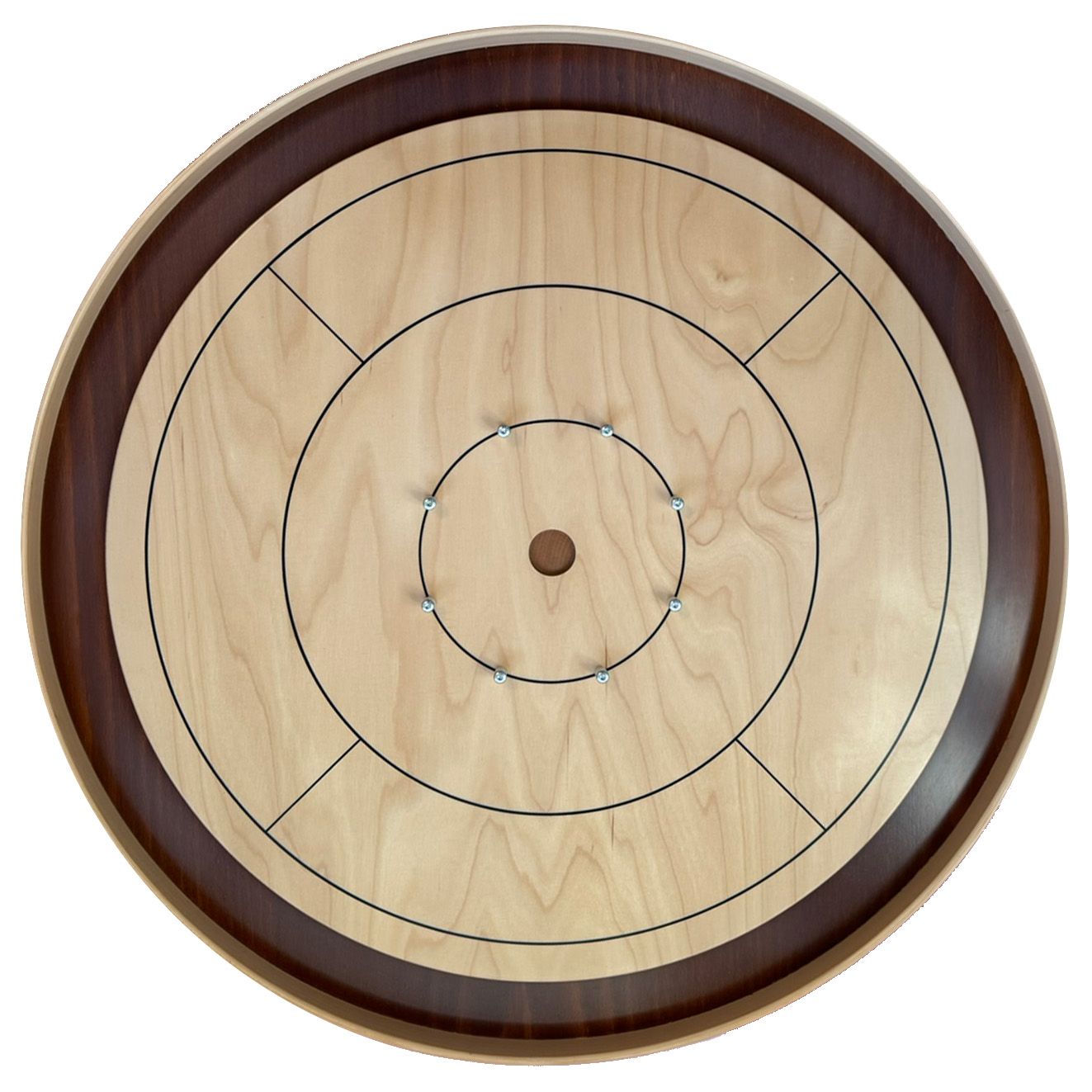
Crokinole is a traditional two- or four-player dexterity game, played on a circular wooden board, with 3 rings and an inner recessed 'bullseye'. A ring of posts is set around the inner circle, which functions as an obstacle to reach this area. Playing pieces are wooden circular disks similar to checkers pieces. Players take turns shooting disks across the board by flicking them with their fingers in an effort to land them in the highest scoring ring on the board, the highest score (20 points) achieved by shooting a disk into the centre, recessed hole. From the outside in, rings are worth 5, 10, 15 points. As a traditional game, there are often many variations played, but the following method is based on the National Crokinole Association's rules which also govern the World Crokinole Championship. Each disk to be shot must be placed on the outer boundary and within the shooting player's quadrant. If there are no opponent's disks on the board, the shot disk must land in the inner ring or it is removed. If there is an opponent's disk on the board, the shot disk must hit an opponent's piece, either directly, or by bumping another disk into it. Disks landing in the centre hole are removed and scored at the end of the round. Disks that lie outside--or are touching--the outer boundary after each shot are removed from play for the round. The player to score the most points wins the round and scores 2 points, and if a tie, each player scores 1 point. A "game" is usually played to four rounds. The number of "games" in a match is set by the tournament. Alternatively, play is to a set score, usually the first player or team to 100, and each round is scored by cancellation. For example if Player One scores 250, and Player Two scores 225, then Player One will add 25 to his/her game score.

What it feels like

Team-Based Game Flicking Action / Dexterity

Game intelligence

Learn the game

100% knowledge coverage

Setup

1. Place the Crokinole board flat on a stable surface.\n2. Install the 8 wooden posts into the predrilled holes on the 15-point ring line. Posts should fit snugly. They may be permanently fixed with a single drop of wood glue on the bottom of each post before insertion, or left removable for waxing and cleaning.\n3. Each player or partnership chooses a color (Natural or Black) and takes their disks.\n - Two players: each takes 12 disks.\n - Four players (partnerships): each player takes 6 disks; partners sit across the board from each other.\n - Three players (Option 1 – 2v1): two partners each take 6 disks; the solo player takes 12 disks.\n - Three players (Option 2 – free-for-all): a third set of 12 disks must be purchased separately.\n4. Each player/partnership places a scoring peg in the starting hole of their scoring lid.\n5. Determine the first player. In subsequent rounds, the "First Player" designation rotates (switches in 2-player; moves clockwise in 4-player).

Turn flow

Play proceeds in rounds. Within each round, players alternate shooting one disk per turn until all disks have been shot. The active player (shooter) flicks one disk from their assigned quadrant, attempting either to score in a high-value ring/hole or to knock opposing disks to lower-value areas or into the ditch. After all disks are shot, the round is scored. Only the difference between the higher and lower scores is awarded to the winning player/partnership; the losing side scores 0 for the round. Play continues round by round until a player/partnership reaches 100 points (or 8 points in Match-Play format).

Scoring and victory

At the end of each round, each side totals their disk values (plus 20-point disks set aside). The lower total is subtracted from the higher; only the difference is added to the winner's cumulative score. The losing side scores 0 for the round. Ties yield 0 for both. The first player/partnership to reach 100 cumulative points wins (or 8 points in Match-Play format). Tie at game end: play one more determining round. Target score: 100 Scoring sources: 20-point central hole (disk removed immediately and counted at round end), 15-point inner ring (inside the post boundary), 10-point middle scoring ring, 5-point outer scoring ring, 0 points for disks in the outer lip / touching the starting line / in the ditch

Source: Rulebook

Rules to know

The most useful rules for getting a first game right.

General

The board is a 26-inch playing surface with a surrounding 2-inch ditch, divided into quadrants and four scoring rings plus a central hole.

The Crokinole board consists of a 26-inch circular playing surface encircled by a 2-inch ditch. The surface is divided into four equal quadrants, each marking the shooting area for one player. The board also has four concentric scoring rings and a central hole: (1) Central hole – 20 points; (2) Inner ring, enclosed by 8 posts – 15 points; (3) Middle scoring ring – 10 points; (4) Outer scoring ring – 5 points; (5) Outer lip between the shooting/starting line and the edge of the playing surface – 0 points. Disks that fall or travel into the ditch are out of bounds and score 0.

General

A disk is shot by bracing the middle or index finger against the thumb and snapping it against the disk.

A Crokinole disk is shot by bracing the end of the middle or index finger against the thumb and snapping the finger against the disk to drive it across the playing surface. Once the flicking finger has moved the disk, the shot has been taken — even if the disk has only moved a fraction of an inch. There are no take-backs after any movement has occurred.

Restriction

Shots must be taken with the disk flat and touching the starting line within the shooter's assigned quadrant.

All shots must be taken with the disk lying flat and touching the starting line within the shooter's assigned quadrant. A disk may be placed on the quadrant line itself, but no more than halfway over. Only the shooter's shooting hand may touch the board during a shot. No other player may touch the board. No disk may be placed on the board until it is time to shoot it.

Restriction

The shooter must remain seated with at least one posterior cheek in contact with their chair throughout the shot.

One Cheek Rule: The shooter must remain seated with at least one posterior 'cheek' in contact with the chair at all times during a shot. Players' chairs may not be moved until the end of the round.

Restriction

Unshot disks must remain on the table in full view; they may not be held in players' hands.

Unshot disks should not be held in players' hands. They must remain on the table in full view of all participants at all times.

Special

When no opposing disks are on the board, the shooter must land in or touching the 15-point circle; failure removes all contacted disks.

If the board contains no opposing disks, the shooter may attempt to land a disk in the center 20-point hole. If the disk does not land flat in the 20-point hole, it must come to rest inside or touching the 15-point circle (the ring enclosed by the 8 posts). The shooter may aim for the center directly, or aim to knock their own disk(s) into or touching the 15-point circle, possibly landing one in the 20-point hole. If no disks come to rest in the specified area (20-point hole or touching/inside the 15-point circle), all disks contacted during the shot are removed to the ditch until the end of the round.

Restriction

When opposing disks are on the board, the shooter must contact at least one opponent's disk or their shot and any friendly disks it touched are removed.

If there are opposing disks on the playing surface, the shooter may attempt to strike an opponent's disk directly, or aim to knock a friendly disk into an opponent's disk. If no opposing disk is contacted during the shot, the shooter's disk is removed from the board along with all friendly disks it touched during the shot.

Scoring

A disk landing flat in the 20-point hole is immediately removed and reserved for the owner to score at round end.

Any disk which settles flat in the 20-point hole is immediately removed from the board and placed near the score box to be added to the owner's total in the scoring phase — even if the owner is the shooter's opponent. If a disk is knocked into the 20-point hole by an opponent's disk, the disk's owner (not the opponent who knocked it in) receives the 20 points. Important caveat: if the shooter was required to contact an opposing disk (because opposing disks were on the board) and failed to do so, a center-hole shot is instead removed to the ditch (scoring 0), along with any disks it touched.

Strategy briefing

Prioritize eliminating opponent disks when they are on the board

Rule must_contact_opposing_disk requires that you hit at least one opponent disk whenever any are present; failing to do so removes your shot disk and any friendly disks it touched. Therefore, aggressive elimination shots are not just tactically good — they are mandatory, and precision in those shots doubly matters.

Use the 20-point hole strategically but only when safe

A disk landing in the 20-point hole is always credited to its owner, even if an opponent knocked it in. This means shooting for the center is highest-value but also risky — if opposing disks are present and you miss them en route, your center shot goes to the ditch. Only attempt the 20-point hole when you have a clear path that also contacts an opponent's disk, or when no opposing disks are on the board.

Manage disk placement near the 15-point ring when no opponents are on the board

When the board is clear of opposing disks, any shot that doesn't reach the 20-point hole must land inside or touching the 15-point circle or else all contacted disks are ditched. Place your disks defensively touching the 15-point circle's boundary so they are safe and also force opponents into mandatory-contact situations on their next shot.

Exploit the scoring differential rule to protect leads

Since only the difference between scores is awarded each round, a player with a commanding lead benefits from keeping rounds low-scoring. If you are behind, aim to maximize your own score each round, as every point gap you close reduces what your opponent earns.

Be precise near ring boundaries

A disk touching the dividing line between the 15 and 10 rings scores only 10 points. A disk touching the starting line is ditched entirely. Shooting slightly short of a line boundary is always safer than landing exactly on it, since touching counts as the lower value or zero.

In Match-Play format, consistency beats perfection

The Match-Play Rule awards 2 points for winning a round and 1 point each for a tie, playing to just 8 points. This greatly compresses the game and means consistent round wins matter more than occasional big-score rounds. Eliminate opponent disks reliably and aim for solid mid-ring placement rather than high-risk center attempts.

Use partner coordination in four-player games

In the four-player game, partners sit across from each other. A partner can shoot a disk into a favorable position for their teammate to exploit in the next alternating shot, or set up a screen of friendly disks in the 15-point ring to complicate the opponents' mandatory-contact shots.

Common questions and edge cases

A shooter lands a disk in the 20-point hole, but there were opposing disks on the board that the shooter never contacted. Does the shooter score 20 points?

No. If opposing disks were present on the board and the shooter failed to contact any of them, the 20-point disk is removed to the ditch (scores 0), along with any friendly disks it touched. The rule requiring contact with an opposing disk overrides the 20-point reward.

An opponent's disk knocks my disk into the 20-point hole. Who scores the 20 points?

The owner of the disk that landed in the 20-point hole scores the 20 points — not the opponent who knocked it in. The disk is removed and reserved for its owner's total at round end.

My disk comes to rest exactly on the line between the 15-point and 10-point rings. How is it scored?

It scores the lower value: 10 points. Any disk touching a dividing circle between two rings is always scored at the lower ring's value.

My disk slides back and comes to rest touching the starting line. What happens?

The disk is immediately removed to the ditch and scores 0. A disk touching the starting line is treated as out of bounds.

My disk flies off the board but bounces back onto the playing surface and moves other disks. What happens?

The rebounding disk is removed to the ditch. All disks disturbed after the ricochet are replaced to their original positions as agreed by the players. The shot effectively ends with the offending disk in the ditch.

There are no opposing disks on the board. I shoot and my disk comes to rest in the 5-point ring, not touching the 15-point circle. What happens?

Because no opposing disks were present, the shooter was required to land the disk in the 20-point hole or within/touching the 15-point circle. Since the disk only reached the 5-point ring, all disks contacted during the shot are removed to the ditch. The shooter's disk is also removed.

No opposing disks are on the board. I shoot a new disk into one of my own disks already on the board, and that existing disk slides into the 15-point circle. Does this count?

Yes. With no opposing disks present, a shooter may knock a friendly disk into or touching the 15-point circle to satisfy the requirement. As long as at least one disk (the shooter's or a contacted friendly disk) comes to rest inside or touching the 15-point circle, the shot is legal.

Both players/partnerships total the same score in a round. How many points does each receive?

Neither player/partnership adds any points to their cumulative score for that round. Both receive 0 for the round.

In three-player Option Two, two players tie for second place in a round. How are Match-Play points distributed?

The player with the highest score receives 2 points. Both players tied for second receive 0 points each.

I attempt to flick my disk but it only moves a tiny fraction of an inch. Is the shot considered taken?

Yes. Once the flicking finger has moved the disk at all — even a fraction — the shot has been taken. There are no take-backs.

Ask About This Game

Similar games