1990 Puesto n.º 3350 en BGG

Daytona 500

2–4 jugadores 70 min A partir de 10 años 1.8/5 de complejidad 6.0/10 de valoración

Acerca de este juego

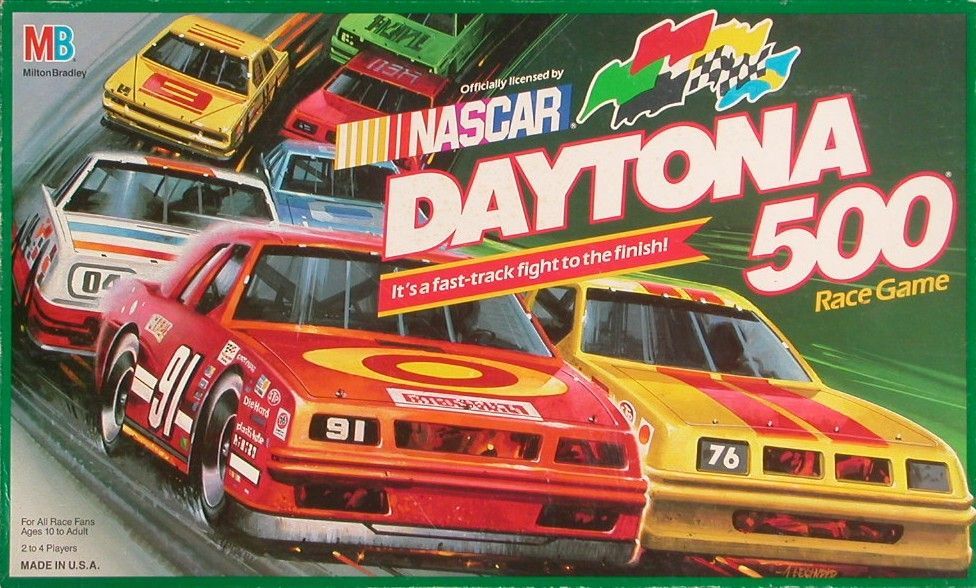
Six little plastic cars race around the big Daytona track. The track is three spaces wide except for a sweeping curve at either end. In the curves, the track narrows to two lanes. The outer lane is a passing lane, requiring twice as many movement points to use and in which a car may not end its turn. Movement points come from play of the special deck of cards. Selecting a card from your hand, you move each of the cars on the card the prescribed number of spaces, trying to position your own car or cars most advantageously while leaving your opponents blocked. Before each race, the six cars are auctioned off, and you bid for them based on the cards in your hand. Payout is based on where your car(s) finished in the race. Most money wins. Suggested game length is three races (each race lasts about 20 minutes), enough to give the luck of the draw a chance to even out.

Qué sensaciones ofrece

Grid Movement Race Auction / Bidding Hand Management Racing Card Game Sports

Explora estas mecánicas en Cardboard

Crea un prototipo original con patrones de diseño reutilizables, no con el contenido de este juego.

Abrir el taller de mecánicas

Inteligencia del juego

Aprende el juego

100% de cobertura de conocimiento

Preparación

1. Give each player $300,000 in starting funds. 2. Choose a dealer. 3. Separate the six bidding cards (no numbers on them) and shuffle them facedown near the board. 4. Set aside the six #9 race car cards. 5. Shuffle the remaining 36 cards and deal them facedown equally to all players. Players may look at their own cards. 6. Proceed to the Bid for Cars phase. 7. Repeat setup for each of the three races, rotating the dealer counterclockwise each time.

Flujo del turno

Each race consists of two phases: Auction and Racing. AUCTION PHASE: Flip one bidding card to reveal a car for auction. Bidding starts with the player to the right of the dealer and proceeds counterclockwise. Each active bidder must raise the bid in multiples of $10,000 or pass (passing eliminates them from that auction). The winner pays the bank, displays the bidding card, adds that car's #9 race card to their hand, and places the car in the next vacant starting position. Bidding for the next car starts to the right of the last buyer. Repeat for all six cars. Any player still without a car when the last car is auctioned must buy it for $10,000. Any car left unsold is placed on the track and its #9 card is removed from play. RACING PHASE: Play begins with the owner of the first-position car and rotates counterclockwise. On your turn, play one card face-up to the discard pile. Move each car shown on the card in the listed order, as many spaces as indicated or until blocked. White (wild) cars on a card move any car not already listed on the card that can travel the full indicated distance. When any car moves, the car directly behind it is drafted forward one space (if it has crossed the start line). Cars may only use the red (outer) lane for passing and must return to the inner lane whenever possible. When a car crosses the finish line, it is placed in the next available finishing position. Once all of a player's cars finish, that player immediately discards their remaining hand. Racing continues until all cars finish or all players run out of cards.

Puntuación y victoria

After three races, the player with the most total money wins. Fuentes de puntuación: Race prize money: 1st=$300,000, 2nd=$200,000, 3rd=$150,000, 4th=$100,000, 5th=$80,000, 6th=$50,000 per car per race

Fuente: Rulebook

Reglas que debes conocer

Las reglas más útiles para jugar bien la primera partida.

Setup

Each player begins the game with $300,000.

At the start of the game, before any race, each player receives $300,000 from the bank. This is the only starting money players receive; all further income comes from race prize payouts.

General

The game consists of exactly three races.

Players run exactly three races in sequence. After each race, the dealer rotates counterclockwise to the next player. After all three races are complete, the player with the most money wins.

Setup

The dealer rotates counterclockwise after each race.

A dealer is chosen at the start of the game. After each race concludes, the dealer role passes counterclockwise to the next player. This affects who bids first in the subsequent race's auction, since bidding starts to the right of the dealer.

Setup

Shuffle bidding cards facedown, set aside #9 cards, then deal remaining 36 cards to players.

At the start of each race: (1) Shuffle the six bidding cards (those with no numbers) and place them facedown near the board. (2) Set aside all six #9 race car cards — they are not dealt out. (3) Shuffle the remaining 36 cards and deal them facedown and equally to all players. Players may look at their own hand.

Turn structure

The first auction starts to the right of the dealer; subsequent auctions start to the right of the last buyer.

For the very first car auctioned each race, bidding starts with the player immediately to the right of the dealer and proceeds counterclockwise. For each subsequent car, bidding starts with the player immediately to the right of the player who won the previous auction, and continues counterclockwise.

Trading

Bids must be higher than the current bid, in multiples of $10,000; a player cannot bid more than they have.

During an auction, each player in turn must either raise the current bid by at least $10,000 (and in multiples of $10,000) or pass. A player may never bid more money than they currently possess. Once a player passes on a specific car's auction, they are eliminated from that auction and cannot re-enter.

Restriction

Players are limited to 3 cars (2-player) or 2 cars (3- or 4-player) and may not bid beyond that limit.

In a 2-player game, each player may own at most 3 cars. In a 3-player or 4-player game, each player may own at most 2 cars. A player who has reached their car limit may not place bids in further auctions during that race.

Trading

The auction winner pays the bank, displays the bidding card, adds the #9 card to hand, and places the car on the track.

When a player wins a car's auction, they must: (1) Pay the bid amount to the bank. (2) Display the bidding card face-up in front of them to identify which cars they own. (3) Take the #9 race card corresponding to that car and add it to their hand. (4) Place the physical car token in the next available numbered starting position on the track.

Informe estratégico

Auction Spending vs. Prize Value

The top prize is $300,000 for 1st place. Overpaying at auction directly eats into net profit. Bidding more than ~$250,000 for any single car is likely unprofitable even with a 1st place finish. Track your spending relative to expected prize earnings across all three races.

Card Hand Advantage from Buying Cars

Each car you win at auction adds the #9 card for that car to your hand. Since the 36 race cards are dealt equally but #9 cards are bonuses on top, players who win more cars get larger hands — meaning more turns during racing and greater control over car movement.

Card Player Controls Movement

When you play a card, you move all cars listed — including opponents' cars. Conversely, opponents move your cars when they play cards. Use cards showing opponent cars to strategically block them (within the must-move-maximum constraint) and use your turns to advance your own cars optimally.

Drafting Acceleration

Drafting can chain through a line of cars, granting free forward movement to multiple cars at once. Positioning your cars directly behind fast-moving cars — even opponents' — can generate significant free advancement without spending card plays.

White Wild Card Usage

The white wild car slot is only useful if a car not already on the card can travel the full listed distance. Before playing a wild card, verify there is an eligible car that can complete the full move. Otherwise the wild slot is wasted.

Red Lane Timing

The red lane enables passing but cars cannot end movement there. Plan diagonal moves carefully so that after a pass using the red lane, your car has room to return to the inner lane before the move ends.

Car Limit and Portfolio Strategy

In a 3- or 4-player game, you can own at most 2 cars. Spreading bids across two competitive cars can be more lucrative than concentrating money on one. In a 2-player game, owning all 3 cars maximizes your racing control and prize opportunities.

Early Finish and Hand Depletion

Once all your cars finish, you must discard your remaining hand immediately. Avoid finishing all your cars prematurely if opponents still have cards and can move their remaining cars into better positions. Timing one car to finish later keeps you in the game longer.

Starting Position Value

Cars are placed in numbered starting positions in the order they are won at auction. Winning an early auction secures a better starting position on the track. A forward starting position reduces the distance to the finish line and lessens exposure to being blocked.

Preguntas frecuentes y casos límite

Can the player who played the card move my car in a way that hurts me, even if they don't own it?

Yes. The player who plays the card — not the car's owner — controls all movement decisions for that card. However, they are constrained by the must-move-maximum rule: they cannot intentionally choose a path that blocks your car sooner than a better path would allow.

Can I use the white (wild) card slot to move a car just one space if the card shows three spaces?

No. The white wild car slot may only be used for a car that can travel the full number of spaces shown. If no car (excluding those already on the card) can complete the full distance, no move is made for the white car slot.

If moving one car drafts a second car forward, does the second car's movement then draft a third car?

Yes. Drafting can cascade through an entire line of contiguous cars. Each car that is drafted forward one space may in turn cause the car behind it to also be drafted forward one space, continuing down the line.

Will a car behind the start line be drafted when the car ahead of it moves?

No. Cars that have not yet crossed the start line are exempt from drafting and will not be pulled forward when the car ahead of them moves.

What happens if a car is in the red lane at the end of its movement?

A car may never end its movement in the red lane. The red lane is for passing only. If it is possible for the car to move back to the inner lane, it must do so. The card player must plan movement so the car does not illegally end in the red lane.

If a car goes unsold at auction, can any player play its #9 card during the race?

No. If a car is unsold, its #9 race card is removed from play entirely. No player receives it, so it will never be played during that race.

If I'm forced to buy the last car because I have no car, do I have to pay more than $10,000 if others bid it up?

The forced purchase rule applies only when the last car comes up for auction and a player still has no car. In that scenario, the forced buyer pays $10,000. However, other players can still bid on the car first; the forced-buy rule only triggers if the car would otherwise go unsold or the carless player needs it.

If all my cars finish the race while I still have cards, do I lose those cards permanently or keep them?

You immediately discard all remaining cards in your hand as soon as your last car crosses the finish line. You do not keep or carry over cards between races — cards are re-dealt at the start of each race anyway.

What prize does a car earn if it does not finish before cards run out?

None. A car that has not crossed the finish line when the race ends (either because all cars finished or all players ran out of cards) earns no prize money whatsoever.

Does receiving the #9 card at auction give me an extra card advantage in the race?

Yes. The #9 race card for each purchased car is given directly to the winning bidder and added to their hand after the cards have already been dealt. This means car buyers receive more cards than players who don't win auctions, giving them more turns and options during racing.

Pregunta Sobre Este Juego

Juegos similares